A point that is disarmed. A structure that slips before the eyes, that fades to an old form: the duality between being something unique and returning to the ordinary. A daily ritual, that of retracing the paths, that of losing something that was believed to be safe. The restlessness
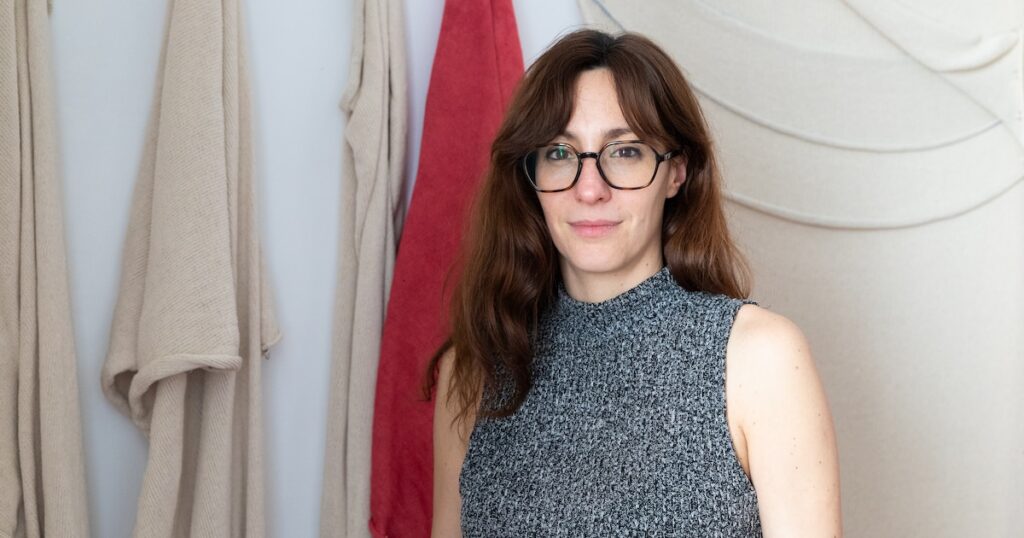
The exploration of the fragility of forms and constant transformation are the axis of the performative installation of Angeles Jacobi (Buenos Aires, 1989), who in his work reveals how “disarmament has something very honest and very poetic” and generates an invitation to rethink the idea of permanence.
“Everything changes, everything wears out, everything transforms. And the unweaving makes this process visible without hiding it. For me it speaks of links, of personal processes, of how fragile everything is. I am also interested in how people react when something begins to come apart in front of them: if they look, if it bothers them, if they stay still,” the artist explains to Infobae Culture.
In the purity of Everything we have builtwhich marks the closure of the program Hunters Impulsein Hunters Foundationthere lies a comforting force, that of an apparently silent, almost desperate ritual, in which behind what is simple it overwhelms us as inevitable.
“That gesture says a lot about how we experience loss and the passage of time. Deep down, for me it is a way of talking about life, death and how everything can begin again,” he said.
The installation, composed of fabrics, structures under construction and repeated gestures, investigates the way in which the intimate is redefined and displaces its limits through a continuous action that transforms what seemed stable. It is, in that sense, an invitation to rethink the idea of permanence and to experience disarmament as a vital process.
Jacobi proposes a route where the structure, at first sight solid, stops being a limit and opens towards disconfiguration, remembering that all permanence can be undone and begun again, as if his hands and the threads were both the beginning and the end.
The development of the work was supervised by Gabriel Baggiowho accompanied Jacobi in technical, conceptual and poetic reflection. Baggio, in a text titled When the dawn comesreflects on the investigation of both naturalized and symbolized genealogies, and how these reformulate lineages and challenge the notion of fixed identity.
“The construction on what is given and inherited becomes, to say the least, difficult,” he writes, and highlights that Jacobi chooses to avoid any materiality that can be fixed to focus on the mutations that the act of disassembling implies.
“The sound of the unraveling merges with our heartbeats and insists, point by point, in reminding us that time exists in the coming and going: in a constant flow that avoids projection towards a single direction.” Baggio concludes that the work confronts the public with an ethereal contemporaneity, which leaves behind affiliations to think about a collective and corporal belonging, where “the construction of the possible world will be our responsibility. When dawn comes, once again.”
Jacobi came to weaving “by chance”: “During the pandemic I started embroidering with the punch needle and, due to a mistake, I ended up unraveling everything I had done. That act fascinated me, I was surprised by how simple and at the same time how powerful it was to pull a thread and see how everything falls apart. From that moment on, textiles, and especially unweaving, became my most natural way of working,” she explained about her beginnings.
In his installation, by dismantling and reconstructing the limits of space and identity, he is part of a collective search for new ways of living and thinking about permanence, in dialogue with the public and with the time that passes in each gesture and each thread that is unweaved. His textile installations, in this sense, are designed to be disassembled during the exhibition using motorized mechanisms. There is, in this intrusion of the technological, an aspect that opens towards the industrial as an arm of the everyday, to the machine as a mediator in the human experience.
With Baggio, Jacobi explained, they were “seeing how to bring the space, testing colors, materials, scales, tensions, the speed of the mechanism… a lot of trial and error. The work took shape in the same process, as the material and the movement showed what they needed. It ended up being an installation that functions almost like a living scene, where the unweaving marks time.”
The artist has presented her work in spaces such as Motorenhallein Dresden, and Ersterersterin Berlin, and has participated in the Bienal Contextile, in Portugal, and in the Bienalsur, in Argentina.
He Hunters Impulse Programwhich takes place between May 25 and November 22, accompanies artistic processes in development, providing support both in the gestation and in the public presentation of the works. Aimed at artists who explore transdisciplinary experiences or push the boundaries of their disciplines of origin, this year the program selected Tirco Matute, Victoria Boulay and Jacobi through an open call.
Each artist resides for four months with the support of Fundación Cazadores and is mentored by a professional specially summoned according to the characteristics of their project. The selection jury was made up of Maricel Álvarez, Gonzalo Aguilar, Raúl Flores and Teresa Riccardiunder the artistic direction of Mariana Obersztern.
Everything we have builtwhich opened on November 6, can be visited for the last time on the 22nd of this month at 5 p.m., at Fundación Cazadores, Villarroel 1438, Chacarita.
Photos: Hunters Foundation