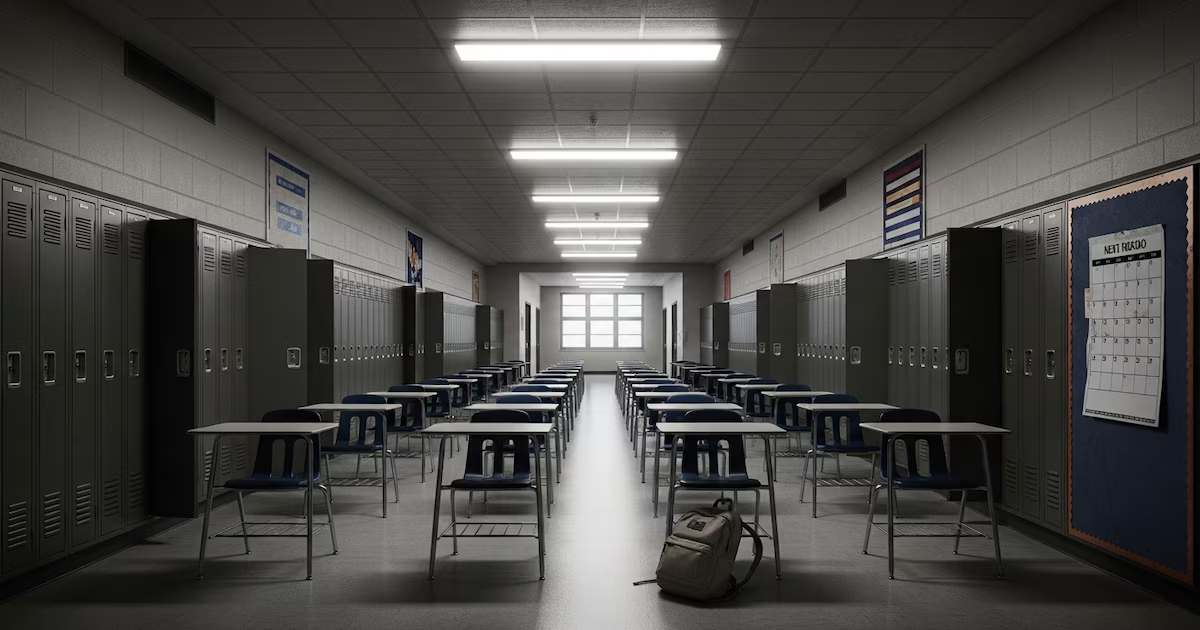
The classrooms of schools have maintained the same structural design for decades, even centuries, without any fundamental modifications. This permanence is observed both in the schools where previous generations studied and in those attended by current students.
The question about the validity of the traditional structure of educational spaces is discussed in different areas, especially based on the growing evidence on its impact on school performance. Agustina Selvi Paglayaneducation specialist, delved into concrete data and international evidence, in a talk with Infobae Live At Nine.
“It comes from the Prussian system of the 18th century, where Prussia was an authoritarian regime, it was an absolutist king. So, in addition, it was not a system designed for a democratic society,” indicated the professional. He added that the physical structure of the classrooms, with the teacher in front and the students lined up, “It is designed so that the teacher has that authority and that authority that represents the authority of the State”.
According to the specialist, this format does not promote debate or questioning, but rather memorization and repetition: “Children sitting in a row. And what does a boy have to do to do well in school? Learn by heart what the teacher tells him. And repeat.”
Selvi Paglayan He maintained that this design continues in force in Latin America and in countries considered leaders in education.and that reproduces forms of authority and inequality: “I think it is important to keep in mind that it is not that Argentina is backward,” he said.
The classic layout has measurable effects on performance. Paglayan cited international research: “A paper from Stanford University, which followed 4,000 students over time, saw that classroom design determines up to 20% of the performance of these students. It’s a lot. And they talk about the light, they talk about the noise, they talk about the ventilation, they talk about the temperature inside.”
Minor changes can have significant effects. “You don’t need to do a total renovation of the classroom, because doing even things like changing the paint, changing the lighting, other than the fluorescent tube, adding plants, minimal things generate up to 70% of the impact of these mega structural reforms,” explained the specialist.
Paglayan also highlighted how alternative systems address the relationship between physical space, motivation and collaboration. “With other Waldorf, Reggio Emilia or other philosophies, there is a lot of evidence that these are models that were intended as an alternative to this traditional model. The traditional model is the one that abounds throughout the world.”
He described the tendency to organize students into groups and allow movement within classrooms: “The trend is that the most progressive or avant-garde education groups are moving more towards the group and also made it so that you are not sitting, that you are moving. That’s because sitting still was part of teaching you to stay still, to be obedient.”
The specialist stressed that project-based learning and interdisciplinary work enhance motivation and the acquisition of content. “Precisely because you let them choose, they learn with much more motivation. And they see: if I want to build houses, I need to know mathematics, I need to know physics, I need to know about art history topics and a lot of things like that. So you take what interests you and, when you work on a project, the truth is that the best projects are interdisciplinary ones”.
For Paglayan, taking advantage of curiosity favors the teaching of key content: “It is simply the point that learning is much greater when one has an intrinsic motivation to learn. So, it is simply at that moment you take advantage of what makes you curious.”
And he also warned that many of the reforms being debated internationally only apply to specific groups or in small pilot settings, and that most classrooms in the world maintain the traditional large-scale layout.
“In this type of classrooms, the evidence that exists about the impact they have on learning is mainly for young children, such as kindergarten and preschool children.”and in those contexts it works very well,” he explained. He added: “I don’t think there is any study that looks at this on a large scale and in primary and secondary schools.”
—
Infobae accompanies you every day on YouTube with interviews, analysis and the most outstanding information, in a close and dynamic format.
• From 7 to 9: Infobae at Dawn: Nacho Giron, Luciana Rubinska and Belén Escobar.
• From 9 to 12: Infobae at Nine: Gonzalo Sánchez, Tatiana Schapiro, Ramón Indart and Cecilia Boufflet.
• From 12 to 15: Infobae at Noon: Maru Duffard, Andrei Serbin Pont, Jimena Grandinetti, Fede Mayol and Facundo Kablan.
• From 3pm to 6pm: Infobae in the Afternoon: Manu Jove, Maia Jastreblansky and Paula Guardia Bourdin; Marcos Shaw, Lara López Calvo and Tomás Trapé rotate during the week
• From 6 to 9 p.m.: Infobae to Return: Gonzalo Aziz, Diego Iglesias, Malena de los Ríos and Matías Barbería; Gustavo Lazzari, Martín Tetaz and Mica Mendelevich rotate during the week
Follow us on our channel YouTube @infobae.