The double earthquake that occurred on June 24 in Venezuela already leaves a balance, according to the latest report official available, of 1,430 dead, 3,238 injured and between 40,000 and 50,000 missing, where there is still hope of finding them alive.
To this end, 44 urban search and rescue teams have arrived, or are close to arriving, in the Latin American country. The so-called Uses have arrived from 25 different countries on all continents. Some sent by governments, others traveling voluntarily.
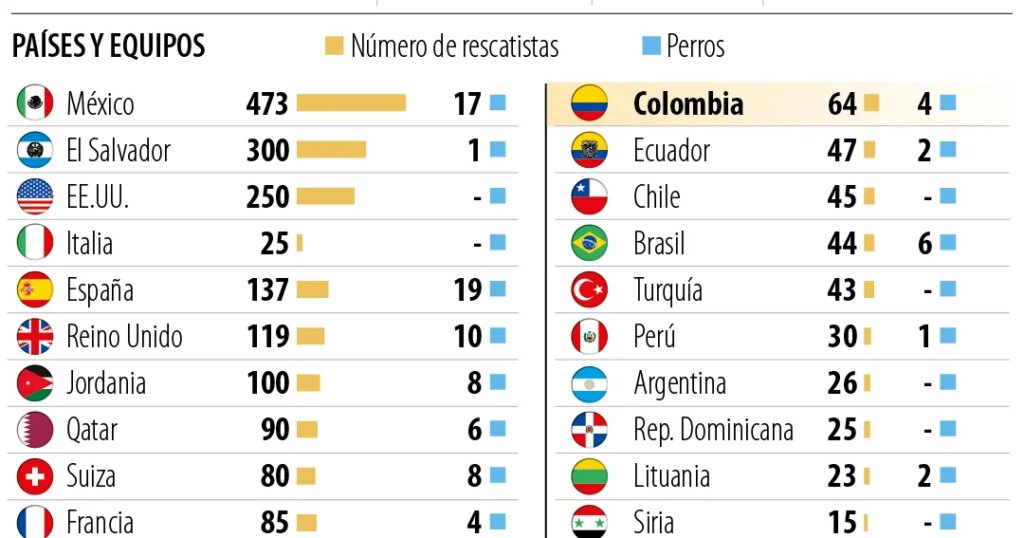
According to data collected by the Office of the UN For the Coordination of Humanitarian Affairs, the emergency in Venezuela mobilized a wide deployment of human and technical resources. In total, 27 countries sent 44 urban search and rescue (USAR) teams, made up of 2,378 rescuers and 140 dogs specialized in locating people.
Mexico led the international contingent with 473 rescuers and 17 search dogs, followed by El Salvador, which sent 300 specialists, and the United States, with 250 members. The contributions of Spain also stand out, with 137 rescuers and 19 dogs, the largest number of canines among all participating countries.
Europe played a significant role in the rescue efforts. The United Kingdom deployed 119 rescuers and 10 dogs; France, 85 rescuers; Switzerland, 80 rescuers and eight dogs; Germany, 74 specialists and seven canines; while the Czech Republic and the Netherlands contributed 69 and 64 rescuers, respectively, both with eight search dogs.
In Latin America there was also a wide cooperation regional. In addition to Mexico and El Salvador, Colombia participated with 64 rescuers and four dogs, Ecuador with 47 rescuers, Chile with 45, Brazil with 44, Peru with 30 and Argentina with 26, among other countries.
The deployment highlights the importance of international cooperation in the first hours of an emergency, when the chances of finding survivors depend mostly on the rapid response of rescue and search teams.