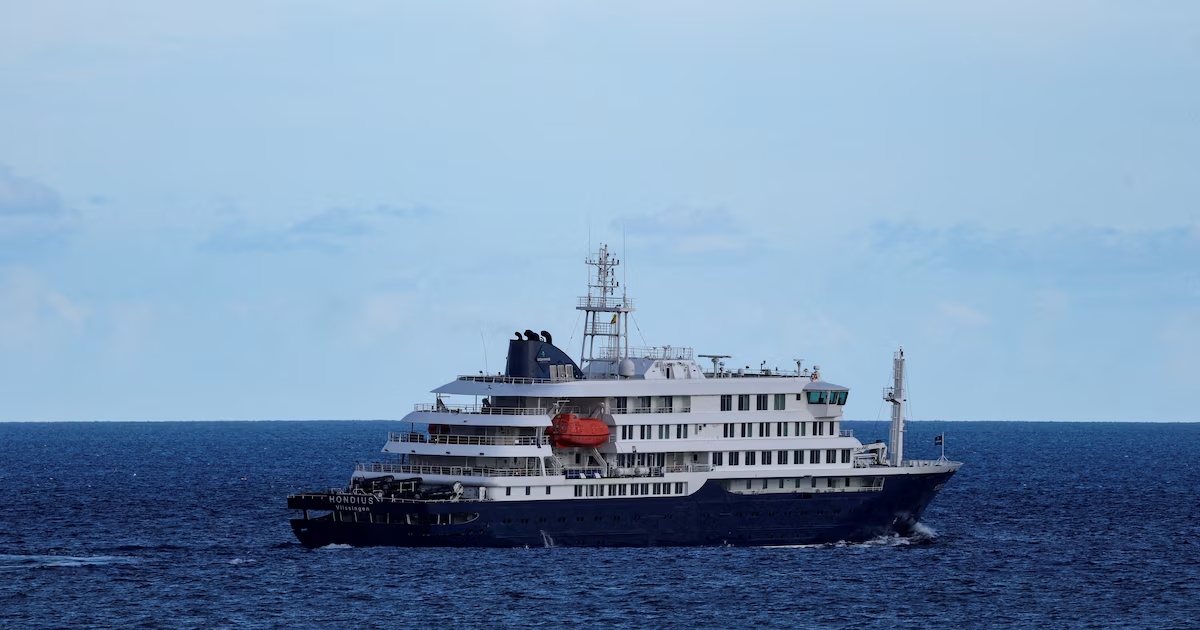
The MV Hondius cruise ship continues its journey to the Netherlands, where it will arrive between Sunday and Monday of next week
After the disembarkation of all the passengers and part of the crew of the MV Hondius shipattention remains on the evolution of their health status. Two of the people who were traveling on the cruise ship and who were evacuated last Sunday have given hantavirus positive: a Spaniard with mild symptoms and a French woman whose prognosis is serious, since she presents the most severe condition of lung infection due to the virus, for which she required assisted respiration.
Hantavirus infections continue to be limited only to people who were on board the ship, with no confirmed cases outside the cruise ship having occurred, for the moment. In different countries, measures are being carried out to prevent the spread of the outbreak and the World Health Organization (WHO) has recommended a 42 day quarantine.
In Spain it will be fulfilled. The fourteen passengers who traveled aboard the MV Hondius cruise ship are already performing it at the Central Defense Hospital Gomez Ullain Madrid. Yesterday the Ministry of Health delayed the start of the quarantine until May 10, so it will last until June 21.
Argentina sends diagnostic kits to Europe and Africa due to the hantavirus outbreak
Argentina has sent diagnostic supplies to laboratories in Senegal, South Africa, the Netherlands, Spain and the United Kingdom to identify hantavirus after the outbreak registered on the MV Hondius cruise ship, which departed from Argentine territory on April 1, as reported by the Ministry of Health and the National Administration of Laboratories and Health Institutes (ANLIS) Carlos Malbrán, cited by The Sixth. The batch shipped includes reagents, positive controls, plates and antibodies for PCR and ELISA techniques, allowing nearly 2,500 tests to be carried out.
The preparation and transportation of the material has required strict conditions of biosecurity and specialized conservation teams, to guarantee its integrity during the international route, have been stated by the Argentine health portfolio and have been reproduced on Spanish television.
The European Center for Disease Prevention and Control rules out mutations in the Hondius hantavirus, but continues investigating
The European Center for Disease Prevention and Control (ECDC) has reported that there is no evidence of mutation in the hantavirus detected in the specimens from the MV Hondius cruise ship, according to statements provided by the epidemiologist Andreas Hoefer and collected by the flamenco medium VRT News. Specialists maintain that there are no differences in the usual behavior of the virus.
Hoefer has specified that the transmission of the hantavirus, usually linked to rodents, probably occurred this way on the Hondius cruise ship, a situation in which a person-to-person contagionaccording to VRT News. In Hoefer’s words, the investigation is ongoing, but, so far, analyzes have not detected signs of a more serious or contagious variant of the hantavirus.
The French woman infected by hantavirus from the MV Hondius cruise ship remains in intensive care
The French woman infected by the Andean hantavirus who was a passenger on the MV Hondius cruise ship remains “in serious condition” and in intensive care at the Bichat hospital in Paris, while the four school-age children considered a contact case have tested negative, the French Government reported this Wednesday.
Regarding the other four French passengers of the MV Hondius, also admitted to the same hospital, they continue to test “negative and do not present any symptoms, the Executive added in a statement.”
Of the other 18 contact cases, who like the children are admitted to follow a strict quarantine, the Executive did not detail whether they tested negative and limited itself to saying that they are “receiving very rigorous medical care” and that “none present symptoms.”
The total of 22 French contact cases were related to a Dutch woman, a passenger on the MV Hondius, who died of hantavirus on April 26 in Johannesburg, after flying to the South African city from the island of Saint Helena, where the cruise ship had docked.
*Information prepared by EFE.
Why the hantavirus quarantine is longer than that of other viral diseases
The outbreak on the MV Hondius cruise ship forces 42 days of confinement, an unprecedented period supported by scientific evidence. WHO recommendations
Add Infobae in

The hantavirus outbreak aboard the MV Hondius cruise ship surprised the international community not only because of the appearance of cases on different continentsbut also by the duration of the quarantine imposed on passengers and contacts.
In video: the Spaniard admitted to Gómez Ulla for hantavirus continues with symptoms, but stable
The 14 Spaniards isolated in the Gómez Ulla Hospital are completing their fourth night of quarantine
The Spanish citizen infected with hantavirus remains stable in the High Level Isolation and Treatment Unit (UATAN) of the Gómez Ulla Hospital after receiving oxygen therapy for low-grade fever and respiratory distress that developed on Monday night. The other 13 passengers of the MV Hondius isolated in the same center remain asymptomatic. The next health update will be made public in 24 hours.
On Sunday, one week after admission, the 13 negative cases will undergo two PCR tests which, if confirmed, will allow the quarantine to be made more flexible with visits and room exits under protective measures. Minister Mónica García has warned that new positives could emerge given the long incubation period, and has met with her counterparts from eleven countries affected by the outbreak.
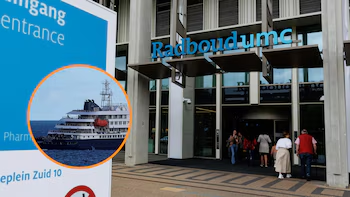
He Radboudumc University Hospital of Nijmegen (Netherlands) has placed 12 employees in “preventive quarantine” after detecting failures in the security protocol with one of the hantavirus-positive passengers of the MV Hondius. As confirmed by the institution in a statement yesterday at 9:00 p.m., this is the infected patient who was admitted on May 7.
Brussels proposes promoting a nine-step roadmap against future global health emergencies
The European Commissioner for International Associations, Josef Síkelahas used the MV Hondius hantavirus outbreak as an argument to defend a greater international health cooperation. “Last week’s hantavirus outbreak on a cruise ship in the Atlantic reminds us of our vulnerability when it comes to health,” he stated at a press conference from Brussels, where he presented a nine-step roadmap called Global Health Resilience.
Síkela has warned that “the frequency and intensity of disease outbreaks is increasing” and denounces that “too many actors” with “too many overlapping mandates” are involved in cross-border situations. The proposed strategy seeks to reduce this fragmentation and reinforce the coordinating role of the European Commissionboth within the bloc and in its relationship with third countries. The EU has already mobilized more than €6 billion for health investments through the Neighbourhood, Development and International Cooperation Instrument.
Among the pillars of the initiative are the strengthening national health systemsparticipation in global epidemic detection networks, greater availability of medicines and vaccines in vulnerable areas, diversification of supply chains and the fight against health misinformation. The roadmap is planned for the period 2026-2027, although the Commission has not presented a precise calendar or specific financial envelope.

EU countries coordinate Hondius contact tracing as Netherlands prepares for cruise ship’s arrival
Representatives of the EU countries affected by the hantavirus outbreak, the United Kingdom, the ECDC and the European Commission have held a coordination meeting in which they have discussed the evacuation of repatriated European citizens and the contact tracing of the flight from Johannesburg. Each country has presented its cases, contacts and how monitoring has been carried out in each region.
The Netherlands, for its part, has reported that it expects to receive the MV Hondius between Sunday and Monday. The crew will undergo a PCR upon arrival and another one a week into quarantine, in line with the protocol applied in Spain. The Dutch authorities have detailed that those who are not picked up by their countries of origin will undergo quarantine in the Netherlands.
WHO admits “public concerns” about hantavirus and announces technical meetings on treatments and vaccines
The World Health Organization (WHO) has recognized from Geneva that there are “public concerns” about the hantavirus linked to MV Hondius, motivated by its lethality, an incubation period of up to six weeks and the absence of a vaccine or specific treatment.
Spokesperson Nika Alexander has specified that the operation deployed in Tenerife had a “successful” response and an example of “solidarity in action.”
Given the uncertainties, the WHO announced the convening of technical meetings on antivirals, monoclonal antibodies, diagnosis, vaccines and pending lines of research regarding the virus.