Annually, Transparency International, a global non-governmental organization founded in 1993, publishes its Corruption Perceptions Index, an analysis based on independent data sources from around the world. The study is based on a scale of 0 to 100, where 0 means “high corruption” and 100 means “low corruption,” evaluating 182 countries and territories according to perceived levels of corruption in their public sector.
Reviewing by region, Western Europe and the European Union have the best average, standing at 64, while Sub-Saharan Africa has the lowest, with a regional average of 32. In the case of Latin America, the region has an average of 37.
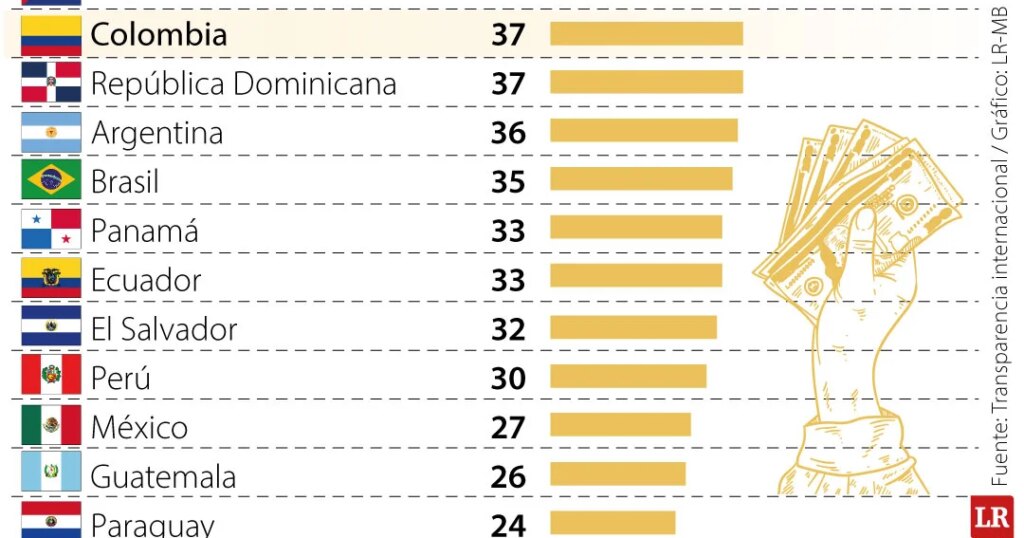
Specifically, Colombia is located in a medium-high position in the region, with 37 perception points in corruption and occupying box 16, just below Cuba and above the Dominican Republic. This score implies a drop of seven positions compared to the 2024 index, placing the country in position 99 out of 182.
The countries with the lowest perception of corruption in Latin America are Uruguay (73), Chile (63) and Costa Rica (53).
On the other hand, the countries with the highest perception of corruption are Venezuela, Nicaragua and Bolivia, with 10, 14 and 20 points, respectively. Features such as political conflicts, state violence and democratic deterioration are probably those that most affect these three nations, and can greatly influence the perception of the public sector in their territories.
“It is not surprising that countries with full democracies tend to obtain high scores on the CPI, while non-democratic regimes generally obtain the worst results. In most of the world’s full autocracies, such as Venezuela and Azerbaijan, corruption is systemic and manifests itself at all levels,” says Transparency International.
Countries such as Guatemala and the Dominican Republic significantly improved their position in the index compared to last year, as did Costa Rica, which in this edition of the study was ranked as the third most transparent country in Latin America.
Those with the least corruption
At the top of the table, Denmark heads the list of countries with the lowest perception of corruption, reaching 89 points for the eighth consecutive year. Finland and Singapore follow in the classification, with 88 and 84 points, respectively, as well as New Zealand and Norway, with 81 points each.
Transparency International highlights the importance of institutions and democracy as a fundamental factor for the control of state corruption, emphasizing that “Full democracies have an average score of 71 on the CPI, while imperfect democracies have an average of 47 and authoritarian regimes, just 32”.
Some of the countries that showed improvement in the index were Albania, Senegal and Ivory Coast, leaving the bottom of the table in 2024 to be in the middle section this year thanks to institutional reforms, a behavior that stands out with a key fact: Only 31 countries have improved their position in the index since 2012, while 50 nations have worsened and 100 have remained the same.
Those with the greatest corruption
According to the index, the highest levels of perceived corruption are found in Somalia and South Sudan, with just 9 points in the Transparency International table. Venezuela, Yemen and Syria are the ones that follow at the bottom of the classification with 10, 13 and 15 points respectively, countries that share traits such as armed conflicts and the strong detriment of their democratic and state institutions.
It should be noted that powers such as the United States, Canada and the United Kingdom registered notable declines in their historical scores, due to the weakening of controls. and independent balances, in addition to the growth of economic influence on regulatory issues, they warn.
Finally, it should be noted that for this year the outlook may be negative due to global situations.
Governments around the world failed to control corruption
For the first time in more than a decade, the world average fell to 42 out of 100, which for Transparency International reflects global stagnation, because “the vast majority of countries fail to keep corruption under control: 122 out of 182 obtained a score of less than 50 on the index,” the organization stated. The entity affirms that independent judicial systems are vital to combat impunity, in addition to strengthening democracy and civil liberties.