Follow and read us on Google Discover
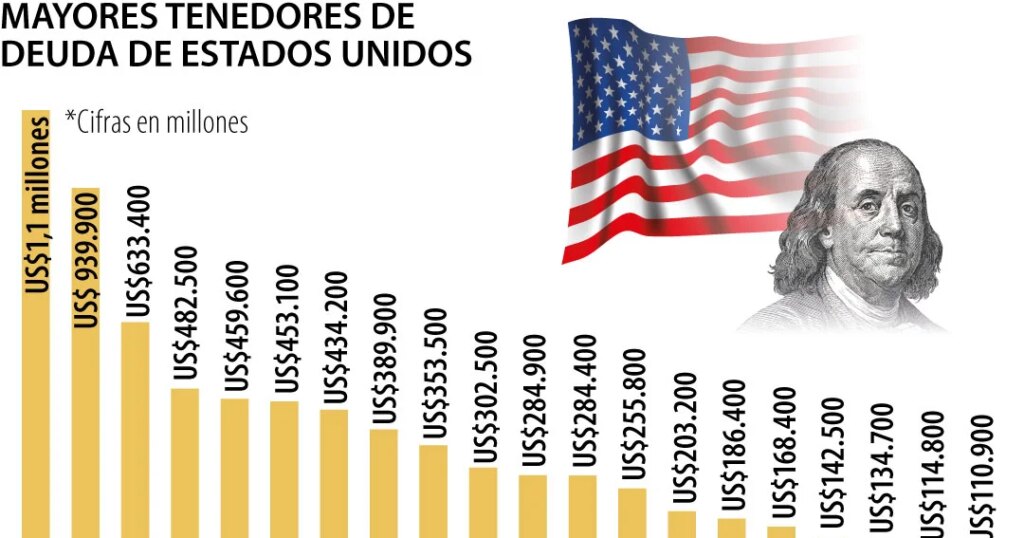
Japan ranks first as holder of US public debt according to data from the Treasury Department with cutoff to June of this year. Although it experienced an annual decrease in its holdings of 3.3%, it remains the largest foreign holder with US$1.1 trillion.
It is followed by the United Kingdom with holdings of US$939.9 billion and China with US$633.4 billion. The top 5 is closed by Belgium with US$482.5 billion and Canada with US$459.6 billion.
Total foreign holdings of US Treasury bonds reached $9.29 trillion.
Japan and the fear of a global domino effect
Beyond the ranking, the key point in Japan, which, being the main holder of US debt, could trigger a crisis in the financial market. According to international media, Japan is carrying out a massive sale of US bonds, at a time when it is trying to boost the price of the yen.
The sale of US bonds coincides with the increase in Japanese bond yields, which are making Asian securities increasingly attractive to investors in the country itself compared to US bonds.
According to the calculations of Bloombergfor every $100 billion reduction in Japan’s U.S. bond portfolio, the U.S. bond suffers a 37 basis point increase in yield. Hence the reason why the financial market feels uncertainty that Japan will continue with this sale.
On this point, Juan Pablo VieiraCEO of JP Tactical Tradingexplained that “Japan occupies a strategic position in the international financial system, not only because it is the largest foreign holder of United States Treasury bonds, with around US$1.1 trillion, but because for decades Japanese investors have had incentives to seek profitability outside their country in the face of low yields on domestic debt.”
The change that is observed today is precisely that, there is a higher yield on Japanese bonds, which has generated an incentive to divest from US debt. “The Japanese government bond market, known as JGBis going through a stage of normalization after years of extremely low rates. With Japanese yields reaching levels not seen in decades, domestic assets are beginning to compete more directly with US bonds for Japanese capital,” he said. Scallop.
At what point would the domino effect be generated? If Japanese investors find enough attractiveness in local public debt, they could progressively reduce their positions in the US Treasury, which would increase the cost of financing in the North American giant.
“A massive sale of Treasuries puts downward pressure on the price of bonds and, due to the inverse relationship between price and yield, raises their rates. This makes financing the US Government more expensive and, given that Treasury bonds serve as a reference for a large part of the global financial system, also increase the cost of credit for companies, households and other governments,” said the expert.
That is why the market closely watches the JGB. Japan functions as one of the great intermediation nodes of global savings: an important modification in the incentives of its investors can be transmitted from Tokyo to Wall Street and later to other markets.