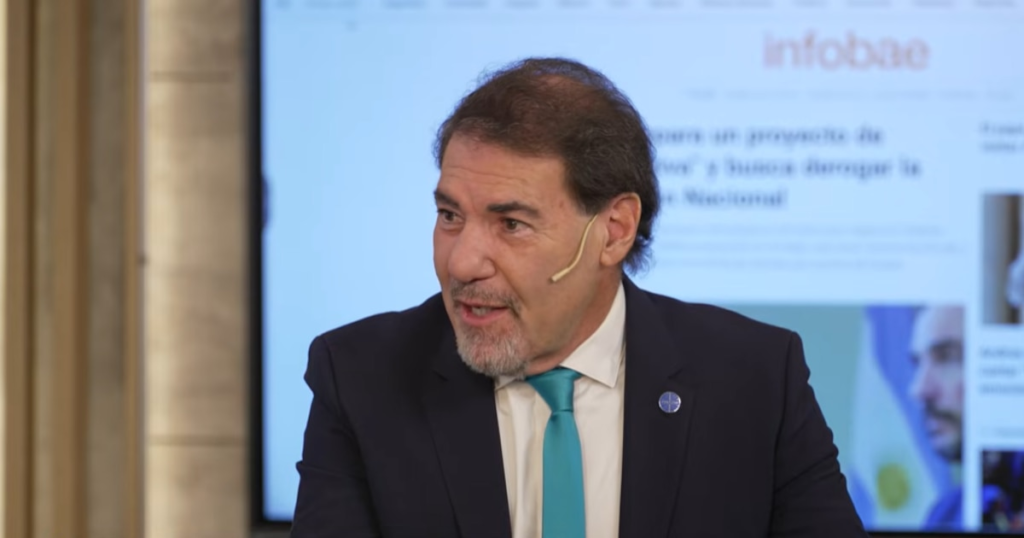
The president of BYMA (Argentine Stock Exchanges and Markets), Claudio Zuchovickihe said, in dialogue with Infobae Livethat the economic scenario that Argentina faces “is like a prison without a goalkeeper” and spoke of the auspicious future that he foresees for the country. He welcomed the fact that the need for structural reforms over financial emergencies is put on the table.
Not long ago, another economist, Miguel Angel Brodahad used the same football metaphor, “kick a penalty without a goalkeeper”to describe the opportunity that Argentina faces in terms of implementing the delayed structural reforms that the business community has been demanding for decades.
Along the same lines, Zuchovicki explained: “From the point of view of the context that Argentina and my profession go through, it is like a penalty in which the goalkeeper went the other way and you have the possibility of defining. Part of my failure is to always be optimistic, but it is also true that there are many things that do not depend on us, but on the context.”
“And the truth is that, for Argentina, I speak especially to the youngest people—as if I were speaking to my children—: it is worth fighting for,” he highlighted.
Regarding the direction of Argentina, he noted that “we produce what the world wants to buy already very good price. I always make the same point: we all talk about artificial intelligence, which is great and is going to change our activity and many others, but for artificial intelligence to exist you need energy.”
“The other day Microsoft’s shares fell because the company declared it did not have enough energy to connect the chips it had purchased. And we are energy exporters. We are food exporters, we are knowledge exporters. I don’t know if ‘the forces of heaven’ exist, but something happened: All indicators point to the fact that you have a historic opportunity.”, he remarked.
Zuchovicki highlighted the importance of laws being made in Congress and not by decree due to the institutionality that it gives to the country.
In this sense, he stressed the importance of structural reforms and he asked himself: “Who can defend the non labor reform When do you have 50% informality? We have already lost the battle: half of the workers are in the black. What are you defending? How can you not defend tax reform? With what face do you not defend a tax reform when half does not pay taxes and the one who does pay pays double because the other half does not pay taxes?”
“Later we will discuss the form, who and how. But what is essentially suffocating the productive sector is unfair competition from the point of view of social arbitration,” he added.
At the same time, he believes that the only thing that can really solve the time it takes for structural changes to have a positive impact on employment is education. “If there are no human resources, no matter how much money you put in, this will fail.”
On the other hand, he considered that good companies, those that want to transcend time, do not talk about politics but rather focus on their own business. That message was given to him by an Argentine businessman when Zuchovicki wanted to convince him to go public. “The answer he gave me surprised me. He said that companies that talk about politics are those that need the favor of the State or depend more on a politician than on the market. If we talk about going public, we don’t have to talk about politics. Let’s talk about labor reform, because my problem is how much I pay, what risks I take in a company,” he said.
Regarding the crisis that is observed in many SMEs, Zuchovicki said: “Companies feel the loss of people’s purchasing power and, therefore, consumption falls. In the AMBA we had energy, transportation and health subsidies; now we have a lot less subsidies.”
“The real salary grew – if you take the majority of salaries, they rose more than inflation – but your disposable salary fell, because the electricity rate increased, for example. So, in the AMBA today we have a horrible mood,” he explained.
In this context, he assured that the Government must solve macro problems and pointed out that the ideology that exists today is to try to have clear rules and to depend as little as possible on the State.
“What they are trying to do is deregulate the number of people who have to ask permission to do something,” he explained, referring to the Executive’s policy.
The complete interview with Claudio Zuchovicki:
Infobae Live
- From 9 to 12: Gonzalo Sánchez, María Eugenia Duffard, Cecilia Boufflet and Ramón Indart.
- From 18 to 21: Jesica Bossi, Diego Iglesias, Virginia Porcella and Federico Mayol.
News, talks and protagonists, live.
Follow us on our channel YouTube @infobae