For the hedge fund billionaire Louis Bacon The crystal-clear waters and rivers bordered by dense forests of the Gulf of Chiriquí, in western Panama, form an ecological oasis. For the promoter John McKeownOn the other hand, the Gulf is a gateway to potential markets for the region’s valuable products and an opportunity to boost the local economy.
These competing visions are at the center of a bitter dispute between the two wealthy Americans, who claim to be defending Panama’s best interests.
The conflict revolves around a US$260 million port that McKeown seeks to develop on the Pacific coast, just south of the city of David. Ocean Pacific Investments, The company he directs presents the Puerto Barú project as the first “green” port in Panama, capable of relieving pressure on the commercial centers of Panama City and connecting with trade routes to North America and Asia.
Chiriquí, with about 500,000 inhabitants, is one of the main agricultural regions of the country and produces coffee, papaya and shrimp, among other foods.
The dispute has reached Panama’s Supreme Court, which is evaluating the port’s environmental approval after a group of local nonprofit organizations challenged it. The confrontation has already led to civil and criminal complaints against some of these NGOs. The outcome could define the future of a virtually intact area of Panama that has received little of the wealth circulating through its prosperous capital.
For Bacon, the project represents an unacceptable risk.
“I am concerned that those responsible for this project have no experience in developing or operating commercial ports and yet are proposing to build a large port in one of the most environmentally sensitive areas of Panama,” he wrote in a statement to BloombergNews. “You only have to look at a map to realize that this is not a suitable location for a project of this type.”
For its part, Ocean Pacific stated that it has taken steps to address potential environmental impacts and that the campaign to stop the port could be driven by personal interests.
“If I believed that Puerto Barú would cause significant damage to a part of Panama, a country that I not only love but call home, I would never have dedicated my time or resources to the development of this project,” he said. McKeown in a statement.
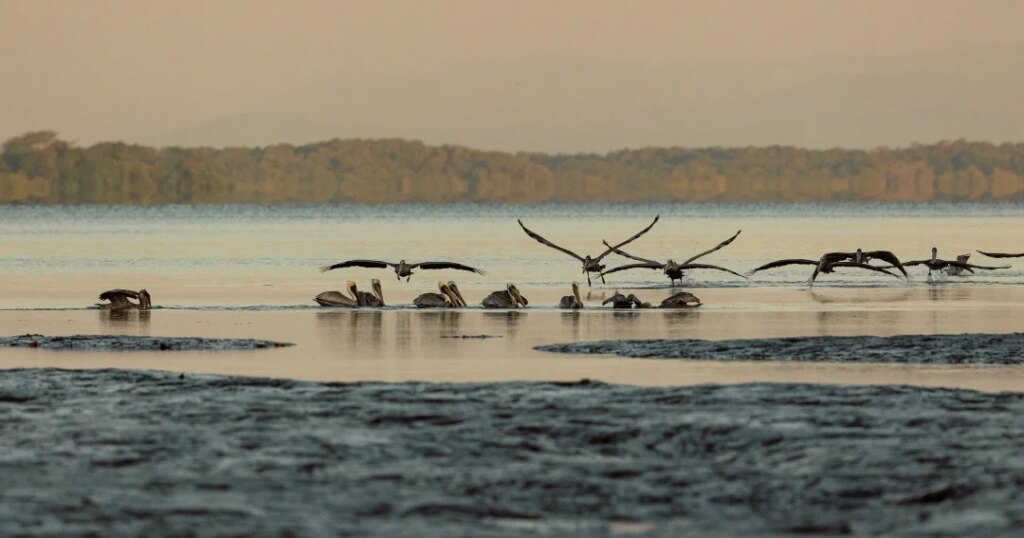
The disputed site lies between winding canals that are home to a quarter of Panama’s mangroves. These ecosystems and their dense root networks protect coastlines, provide refuge for marine life and absorb enormous amounts of carbon.
Ocean Pacific plans to build a 124-hectare commercial port. According to the company, it would be the largest private investment in the history of the province of Chiriquí and would benefit the area not only with an increase in industrial activity, but also with more tourism, since the project would include a dock for recreational boats. An economic assessment commissioned by the company in 2021 estimated it could generate more than 1,100 jobs.
Six Panamanian environmental groups argue that the port and the resulting cargo ship traffic would cause irreversible damage to the local ecosystem due to pollution, water churning and blocking sunlight.
Juan Carlos Monterrey Gómez, executive director of the environmental consulting firm VANGLabs and Panama’s former special representative for climate change, said that some impact on the local environment is inevitable in a project of this magnitude. Monterrey is not linked to any of the groups opposed to the project.
A spokesperson for Ocean Pacific He said the company “strongly disagrees” that the port will cause irreparable damage and stated that potential impacts were “exhaustively studied and addressed in detail” during the environmental assessment. The process, approved two years ago, took four years and included a public hearing with broad participation, according to the company, which noted that the review was comparable to those conducted for infrastructure projects in the US.
The project website claims that it was designed to meet “high sustainability standards,” with solar panels to cover all its energy needs and specific conservation areas.
The spokesperson added that the company has always made clear that it is not a port operator and that it plans to partner with one.
Ocean Pacific He has continued working at the port while the court analyzes the case. At the same time, it counterattacked the non-profit organizations and filed criminal complaints against two of them for slander, defamation and crimes against the economy.
Shortly afterward, both organizations said their bank accounts had been frozen by court order. Unable to pay their staff or raise funds, the groups are struggling to stay afloat, while their workers say the measures have intimidated other organizations that might otherwise have spoken out.
The case is generating the kind of chilling effect associated with so-called SLlapp lawsuits, used to intimidate critics, he said. Joana Abregoformer legal manager and now external consultant for CIAM, one of the affected organizations.
Ocean Pacific declined to comment on the ongoing litigation.
One of the reasons why Ciam and Adopt Forestthe other nonprofit organization accused, were able to express such strong opposition from the beginning is Louis Bacon. The 70-year-old financier made a fortune with his hedge fund Moore Capital Management and has allocated part of that wealth to the purchase of land and conservation projects in different parts of the world. According to The Land Report, he is the 70th largest landowner in the US and has placed 94% of that land under conservation easements, a legal figure that permanently prohibits future development.
The term conservationist may suggest low-key management, but that’s not Bacon’s style. He was a co-founder of the Waterkeeper Alliance, a nonprofit organization formerly led by Robert F. Kennedy Jr. that seeks to enforce environmental laws.
Through the Moore Charitable Foundation, Bacon has frequently taken an activist approach and collaborated with local groups to oppose projects near his properties, including a cement plant in North Carolina. He also played a leading role in a bitter years-long dispute with Peter Nygard, the disgraced Canadian fashion mogul, over neighboring properties they both owned in the Bahamas.
The dispute over Barú also has a personal dimension. Bacon owns Islas Secas, an all-inclusive ecotourism resort located on an archipelago about 30 miles southwest of the planned port, where rates start at $3,500 a night. Bacon said the port would be far enough away not to directly affect his island, but warned that dredging and habitat alteration could create knock-on effects. He denied that his opposition seeks to protect his luxury hotel and assured that his commitment to Panama will not change even if the project moves forward.
Bacon called Ocean Pacific’s legal action against the nonprofits extraordinary. “I have never had to support environmental defenders who face criminal penalties simply for raising concerns about a development project,” he said. “The use of legal action to pursue whistleblowers is abhorrent.”
Bacon has personally covered Adopta Bosque’s legal costs and has also helped fund the broader campaign against the project, which includes an online petition and website on which the six nonprofits lay out their mission. The initiative is supported by nearly 40 “supporting organizations,” many of which have received prior funding from Bacon for other activities. He also paid for an alternative plan that proposed moving the port about 80 kilometers west, to Puerto Armuelles, and his foundation funded an impact analysis that estimated the project’s environmental cost over 20 years at around $30 million.
McKeown He also has personal ties to Panama. A part-time resident of the country, he said he became interested in Chiriquí’s potential as a maritime hub during a deep-sea fishing excursion, when the captain had to travel seven hours to resupply because there was no suitable dock.
He also has experience combining business and conservation initiatives. As president of Synergy Oil & Gas, a closely held energy company based in the Los Angeles area, he helped create one of the largest protected wetlands in California with authorities by agreeing to the closure of a former oil field. Prior to Synergy, McKeown was a real estate broker and owner of several container yards and logistics operations. He said he has raised funds for Puerto Barú from several American investors, whom he declined to identify.
Bacon said he has personally raised concerns about the project with Panamanian officials and also through his local foundation. He added that he contacted Ocean Pacific to offer to fund additional scientific analysis and a coastal modeling study, but received no response.
An Ocean Pacific spokesman said McKeown exchanged emails with Bacon’s son Trevor and concluded that new analyzes would duplicate studies already done. McKeown also maintained that Puerto Armuelles is too far from the region’s agricultural areas to be a viable alternative.
The Minister of the Environment of Panama, Juan Carlos Navarrosaid in a statement that the ministry is legally “obliged to respect” the environmental approval of Puerto Barú, granted by a previous administration, and that it will abide by the Supreme Court’s decision when it occurs. He declined to comment on Ocean Pacific’s lawsuits against the NGOs, but noted that the nature of those legal actions has ministry officials “deeply concerned.”
“Panama is a democratic country,” he said. “At the Ministry of the Environment we value and promote active and solid citizen participation, as well as the contributions of civil society and the scientific community to environmental management.”
Panamanian activists say the port project highlights what they see as a gap between Panama’s reputation as a conservation and environmental leader and the treatment of local nonprofits.
“Organizations like ours are alone. We do not have institutions to protect us in a situation like this,” Abrego said. Two environmentalists who oppose Puerto Barú declined to speak identified for fear of their safety when criticizing the State’s position regarding a development project.
The contradiction is not so unusual, said Monterrey, the former climate envoy, given the bureaucratic tensions that often complicate public policies in many countries.
In his opinion, the port is unlikely to fulfill the promises of its promoters for Panama. “These large projects are often presented as generating jobs and development,” he said, “but they often produce social conflicts, extract wealth from communities and transfer the benefits to other places.” It is now up to the Supreme Court to decide whether Ocean Pacific will have the opportunity to change that narrative.