While the Paraguayan president, Santiago Peña, attended the impeachment trial in Senate after the scandal unleashed in Ueno Bank Due to the insolvency crisis in which it finds itself, the depositors and savers of the financial institution continue to wait for the future of their savings.
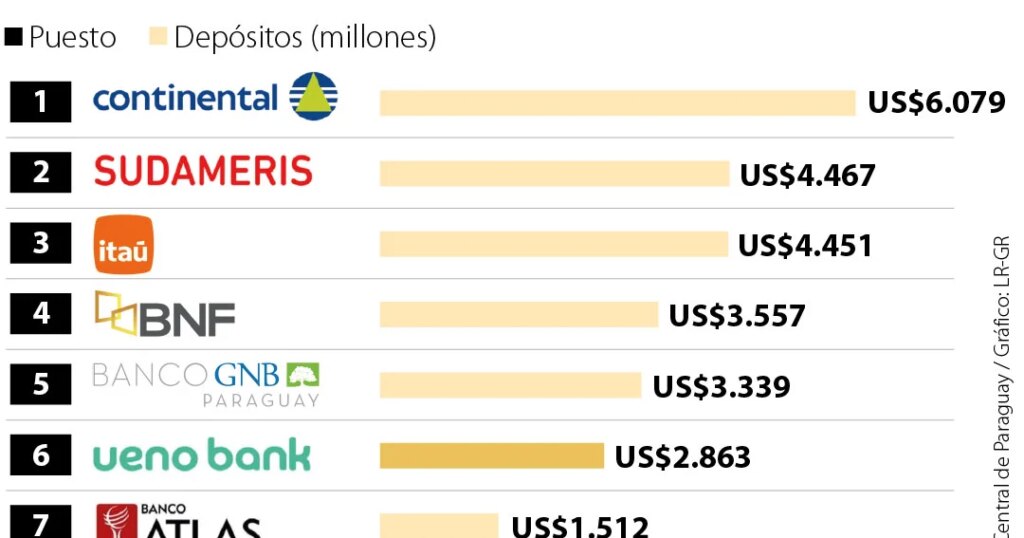
He Central Bank of Paraguay has already started with disbursements for those who had accounts in Ueno, The Issuer also detailed how Paraguayans’ deposits are distributed. The intervened entity is the sixth with the largest amount of deposit money among 16 that operate in Paraguay, with US$2,863 million.
The list of banks by managed deposits, according to information from the Central Bank of Paraguay, he leads it Continental Bank with US$6,079 million. It follows Sudameris with US$4,467 million, Itaú with US$4,451 million, National Development Bank with US$3,557 million and the top 5 is closed by the bank GNBwhich has Colombian capital (the family Gilinski) with US$3,339 million.
After Ueno Bank In sixth place is the Atlas Bank with US$1,512 million, the Family Bank with US$1,332 million, Basa Bank with US$1,267 million, Bancop with US$812 million, Interfisa with US$771 million, Zeta Bank with US$621 million, Solar Bank with US$460 million, Citi with US$382 million, Bank of Brazil with US$102 million and the Bank of the Argentine Nation with US$ 49 million. The 16 entities manage deposit resources for US$32,064 million.
Concern about the fate of the deposits that were in Ueno is reflected in the clients who had their money there. Samuel Acostageneral editor of the newspaper 5 Days of Paraguay, explained to this medium that US$343 million in pension funds, mainly those of the Institute of Social Security, They are staying there.
In turn, US$850 million of public funds are also housed there. “It is not known if all of the funds can be recovered. There are also funds from companies and investors,” he added. Acosta.
“Protests over frozen savings will intensify if Peña’s departure appears to grant him impunity or if payments to depositors and pensioners stagnate,” he said. Mariano Machadoprincipal analyst for the Americas of Verisk Maplecroft.
What will happen to the savings?
He Central Bank of Paraguay began with the payment process of the depositor guarantee of Ueno in stages. In a first stage, they will be paid to depositors who meet conditions such as having deposit accounts of up to US$1,600, not having debts with the entity and having accounts enabled in other banks or financial institutions.
For this process, the entities authorized by the Central Bank of Paraguay to make payment to account holders are Banco Atlas, Basa, Continental, Banco de la Nación Argentina, Familiar, GNB, Itaú, Bancop, Interfisa, Solar, Sudameris, Zeta, Financiera FIC, Financiera Paraguayo Japonesa, Finlatina de Finanzas and Your Financial.
“Although the bankruptcy of Ueno Bank generates a contingent liability for the government, the direct fiscal costs appear to be limited to possible liquidity support from the BCP to the deposit guarantee fund. The use of the fund to initiate the refund of deposits does not imply an immediate fiscal cost,” he explained. William Foster, sovereign analyst of Moody’s Ratings.
Foster He also commented that the costs would only be reflected if public entities incurred losses on unrecovered balances or needed support. budgetary.
He BCP has indicated that around 97% of depositors would be fully covered by Paraguay’s deposit guarantee fund and, as of September 2026, the fund had liquidity of US$1.6 billion, equivalent to nearly double the insured deposits of Paraguay. Ueno.
Ueno bonds plummet
Reuters noted that the first international bond issue Ueno Bank, for US$350 million, plummeted to critical levels, reported IFR, a financial information service of Lsegafter regulators took control of the Paraguayan bank, triggering a political crisis that led to the country’s president, Santiago Penato present his resignation on Thursday morning.
According to data from Lsegthe issuance of senior unsecured bonds maturing in 2031 and bearing interest at 6.7% were trading at US$0.07 on Friday morning, compared to US$0.86 reported on November 3, before the Paraguayan bank’s solvency problems became known.
A trader valued the bonds at about $0.05 on Friday, but said it was “hard to know” given the entity’s situation.
Reuters commented that the collapse marks a drastic turnaround for a bond issue that was only eight months old. Ueno placed it at 98.753 with a return of 7% in March and attracted a demand for US$540 million.
Over the course of the week, the financial panic caused by the intervention of Uenobrought with it a massive migration of deposits towards the dollar, causing the guaraní to suffer a severe depreciation of 4.68% in a single day (trading at 6,487 guaraníes per dollar).
The Paraguayan currency accumulated a fall of 8.17% in just five days, which placed the Paraguayan currency as the one with the worst global performance in the ranking of Bloomberg.
These facts highlight the relatively weak quality of Paraguay’s institutions and governance; is mitigated by greater effectiveness of fiscal and monetary policies,” he concluded. Foster.
GNB, from the Gilinski family, registers high demand for savings accounts
The fall of Ueno Bank in Paraguay opened an opportunity for the family’s financial business Gilinski. While the clients of the intervened entity wait to recover their savings, GNB Paraguay Bank reported a high demand for opening digital accounts that caused delays and intermittent failures in its application.
The bank with Colombian capital reported that the traffic of people who were requesting accounts to operate with the entity was affecting the speed and availability of its platform.