The relocation of the Pará jaguar and her two cubs to Esmeralda Provincial Parkin the province of Misiones, came under judicial scrutiny. After a preliminary investigation, the Fiscal Unit for the Investigation of Crimes against the Environment (UFIMA) prosecuted the case, which is currently being processed in the Federal Court of Eldorado, in charge of Miguel Angel Guerrero.
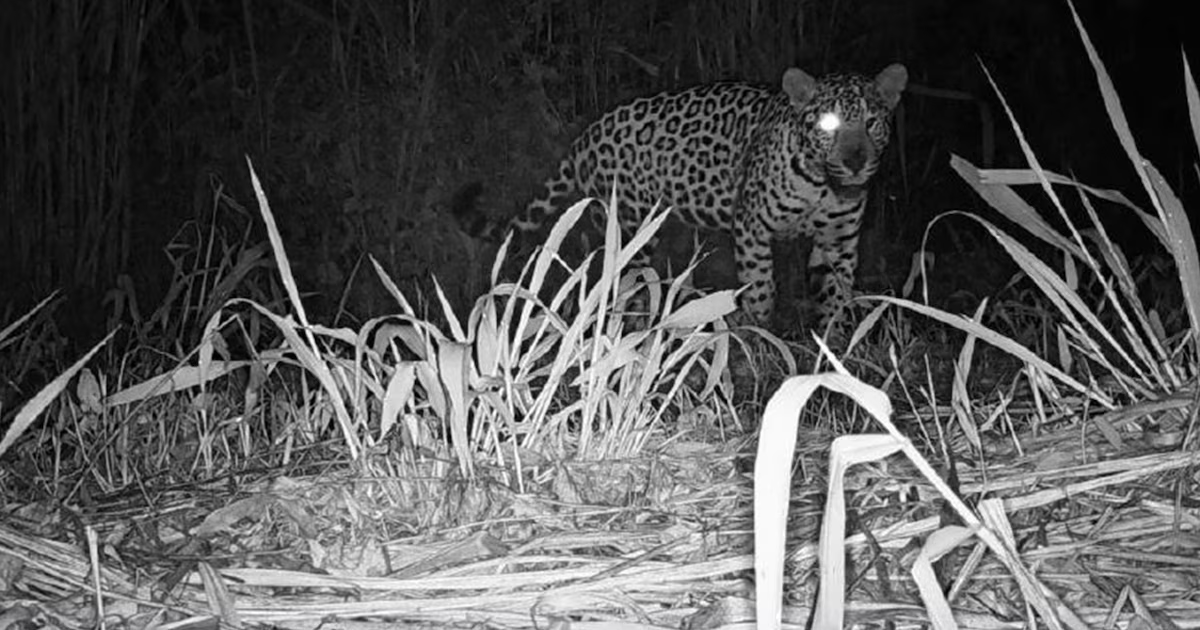
Almost six months after the operation, the scenario is uncertain: There is no confirmation about the whereabouts of the female and everything indicates that the puppies could have died. The last data from the satellite collar that allowed Pará to be monitored corresponds to January 20, 2026 and, so far, its correct operation has not been verified. The day before, January 19, they recorded images in which she is seen alone through a camera trap.
In the case of the cubs, the situation is even more critical: due to their young age they did not have tracking devices and the last record on camera traps dates back to October 24, 2025, at the site where they were released a week before.
Now, Justice seeks to determine whether, in the transfer and subsequent monitoring, the technical and scientific standards required for the management of a species in critical danger of extinction. In that sense, the head of the UFIMA, Ramiro Gonzalezwarned that, being a National Natural Monument (the highest category of legal protection), The intervening authorities have a “position of special guarantor” regarding its conservation and it is necessary to clarify if there were omissions, deficiencies or possible deviations from the standards required in the matter.
Pará and her cubs were moved in separate cages to the Esmeralda Provincial Park (Video/@gobiernodemisiones – Photo/Ministry of Ecology of Misiones)
Infobae consulted the organizations involved in the operation, including the Ministry of Ecology of Misiones, but the owner Martin Recaman He chose not to answer questions.
From the Missionary Institute of Biodiversity (IMiBio), its director Emanuel Grassi assured that the technical documentation of the relocation—including specialist reports and supporting material—has already been made available to Justice, as requested by UFIMA.
For his part, the biologist, researcher at the National Council for Scientific and Technical Research (CONICET) and coordinator of the Yaguareté Project, Agustín Pavioloindicated that it does not consider it prudent to provide additional information, given that the case has already taken judicial status.
As this media learned, the cause was first referred to the Federal Court of Posadasbut he declared himself incompetent due to territory. Finally, he arrived at the office of Miguel Ángel Guerrero, head of the Eldorado Federal Court. “For this, the place where Pará’s presence would have been verified for the last time was taken as a reference, in the Esmeralda Provincial Park, which is located in the San Pedro department under the jurisdiction of said court,” judicial sources indicated.
At the moment, the case is being investigated as a violation of Law 22,421 on the Conservation of Wildlife. “Once the facts have been established, there is a theory of what happened and evidence to support it, the action can be subsumed under legal qualifications and those responsible can be established,” the same sources pointed out.
The case of Pará is not an isolated event. In recent weeks, the Federal Chamber of Resistance ordered reopen the investigation into the disappearance of the yaguareté Miníin the El Impenetrable National Park, in the province of Chaco, an episode that had also remained unclarified. The decision reinforces a pattern that worries specialists and organizations: the difficulty in determining what happens to monitored specimens even within protected areas.
No traces
The transfer of Pará and her two puppies was carried out on October 17, 2025. As he told Infobaethe Ministry of Ecology of Misiones presented it as “an unprecedented operation in the country” that was carried out after nine days of joint work between provincial and national organizations and different organizations. Even the Governor of Misiones, Hugo Passalacquahe highlighted it on his networks. “We reaffirm our commitment to the conservation of the most emblematic species of our beloved Atlantic Forest,” he said.
The decision was made after The female was detected inside the patio of a housewhich raised alerts for possible conflicts with the neighbors of the area known as “2,000 Hectares”, borders the Iguazú National Park. “We are afraid for our children,” they said.. In this context, and added to the fact that the animal had preyed on more than 50 dogs, it was decided to capture it and relocate it to a protected area within the Yabotí Biosphere Reserve.
That decision is now the subject of a judicial investigation.. In the complaint, the head of the UFIMA warns that, “in the face of the possible impact of specimens belonging to an emblematic species whose preservation constitutes a priority public policy at the national level, it is appropriate to judicialize the case, so that the necessary measures are taken to clarify the facts.”
According to the preliminary investigation, After the release, Pará moved from the site, according to the data from the satellite collar, while the cubs remained in the vicinity.. Since then, no images or traces of the babies have been recorded again. Currently, uncertainty also affects the female, whose whereabouts are unknown.
Monitoring of the jaguar is in charge of the Ministry of Ecology, but it is the technical team of the Yaguareté Project (CeIBA-CONICET) that receives the data from the collar, processes the satellite locations, builds maps and shares them with an operational group made up of the Ministry itself, IMiBio, Güirá Oga and Aves Argentinas.
Field monitoring, meanwhile, depends exclusively on the Ministry, which deployed camera traps and telemetry tasks to track the collar’s VHF signal, whose range varies depending on the terrain, from less than 500 meters to more than 4 kilometers.
At a meeting of the Paranaense Jungle Subcommittee of the National Strategic Plan for the Conservation of the Yaguaretécarried out on February 20, 2026, it was considered, based on the data available up to that point, that Pará showed “normal and healthy” behavior and that it did not attempt to return to its place of origin after the transfer. In this context, carrying out a helicopter flight to reestablish contact with the collar was evaluated.
However, by then no new signals had been obtained. The searches carried out in the area did not yield results and the weather conditions (with heavy rains) could have erased possible traces. The 10 installed camera traps also failed to capture new images, which deepened the lack of information about the fate of the animals.
A critically endangered species
These days, in the region of the Misiones jungle, a new binational monitoring of the yaguaretéa scientific campaign that is carried out periodically between Argentina and Brazil to evaluate the status of the population of the most emblematic feline in the region.
The survey is carried out in the Alto Paraná Atlantic Forest, including fundamental protected areas such as the Iguazú National Park and the Iguaçu National Park, key territories for the survival of the species.
This monitoring, which has been carried out periodically for more than 20 years, uses a precise methodology based on camera traps distributed in the jungle, which allow animals to be recorded in their natural habitat. Through these images, specialists are able to identify each specimen by the unique pattern of its spots, which makes it possible to estimate the number of individuals present.
According to the latest available data, In the Misiones jungle there are between 64 and 110 jaguars.with an average of close to 84 specimens, a figure that shows a slight decrease compared to previous studies and that keeps conservation teams on alert.
This deployment contrasts with what is happening with Pará. Despite the existence of these tracking systems, the uncertainty about their destination, as well as the disappearance of Acaí, It reveals the extreme fragility of the species and the limitations that Justice faces when investigating these events. As the investigation revealed The jaguar filesthe majority of cases due to illegal hunting or trafficking in the country end up archived.