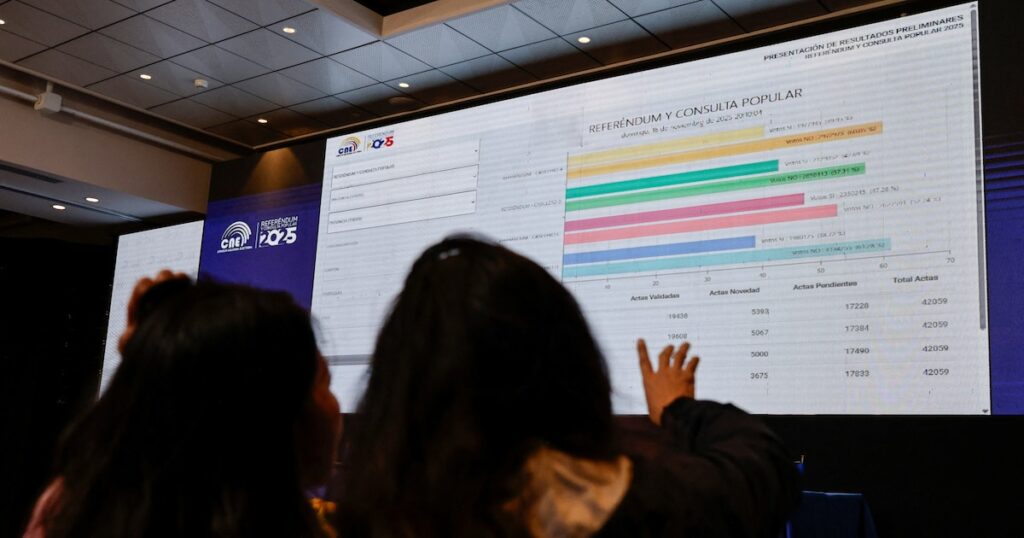
Ecuador turned its back this Sunday on the four questions of the referendum and the popular consultation promoted by the president Daniel Noboa. According to the results of the National Electoral Council (CNE), the “No” He won in all the boxes: in the question about foreign military bases he got around 60% of the vote; in the elimination of public financing for parties, meanwhile, it reaches 57%; in the reduction of the number of assembly members it prevails with 53%; and in the call for a Constituent Assembly, the difference is even wider, with close to 61% for the “No”. The data may vary as the scrutiny progresses, but they mark a clear trend of rejection of the Government’s reforms.
With irreversible tenure, President Daniel Noboa recognized the results: “These are the results. We consulted the Ecuadorians and they have spoken. We fulfilled what we promised: ask them directly. We respect the will of the Ecuadorian people,” he wrote in X. He also noted that his government will continue working “for the country that you deserve, with the tools we have.”
The four questions aimed to modify the institutional framework built since the Montecristi Constitution, in force since 2008. The first sought to eliminate the express prohibition of installing foreign military bases or transferring Ecuadorian facilities to forces from other countries, replacing article 5 of the Magna Carta with a shorter formula that only defines Ecuador as a “territory of peace.”
The second sought to suppress permanent state financing to parties and movements, which for years have received resources through the Permanent Party Fund and the Electoral Promotion Fund. The third sought to drastically reduce the National Assembly: from the current 151 seats to 73, with new allocation criteria by population. And the fourth proposed consulting the citizens if they wanted to convene a Constituent Assembly of 80 members, with a specific statute. to write a new Constitution which then had to be submitted to a referendum.
The message that comes out of the polls is complex and will have different readings depending on each actor, but it leaves at least three political signals. The first is that the largely young electorate – 26.7% of voters are between 18 and 29 years old, and almost half of the voters are under 40 – did not automatically align with the Government’s reform agenda.
Noboa had presented the package as a response to the security crisis and as an attempt to “modernize” the political system, but a significant part of the voters chose to maintain the current restrictions: the ban on foreign military bases is preserved, public financing of the party structure is maintained, the Assembly will not be reduced and the 2008 Constitution will not enter a constituent process.
The second sign is that, although the campaign was short and without official debates, resistance to the presidential proposals managed to articulate. The CNE itself authorized 16 political and social organizations to campaign for Yes or No. Among those who promoted the rejection were the Confederation of Indigenous Nationalities of Ecuador (Conaie), union sectors and opposition parties that, although distant from each other, agreed in questioning the opening to foreign military forces, the elimination of public funds to the parties and the risk of concentrating power in an eventual constituent process.
On the official side, the Government, the ADN movement and other parties such as CREO defended the reforms as an instrument to “guarantee security, transparency and efficiency”but it was not enough to reverse the mistrust of a society accustomed to constitutional changes responding to both government interests and elite disputes.
The context in which Ecuadorians voted helps to understand the result. The country reached this referendum after years of political crisis, with a succession of presidents, the early dissolution of Congress in 2023 and an escalation of criminal violence that has turned Ecuador into one of the most dangerous countries in the region. In this scenario, the Government opted for the plebiscite route: just seven months after the runoff that brought Noboa to power, citizens returned to the polls to vote on high-impact reforms. However, the official campaign was, in the words of local electoral analysts, one of the shortest since the democratic transition, and was dominated by messages on social networks rather than by substantive debates on each proposal.
The rejection of the reform package does not necessarily mean support for the organized opposition, but it does reflect the caution of an electorate that has already seen how previous constituent processes and profound reforms do not always translate into concrete improvements. The experience of the 2008 Constitution, approved after a broad constituent process promoted by Rafael Correa, left lights and shadows: it expanded rights and institutions of control, but it was also perceived by society as a tool to strengthen presidentialism. This Sunday’s consultation was read, in many sectors, as the prelude to a new total redesign of the system, this time under the leadership of Noboa, and the No works as a brake on that possibility.
From the Government’s perspective, the result represents a political setback. Noboa loses the opportunity to reconfigure the legislative scenario with a reduced Assembly and, above all, the attempt to have greater margin for security agreements with foreign powers and to promote a new Constitution that redefines the balance of power is frustrated. In practice, he must continue to govern with the same institutional rules and with a fragmented Congress, in a fragile economic context and with security emergencies still unresolved.
For the opposition and the social movements that promoted the No vote, the result is a victory, but not necessarily a blank check. They have managed to stop the reforms, but they continue to face the challenge of articulating an alternative proposal in the face of a Government that, despite the setback, retains the legitimacy of its mandate and the urgency of showing results in security and the economy.
In a country where plebiscitary processes have been used to legitimize very different political projects, voters seem to have opted for prudence: not moving towards a new Constitution, not suddenly reducing legislative representation, not modifying the party financing matrix and not opening the door, at least for now, to the presence of foreign military bases in their territory.