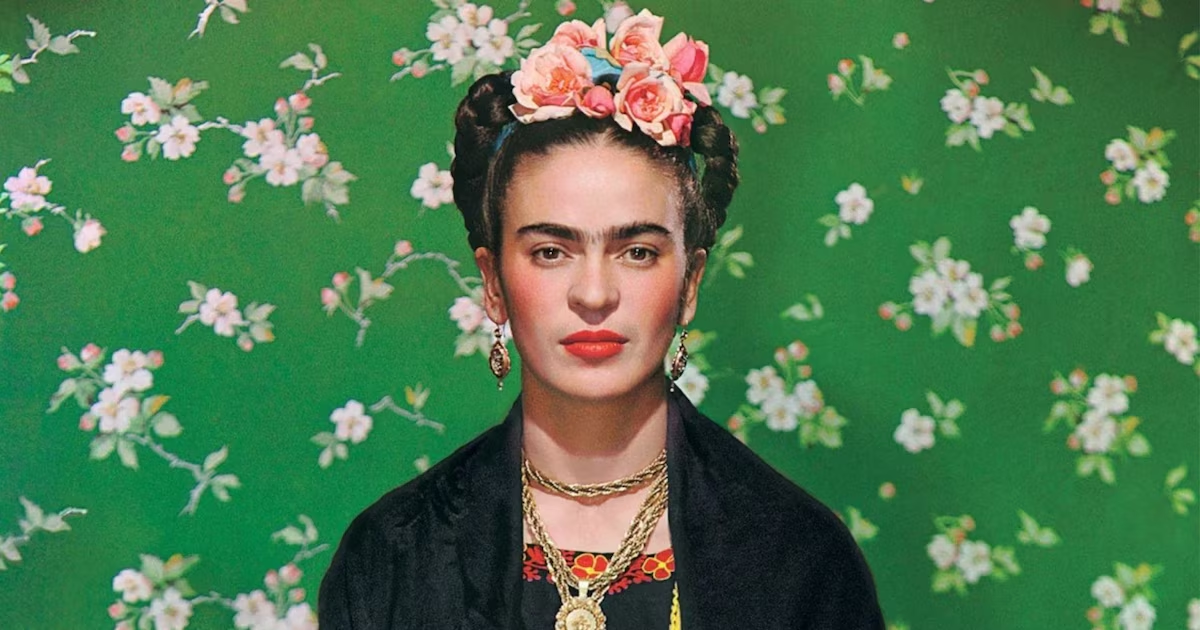
The artistic community of Mexico has directed numerous criticisms at the Government for the recent agreement that will allow the transfer to Spain of one of the most significant collections of Mexican art of the 20th century, which includes pieces of Frida Kahlo and Diego Rivera.
The controversy has intensified after the director of, Santander Lighthouse MuseumDaniel Vega Pérez de Arlucea, stated in The Country that the collection would have a “permanent presence” in the bank’s new cultural center in Madrid, despite the classification of some of these works as “artistic monuments” by the Mexican State.
An open letter signed by about 400 professionals of Mexican culture requests greater clarity from the Government about the duration of the collection’s permanence abroad. The agreement, reached with Banco Santander, covers 160 works belonging until 2023 to the Gelman couple, which, after their purchase by the Zambrano family, have been renamed the “Gelman Santander collection”.
Pieces include works by Kahlo, Rivera, Rufino TamayoJosé Clemente Orozco, María Izquierdo and David Alfaro Siqueirosas well as outstanding examples of contemporary Mexican photography.
An agreement that has generated outrage
Currently, the collection is exhibited in Mexico for the first time in almost twenty years, although the agreement provides for its transfer to Spain in summer, where it will integrate the stable programming of the Museo Faro Santander.
The contract signed between the National Institute of Fine Arts and Literature (Inbal) and Banco Santander, to which he has had access Guardianestablishes that Faro Santander will manage the collection “at any time” between June 2026 and September 30, 2030with the possibility of extending this period by agreement between the parties.
The ambiguity of the agreement and the fear that Kahlo’s works do not return to Mexico have resulted in widespread protest. As stated by the historian Francisco Berzunza to Guardian“she is the most relevant artist in the history of our country and it is easier to contemplate her work outside of Mexico than within the country itself.” The Mexican legislation In 1984, it designated Kahlo’s work as an “artistic monument”, specifying in a presidential decree that it could only leave the national territory temporarily and under the direct responsibility of Inbal, which must ensure its repatriation.
The Mexican Minister of Culture, Claudia Curiel de Icazahas assured that “the collection is Mexican; it has not been sold, it will only leave temporarily,” and indicated that the return is scheduled for 2028. However, the possibility that the custody period in Madrid will be extended until 2030 raises concern. Banco Santander indicates that the agreement “does not imply in any case either the acquisition of the collection or its definitive departure from Mexico,” committing to conservation and dissemination of the pieces until the end of the temporary export period.
What the data does not explain
The 1984 presidential decree was intended to prevent dispersion of works belonging to private collections abroad. As Berzunza points out, “that decree was intended precisely to shield the private collections to ensure that they did not leave the country or fragment, that is why we defend it so strongly.” Currently, Inbal only owns four of Kahlo’s approximately 150 works.
For its part, Gabriela Mosquedacommissioner and one of the signatories of the open letter, states in Guardian that “the legislation in force grants great protection to these works, especially those that have the designation of national artistic monument. They are considered of enormous value for the mexican identity and for the history of our art.”
Despite the reiteration by authorities and the bank that the exit is provisional, Mexican cultural figures emphasize the uncertainty generated by a contract that allows modifying the deadlines and custody of the collection. Professionals in the sector continue to protest against what they consider a opaque agreement and more favorable for the Spanish side.