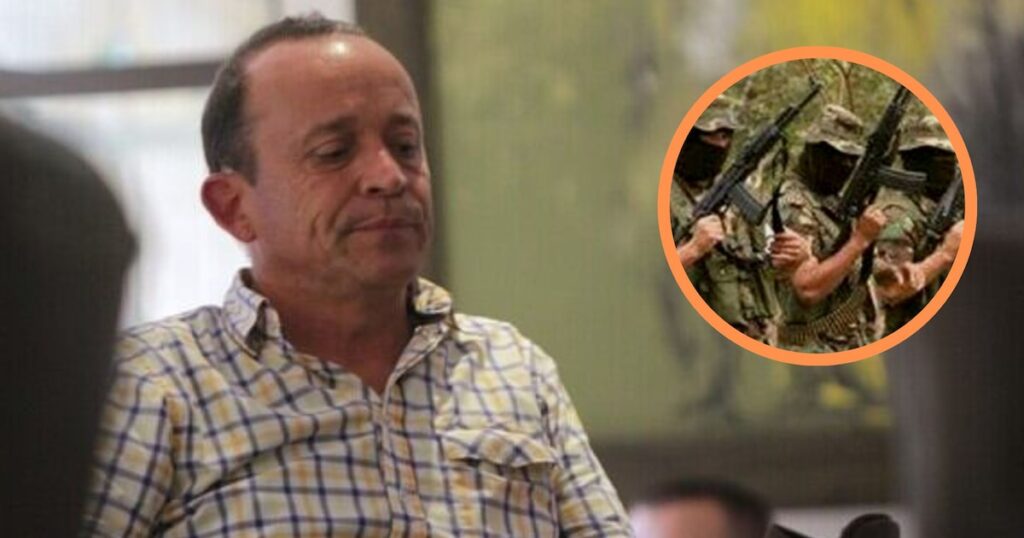
The Superior Court of Antioquia revoked in the second instance the acquittal of Santiago Uribe Vélez, brother of former president Álvaro Uribe Vélez.
The businessman was sentenced to 28 years and 4 months in prison for aggravated homicide, formation of paramilitary groups, conspiracy to commit crimes and accumulation of crimes against humanity.
You can now follow us on Facebook and in our WhatsApp Channel
The magistrates of Criminal Chamber 005 supported the argument of the Prosecutor’s Office, which identifies him as the leader of the illegal organization called ‘The 12 Apostles’, accused of having coordinated a ‘social cleansing’ plan in collaboration with state officials.
The file, revealed by The Timeindicates that ‘The 12 Apostles’ formed alliances with police and military intelligence agents to add names to a blacklist that was later purged.
The investigation also detailed that the paramilitary group received support from civilians, such as Hernán Darío Zapata, alias Pelo de Chonta, identified as one of its hitmen.
The file began with the complaint of Albeiro Martínez in 1995, who linked the creation of the organization to a series of homicides in Yarumal.
The first investigations confirmed the existence of the group and its expansion under the command of Pedro Manuel Benavides and Lieutenant Juan Carlos Meneses in the local Police.
The investigation continued until 1996, when he was formally linked to Santiago Uribe, who was called free.
Three years, according to the file revealed by The Time, The Prosecutor’s Office later closed the case, concluding that the evidence at that time was not sufficiently solid.
However, the case was reactivated in 2010 after new statements by Meneses. Added to this was the testimony of Alexander de Jesús Amaya, bodyguard of the then police chief, who pointed out the rancher as one of the group’s financiers.
Subsequently, the declarant corrected his initial version. The criminal process advanced after Meneses presented recordings between him and Benavides about alleged payments received from Uribe for the commission of crimes.
According to judicial records, the group would have carried out more than 300 selective murders, as well as displacements and disappearances in the region.
Former paramilitary leaders such as Daniel Rendón Herrera, alias Don Mario, and Salvatore Mancuso testified that the brothers Vicente and Carlos Castaño described Uribe as their “natural boss.”
Pablo Hernán Sierra García, under the alias Alberto Guerrero, also presented statements about alleged paramilitary activities at the La Carolina ranch, although he claimed not to have been physically on the property.
The ruling warns that “the first instance and the defense opted for the only recourse of isolating each of the testimonies and attacking their credibility, always separately,” pointing out that, after analyzing the set of evidence and testimonies collected since 1995, Uribe’s responsibility was established.
One of the main witnesses, Juan Carlos Meneses, former police chief in Yarumal, directly linked Uribe Vélez to the organization.
Meneses presented recordings and maintained that the defendant financed the group’s activities. “The network had a room next to the police station to enter there and go unnoticed on the street,” stated Meneses, whose testimony was incorporated by the Prosecutor’s Office since 2010.
José Gilberto Martínez Guzmán, a police officer in the area at that time and a witness presented by Uribe Vélez, offered a statement considered contradictory by the court, attempting to minimize Meneses’ accusation and propose the existence of a conspiracy to discredit the family.
The court determined that the inconsistencies observed in that and other accounts, as well as the flaws in the first sentence, were insufficient to sustain the acquittal granted in 2024.
“They are in no way related to political conspiracies or of that nature,” concludes the document.
The ruling emphasizes that the accusations against Uribe come from facts documented since the 1990s.
The court rejected arguments about possible political motivations, indicated in the defense, and assured that “this circumstance rules out any type of plot hatched by the witness against the accused or his family circle, with a view to discrediting his conduct or that of his brother for his political responsibilities”.
The ruling, which condemns the accused for the crimes of conspiracy to commit aggravated crimes, formation of paramilitary groups and aggravated homicide in the case of driver Camilo Barrientos, indicates that the illegitimate group came to operate with the consent of civilians, businessmen, uniformed officers and a priest.
“The 12 Apostles took their name from the dozen men—ranchers, businessmen, police officers and a priest— which began operating in 1992 in Yarumal, in the north of the department of Antioquia, under the name Autodefensas del Norte Lechero”is indicated in the resolution.