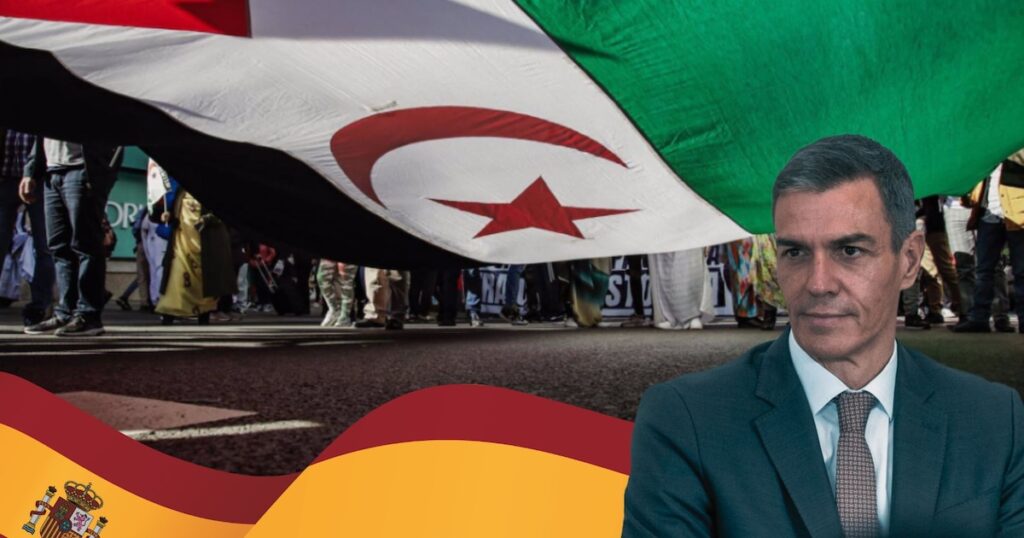
This Friday they are fulfilled 50 years from the moment in which Spain signed the agreement that triggered the Moroccan control of the territories Sahrawis. Until 1975, Western Sahara was province number 53, a territory under Spanish autonomy but with the right, according to the UN and under the recognition of the Spanish State, of self-determination. However, what the King of Morocco, Mohamed VI, began with the Green March, concluded with an exchange of Spanish troops and administrations for Moroccan ones.
The Sahara ceased to have its spanish identitybut he did not do it by his own decision. First, with ‘Operation Swallow’, Spanish citizens quickly and progressively returned to the Iberian Peninsula and the Canary Islands. The loss of daily contact with Spaniards was followed by the loss of nationality of many of the natives of Western Sahara.
A decree published in 1976 allowed the Sahrawis to apply for nationalitybut with a very complicated deadline and a series of bureaucratic procedures that left many of them without margin. Still in 2025 there are people who were born in the territory when it was Spanish autonomy and who have not managed to obtain the certification to be Spanish.
Spain signed the Madrid Agreements with Morocco and Mauritania on November 14, 1975 and a week later he died Francisco Franco. It is evident that, at that moment, the future of the North African enclave was completely displaced by the death of the dictator and the coming to power of his replacement.
In this way, the following year, the Spanish in the Sahara had practically disappeared. With this context, the question arose as to what was happening with the natives that they had been born on soil under Spanish rule at that time, but that was no longer so. A young system that was trying to design a democracy promoted a decree to regulate their situationbut, in many cases, they ended up complicating it.
In February 1976, the Government recognized the right to opt for Spanish nationality for the natives of the Sahara after official decolonization, through the Royal Decree 2258/1976. Those interested had to request it before the Civil Registry or the Consulate, presenting the corresponding documentation. They had a maximum period of one year to do it or, otherwise, they would lose this possibility.
However, it became a impossible procedure for many of them. Spain had withdrawn from the Sahara and with it all its institutions. To make their documents available to the administration, they had to travel to the peninsula, something unfeasible for the majority of Sahrawis, both for economic reasons and for the new control established by Morocco.
In this way, in the last 50 years there have been many public complaints from associations and individual natives that require nationality. Until this year, no clear progress had been made. They could only hold on to the usual processes from any person from abroad. They did not even have the status of “nature letter” that reduces the times for specific cases, such as that of descendants of Sephardim, or the facilities given to people from countries with a common past, such as those born in Equatorial Guinea.
Last March, Add presented a bill to give the Spanish nationality to the Sahrawis born before 1976. The idea, promoted by the representative of Sahrawi origin Tesh Sidi, sought to facilitate obtaining it, granting the status that Jews with roots in the peninsula have and reducing the terms from 10 to two years for those born under the autonomy of Spain, and five for their children.
The Congress of Deputies approved the proposal with votes in favor of all parties, except the PSOEthat rejection for its closeness to Moroccan autonomy since the change of position in 2022, and Vox, which abstained. Since then, the position has remained stuck in legal definition. A little over a week ago, Sumar, in the words of Tesh Sidi, accused the PSOE of blocking the law.
In this way, the native Sahrawis and their descendants continue fighting for a nationality that would facilitate your stay in Spain. With territories lost to the arrival of Morocco and with the Tindouf camps, in Algeria, as an alternative, being able to be Spanish citizens would give them a path that, although it is not what many of them want – since they want to fight for their independence – would open a door to a simpler life.