Yesterday the first lap presidential in Brazil, a country that reaches the change of government period with more people working and lower inflation than in previous years, but also with a public debt equivalent to 82.9% of GDP and an interest rate of 13.75%. Whoever assumes the Presidency will have to find how to sustain growth, relieve pressure on households and organize public accounts whose deficit is close to 10% of the economy.
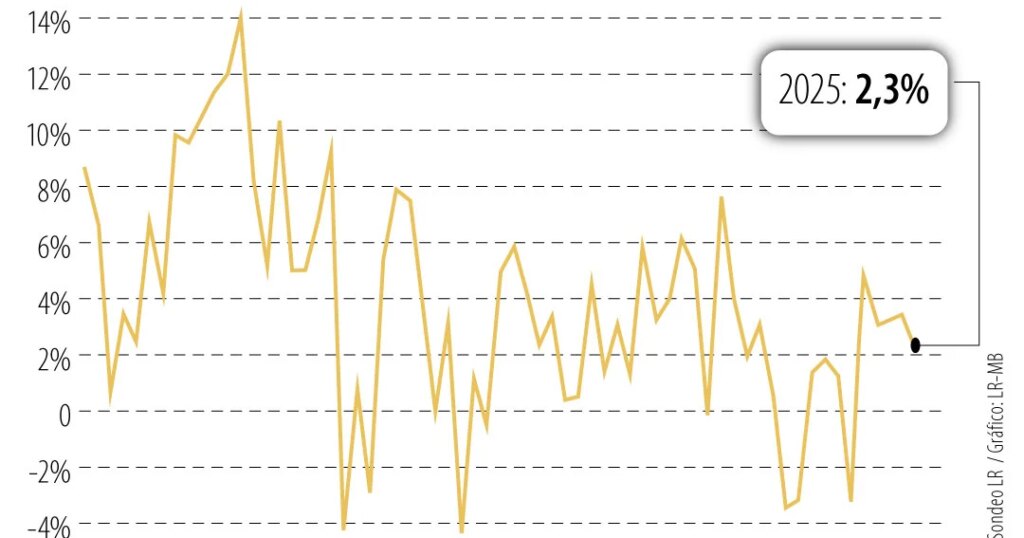
The largest economy in Latin America presents a panorama of progress and challenges. GDP grew 2.3% in 2025, annual inflation was 4.22% in August 2026 and the unemployment rate was 5.3% in the last report published in September. However, the cost of credit and the increase in State obligations limit the space to promote new investments.
These figures are the starting point to understand the economy that the next government will find. Although they can still change before the start of the new term, they show that the challenge will be to maintain progress in employment and income while seeking to curb debt. Public debt is one of the greatest pressures. At the end of 2022 it represented 73.5% of GDP and in August of this year it reached 82.9%, an increase of 9.4 percentage points. To measure it, the balance of the debt is equivalent to almost 83 of every 100 reais that the Brazilian economy produces in a year.
The problem also lies in the difference between what the public sector receives and what it spends. The fiscal deficit, including interest payments, reached 9.48% of GDP in the 12 months to August, compared to 4.68% at the end of 2022. This means that the imbalance more than doubled during that period. Interest explains a good part of that bill. The economic context compiled for this note places its weight around 9% of GDP, while the deficit before paying them, known as the primary result, is around 0.6%. Thus, even an effort to balance current income and expenses faces the cost of meeting accumulated obligations.
For the next leaderthis involves decisions about spending, collection and budget priorities. Allocating more resources to interest payments reduces the margin to finance infrastructure, education, health and other programs without resorting to new obligations. Furthermore, modifying the budget is not easy. A significant part of spending is committed by regulations and obligations, and several payments are linked directly or indirectly to the minimum wage.
Therefore, any substantive change will require agreements with Congress and will have effects on pensions, social aid and other household income. The draft budget for 2027 proposes a primary surplus of 0.5% of GDP. In simple terms, the goal is for income to exceed expenses before interest is paid. Achieving it would be a step to improve accounts, although it would not in itself eliminate debt pressure.
The other figure that goes through economic decisions is the Selic, the reference rate of the Central Bank of Brazil.
In September it stood at 13.75%, after having reached 15% in June 2025. The accumulated reduction from that level is 1.25 percentage points, but financing remains expensive.
During the current presidential term, the rate fell to 10.5% in May 2024 and then rose again.
Inflation, meanwhile, offers a sign of relief. The annual variation in prices went from 5.13% in August 2025 to 4.22% in August 2026, a decrease of 0.91 percentage points.
It was also below the 4.44% recorded in July of this year. The distance compared to 2022 is even greater. In April of that year, inflation reached 12.13%. However, the fact that the indicator has fallen does not mean that the products have returned to their previous prices: it means that, overall, they are becoming more expensive at a slower rate. Furthermore, although 4.22% is within the upper tolerance limit of 4.5%, it still exceeds the central goal of 3%. This distance is relevant for the decisions of the central bankwhich must evaluate how much it can reduce interest without generating new pressures on prices.
Employment is one of the main supports of the economy. The unemployment rate of 5.3%, corresponding to the period ending in August and published on September 29, contrasts with an average close to 9% in 2022. The number of employed people reached a record of 103.5 million. The real average income of workers also increased, which the report places at 3,777 reais (US$722.4). Having more people employed and higher incomes helps sustain household purchases, even when credit is expensive.
But the quality of employment continues to be a challenge. Informality affects 37% of workers. For this reason, the next government must seek to ensure that advances in employment also translate into greater stability and labor protection. In growth, Brazil maintains an expansion, although at a slower speed. GDP increased 3.2% in 2023 and 3.4% in 2024, before moderating to 2.3% in 2025. The loss of pace was 1.1 percentage points between those last two years.
One of the challenges will be to extend this impulse to more sectors. Agriculture and the extractive industry have accumulated expansions of between 25% and 30% since the end of 2022, while manufacturing has remained practically stable. Investment, for its part, is around 17% of GDP. The coin is another piece of this x-ray. In the purchase quote provided for October 2, before the first round, US$1 was equivalent to 5.2192 reais. At the end of 2025, the same series registered 5.4935 reais per dollar, so fewer reais were needed to buy the US currency.
Income tax exemption and adjustments to working hours
Fiscal decisions must coexist with social and tax commitments. Among the measures is the exemption from income tax for incomes of up to 5,000 reais per month, with a reach of around 15 million taxpayers, along with a minimum taxation of 10% for around 140,000 taxpayers with higher incomes. The discussion on the six-day work day and one day of rest will also continue on the table. Any modification must consider its effects on workers and business costs.