Political tension within the national government continues to grow after the results of the first presidential round on May 31, which left Abelardo de la Espriella and Iván Cepeda as the two candidates who will compete for the Presidency of the Republic in the second round scheduled for next June 21.
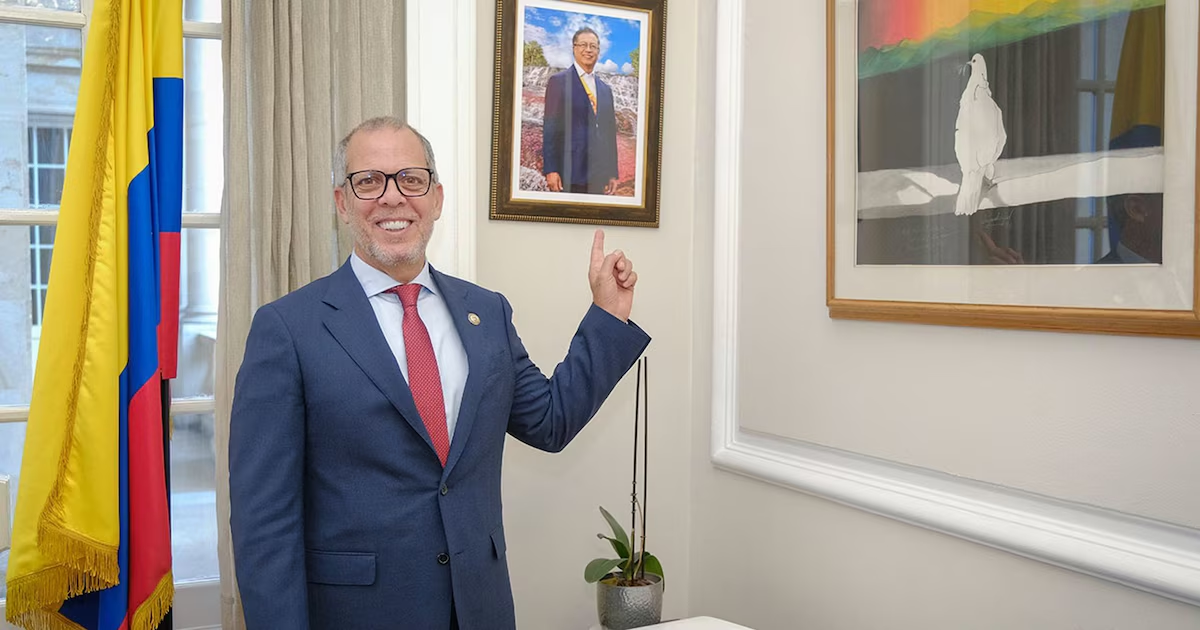
In the midst of this panorama, an unexpected public request arose addressed to President Gustavo Petro by the Colombian ambassador to Brazil, Alfredo Saade, who suggested that the president should resign from his position to dedicate himself fully to supporting the campaign of the Historic Pact candidate, according to information released by Week Magazine.
Saade’s statement became the first public request made by an official of the current Government for Petro to leave the Presidency early with the purpose of becoming directly involved in the electoral contest.
Through his personal account on the social network X, the ambassador expressed a message that quickly generated reactions in different political sectors.
“President @petrogustavo, victory or death. The country needs you free of ties; resign from office and show how 15 million votes are put in the polls. Get up, Colombia,” wrote the diplomat, quoted by Week Magazine.
The publication appeared a few hours after knowing the result of the official pre-count of the National Registry, which placed Abelardo de la Espriella in first place with 10,361,499 votes and Iván Cepeda in second position with 9,688,361 votes, forcing a new election day to define the next president of the country.
Saade’s statements also coincided with a series of messages published by President Petro on his social networks, in which he hinted that he will assume a more active role during the weeks prior to the second round.
One of the statements that attracted the most attention was the one in which he stated that it was necessary to “fight the battle for life and the libertarian history of Colombia” and assured that he had no intention of abandoning the political dispute.
“No one gives up here, we are going to win here and I myself will take the lead,” said the head of state, according to publications compiled by Week Magazine.
Another part of the presidential message that generated debate was when he assured that he would make his own decisions and maintained that three million additional votes are required to achieve victory in the second round.
Petro recalled that in his own electoral experience he had managed to reverse a similar difference and stated that the current scenario is not impossible for the political project that the Historical Pact represents.
For his part, Alfredo Saade continued making publications related to the electoral situation. One of them was addressed to former presidential candidate Sergio Fajardo, to whom he sent a message highlighting the role he could play during this new stage of the campaign.
“Fajardo has in his hands a historic moment for Colombia that will surely make him president of Colombia in the near future. Welcome,” the ambassador wrote.
The official also referred to the internal differences that have arisen within the ruling party and questioned decisions related to political figures close to President Petro. According to him, removing leaders such as Roy Barreras and Armando Benedetti from certain spaces would have been a strategic error for the progressive movement.
Saade maintained that personal disagreements should not prevent the participation of actors with political experience in a stage that he considers decisive for the electoral future of the ruling party. Likewise, he asked to strengthen the political strategy and increase the mobilization capacity for the second round.
The ambassador’s statements reflect the concern that exists within some sectors of the Government about the result of the first round and the need to consolidate alliances that will allow Iván Cepeda’s electoral base to expand in the coming weeks.
Meanwhile, the discussion about the role that President Gustavo Petro should play during the campaign continues to generate controversy in different political sectors, especially due to criticism from those who believe that the president should maintain institutional distance from the electoral process.
The second presidential round on June 21 will be responsible for defining whether the ruling party manages to remain in power or if the country opts for a change of political course.