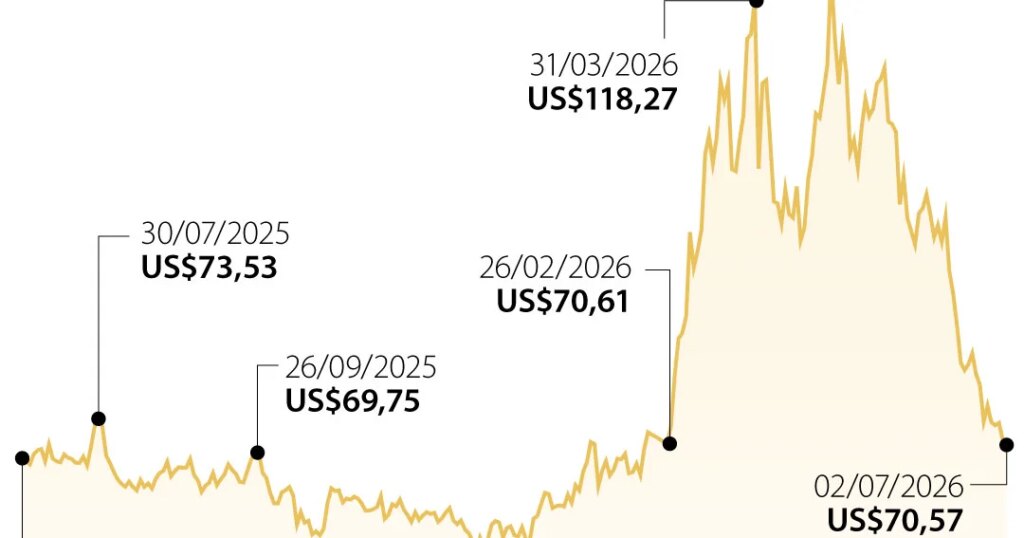
Oil prices have continued their slide to pre-war levels as flows through the Strait of Hormuz increase and traders grapple with signs of oversupply.
Brent futures fell below $71 a barrel, hitting their lowest level since the week before the war with Iran began in late February. West Texas Intermediate (WTI) fell from US$68. Last month, the United Arab Emirates restored its oil exports to pre-war levels, surpassing 3.9 million barrels a day, while a US official estimates that oil supplies through the Strait of Hormuz have now reached more than 10 million barrels a day.
The result has been a flood of oil onto the market at a time when many of the wartime stopgaps remain in place, including the release of emergency reserves. Saudi Arabia has taken the unusual step of selling millions of barrels on a one-time basis to customers in Asia, while resuming shipments of crude oil from inside the Persian Gulf.
Brent contracts are trading with a bearish price structure indicating near-term oversupply, with discounts on the nearest deliveries, and physical premiums have plummeted in recent days.
Brent futures continued their slide after the worst quarter since the pandemic in 2020, falling more than 40% from the peak reached during the height of the war, allaying fears of an oil-fueled inflationary surge. Flows through the Strait of Hormuz — which connects Persian Gulf producers to global buyers — continued despite weekend tensions.
“The market is currently flooded with crude oil,” said Arne Lohmann Rasmussen, chief analyst at A/S Global Risk Management. “Large volumes of oil are putting pressure on the futures market.”
Qatar announced that the next meeting of indirect talks between the United States and Iran will be scheduled as soon as possible after the funeral of former Iranian supreme leader Ali Khamenei, who was killed in an airstrike at the start of the conflict. According to Iranian state media, the ceremonies are expected to begin on July 4 and last for several days.
Ahead of talks with Qatar, Iran reiterated its determination to control maritime traffic through the Strait of Hormuz, emphasizing sticking points such as the Islamic republic’s nuclear program and the conflict in Lebanon. President Donald Trump reiterated to reporters in Virginia on Wednesday that Iran cannot have nuclear weapons.
Total US reserves have fallen to the lowest levels since March 2025, with inventories, excluding strategic reserves, around 1.2 billion barrels, after 12 consecutive weeks of declines.