March 13, 1990, two days before his death, was the last time I saw him. José Antonio Bottiroli. He extended his cold hand and, reaching for mine, held it without strength. I was then a young man in my first years at the Music School of the University of Rosario. To this day, I try to interpret what the noble master was trying to tell me with that last gesture. Without a doubt there was gratitude, a very noticeable feeling in his personality; but perhaps he also sought to transmit to me in this posthumous act his wisdom, that of a man whom I remember sensitive and generous towards the most needy, cultured, elegant, loved and worthy.
On the new year of 1920, his mother, Rosa Elena Bertoragave birth to him in Rosario. He grew up in a happy family that came—like most Rosario residents—from Italy. Rosa was the daughter of Genoese, while her father, Carlos Hermenegildo Antonio Bottiroliof Lombards of Pavia. Bottiroli Over the years he would become an outstanding composer and conductor of classical music, poet and teacher.
He never mentioned a curious fact that others would see as an aristocratic lineage that was unavoidable to mention. His paternal grandmother, Maria Ottone Rattiwas the cousin of one of the most important personalities of modern Italy: Pope Pius XI, creator of the Vatican City State. I wasn’t surprised he didn’t tell me.. Bottiroli It was not confused with the mirage of a surname or with the moral emptiness of those who believe they belong to a social or religious circle; He knew that life levels everything.
To think that for twenty years he attended the Rosario prison every Saturday—ad honorem—to give music to his beloved prisoners, makes any lineage pale in the face of such an act of humanity. I don’t know how he got there or what musical theory he taught them, but I’m sure he was looking to give them the emotional support they so desperately needed. At the same time, he was the director of the prestigious Normal School of Teachers Number 3 of Rosario, always maintaining that duality between high academia and social dedication.
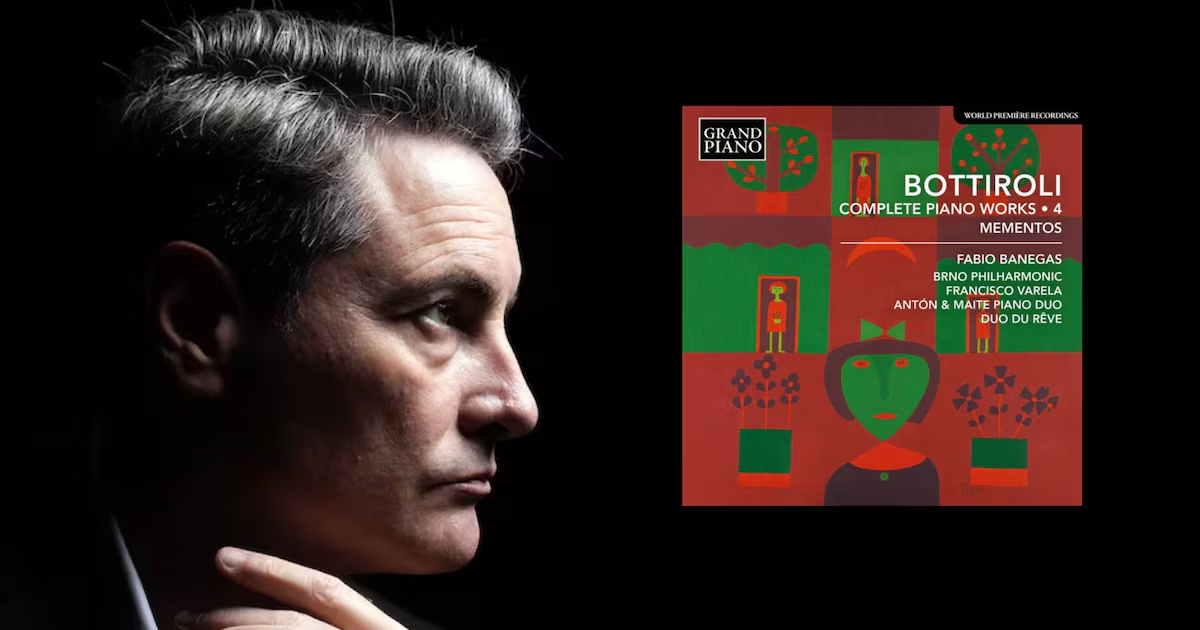
Exactly 40 years after that last meeting, this March 13 the seal Naxos – Grand Piano He internationally released the fourth and final volume of his complete works for piano under my interpretation. With this, a work of enhancement is not simply closed, but it is opened to the world. a musical museum that rescues one of the many Argentine musical legacies that remain mute in the fragility of forgotten manuscripts. In four volumes—with a duration of four hours and forty minutes—this record cycle shows the work of a notable Argentine composer that will last forever under the auspices of one of the most important labels in the world.
In 2018, the musicologist Diego Orellana He presented the director of Naxos in Germany with three tracks that I had just recorded. This was the germinal act by which I found myself signing the contract with the record company with the promise of recording the complete piano works of our teacher. It was a moment of great happiness for the validation that this represented for his work and for positioning the unpublished music of an Argentine composer at this international level. Given the opportunity, fascinating museological curatorial work followed.
The first volume, WaltzesI dedicated it to the works inspired by this dance that emerges throughout the work of Bottiroli. Following the tradition of Chopinthe waltz was the support where he explored his own harmonic language imbued with a nobility that avoids the superficial. I introduced here another characteristic concept of his work, that of musical etopeias: the musical portrait of the psychology and soul of the person invoked. In “Invisible Bird ‘Crespín’”, he extends this concept into a true ornithological study inspired by the shy and elusive life of the naevia taperawhose whistle in two melancholic notes sounds like its name: Crespín.
Bottiroli He had a great fascination with the night and the immensity of the universe. The second volume, Nocturnalbegins with “Vesperal,” a sunset prayer that ushers the listener into nocturnal reverie. Unlike the standard romantic concept, his nocturnes evoke his perception of the cosmos. Micropena ‘Andromeda’” is the synthesis of his inspiration before the night, in which he describes the slow and silent passage of this galactic giant, capturing the mystery of the universe.
The third disc brings together all the works with elegiac content. In elegiesI selected the pieces in which Bottiroli He opens his soul to the memory of those who are no longer here, with works that go beyond lament to become reflections on the transcendence of the soul. In these, the silence of the game is transformed into an eternal memory through the resonances of the piano, making pain become a structure of consolation and nobility.
On the fourth disc, MementosI sought to impact the listener with a chronological snapshot that consolidates the author’s artistic thinking. The program begins with his first existing work: “Symphonic Impressions for Piano and Orchestra,” from 1955, recorded with the Brno Philharmonic under the direction of an Argentine director Francisco Varela. The label suggested adding the complete work for two pianos and chamber music. This unusual and valuable repertoire was left to the distinguished Duo Antón and Maite from Spain, while “Melodía Memento” was performed by the Duo Du Rêve from the Czech Republic, with Jana Jarkovská on flute and Bohumír Stehlík on piano.
The collaboration of these exceptional musicians taught me another lesson: music is an art of coexistence. In an environment where egos often rule, finding colleagues who act as bridges is one of the greatest treasures of the profession; a musical fraternity that puts its talent at the service of rescuing the forgotten.
Academic music is an intangible cultural heritage that represents the deepest thought of a society and a nation. Unlike the plastic arts or literature, its impalpable nature condemns it to being easily postponed in the face of a world that celebrates the opening of museums and retrospectives of fine arts. That is why the presentation and preservation of the complete piano works of José Antonio Bottiroli It constitutes, for me, a gift to the Argentines; a legacy that today, finally, proudly belongs to everyone.