Acquire one dwelling Abroad is no longer just an investment decision or a luxury, but has become a global mobility strategy. While the global tax burden often eats into the margins of real estate investors, there are currently nations without annual property taxes; according Immigrant Investamong them are countries such as Malta, Vanuatu and the United Arab Emirates.
“A country is attractive to invest in housing when it combines a low tax burden, legal certainty and ease of compliance. It is not enough to just look at whether or not there is a property tax,” he said. Andrés Felipe Velasqueztax lawyer.
Countries with zero taxes
In Malta, for example, the annual tax does not apply, but buyers pay a 5% stamp tax, which in Colombia would correspond to a national documentary tax on contracts and documents.
In the archipelago, buying a property valued at US$428,866 and under the Malta Permanent Residence Program allows you to obtain a residence, also known as the Malta Golden Visa.
On the other hand, in the United Arab Emirates, no taxes are imposed on the purchase and a two-year residency can be purchased with the Golden Visa from US$205,000 for investors. Vanuatu, a country in Oceania, does not impose a tax, but does require buyers to pay a 5% stamp duty.
The low tax region
Latin America stands out for being a region that offers real estate tax regimes without annual property taxes or a low tax burden in this area.
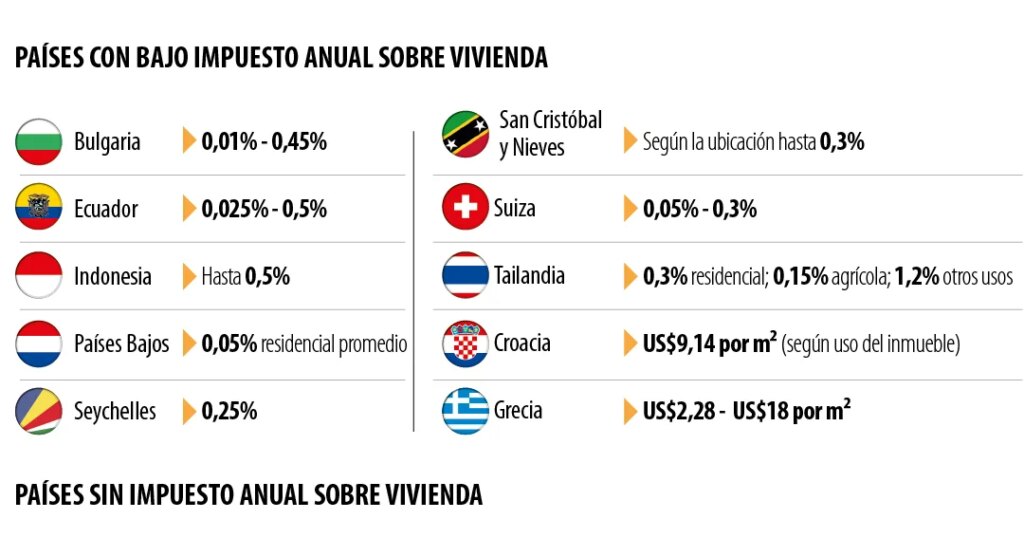
One of the nations that stands out in the region is Ecuador, since it imposes an annual property tax of between 0.025% and 0.5% of its commercial value; In addition, requiring payment of a tax of 10% of the value of the property at the time of purchase.
Of course, rental income has a tax rate of 25% and with respect to profits, which are part of personal income, they have a tax of between 0% and 37%, depending on the seller’s income.
Dominica is another notable country in the region that generally does not impose property taxes. However, it has a 1.25% tax in areas of Rosseau and Canfield. Regarding the tax on the purchase of a property, this is close to 6% and with a stamp tax of 2.5%.
In Saint Kitts and Nevis, the tax depends exclusively on the type of property; For example, for agricultural and institutional it is 0%, for commercial 0.3% and for residential and tourist housing, 0.2%.
The Cayman Islands also does not require an annual property tax, but a 7.5% stamp duty must be paid when purchasing property; Likewise, if a property is rented to a tourist, a 13% tax must be imposed.
For the Turks and Caicos Islands there is no tax annual on properties; It also does not affect rental income or capital gains income, although an 8% stamp duty does apply when transferring money when purchasing.
Colombia a country of destination
“Colombia can be an attractive destination for investment in housing by foreigners, even if it does not have an efficient tax burden. The reason is that the real estate decision does not depend only on taxes, but on sales prices, valuation, rents, urban demand and development potential.” mentioned Velasquez.
In the country, the stamp tax on the sale of properties exceeding 20,000 UVT can be between 1.5% and 3%, and the profit rate on sale is 15%.
For Colombians interested in buying a home outside the country, the United Arab Emirates, due to its contract value rate of 4% in Dubai, may be an option; Panama, due to its dollarization; and the United States, which “has been a very attractive destination for investment in housing, considering that the dollar is the most attractive currency in the world,” he stated. Darío Celedónlawyer of Velázquez Osorio lawyers.