Liviu Librescu leaned the entire weight of his body against the wooden door leading to room 204 of the Norris Hall building at Virginia Tech University. Those doors had no key or lock. They were the few kilos of his 76-year-old body, skinny and small, standing between the murderous fury of a deranged man armed to the teeth and his beloved students.
-Escape now!!… Jump, jump out of the windows quickly! Jump now! he harangued desperately as that chain of strange sounds approached.
The boys opened the windows, kicked off the metal mosquito nets and began to jump from the openings on the second floor. There was no time for many doubts, It seemed safer to jump into the void than to face the hail of bullets that seemed to be washing over the building.
They were at Virginia Polytechnic Institute and State University (better known as Virginia Tech), in the United States. The clock read a little after nine on this cold and gray Monday, April 16, 2007.
The morning would be etched in everyone’s memory: It was the deadliest educational shooting in US history.. Today marks 19 years since this tragedy.
The boy who survived the genocide
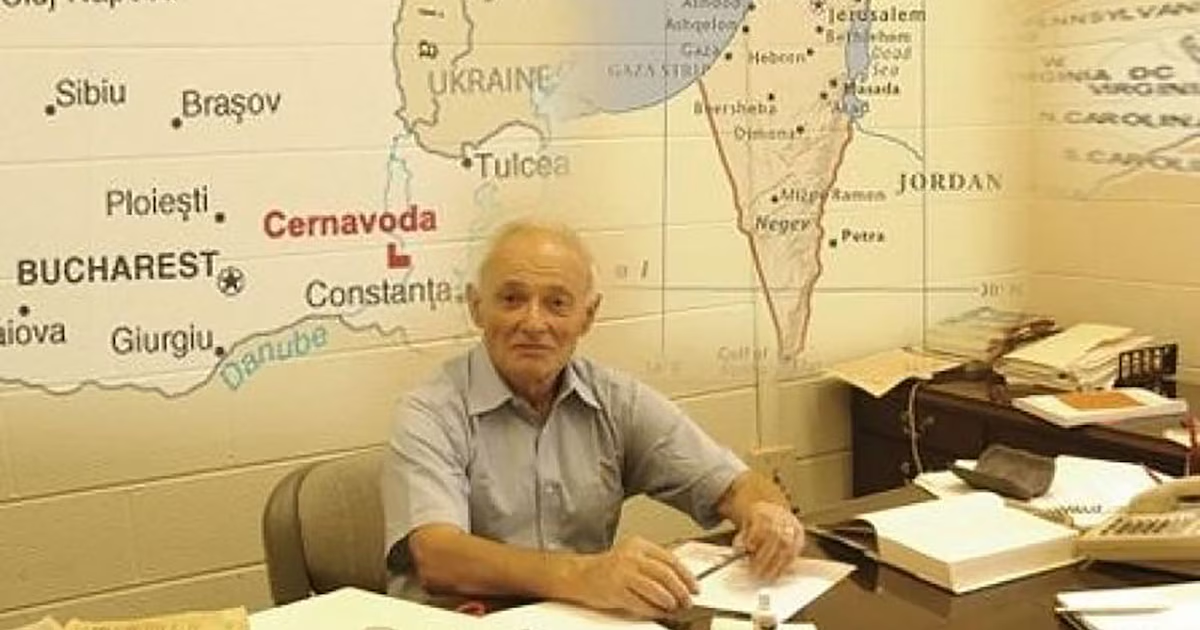
Liviu Librescu (note the symbolic last name of the professor who stars in this story) was born in Romania, on August 18, 1930, into a middle-class professional Jewish family. His father, Isidor Librescu, was a lawyer.
In 1940, when Liviu was about 10 years old, King Carol II appointed the military man Ion Antonescu as Prime Minister of Romania. He was under pressure to contain the political chaos that was plaguing the country, but it went badly because soon after Antonescu demanded that he abdicate and then proclaimed himself the “leader” of the country. What this soldier did next was seal an alliance with Hitler’s Germany and put his anti-Semitic policies into practice. This marked the beginning of a fatal wave of persecution of the Jewish inhabitants. Among them, the family of Liviu Librescu. Isidor was sent to a forced labor camp; the rest of the family, confined to a ghetto in the city of Focșani.
The Soviet occupation in 1944 and the removal of Antonescu through a coup d’état endorsed by King Michael I (son of Carol II) caused Romania to enter a period of transition that ended with the abolition of the monarchy. Antonescu was shot in 1946 and, in December 1947, the communists, backed by the Soviets, demanded the resignation of Michael I. From there a dictatorial communist regime was installed.
The Nazi horror had ended, but a new form of ideological and religious repression had begun.
In that hostile climate without freedoms, Liviu grew and matured. He found a good refuge in his aeronautical engineering studies. He soon began to stand out in the Romanian aerospace agency.
In 1965 he met Marlena, another Holocaust survivor, whom he married and they learned to cope with the dictatorship. That same year the bloody dictator Nicolae Ceaușescu came to power.
The system established was inflexible and required scientists to swear loyalty to the Communist Party and the regime. Liviu refused, he was not planning to do it. That situation led him to being professionally marginalized, he had no chance of publishing his studies. But Liviu was not afraid, so he decided to send his papers to universities abroad clandestinely. Recognition for his work grew despite the Romanian authorities who refused to let him grow or emigrate and even fired him from his job because they considered him a traitor.
It was thanks to pressure from Israeli Prime Minister Menachem Begin that, in 1978, Liviu was authorized to travel to settle in Israel with his wife Marlena and their two children, Joseph and Arieh.
There he began another stage of his existence and began teaching aeronautical and mechanical engineering classes at Tel Aviv University.
In 1985 he was asked to work for a year in the United States as a visiting professor, in the Department of Mechanical Sciences and Engineering at Virginia Tech University. He traveled with his family and felt from instant “like at home”. He was appointed professor and what had been for twelve months ended up being the rest of his life.
Liviu lived in the United States until his death and, according to the directors of the institution where he worked, Liviu became not only a scientific reference, but also a moral reference.
Fate writes the story
Liviu had not only graduated as an aeronautical engineer from the Polytechnic University of Bucharest (the city where he had also completed a master’s degree at the Romanian Academy of Sciences and studied Fluid Mechanics); He was also a pedagogue, aviation professor and mathematician. His specialties were Aeroelasticity and Aerodynamics.
His wife lived with him for 42 years and survived him for six. When the tragedy occurred he told the media ABCNews: “He had inner strength, he was a strong man. There was fire in him, he wasn’t very tall, but he was tough, very tough.”
His department head, Ishwar Puri, commented on the fact of the phenomenal strength that Liviu Librescu demonstrated holding that door: He was a man who always stood “upright as a rod”, he seemed to have a “backbone of steel”..
That cold Monday morning, Liviu Librescu was teaching Solid Mechanics in room 204, located on the second floor of the Norris Hall building at Virginia Tech University in Blacksburg. When the shooting began, students were looking at slides. First they heard strange noises, like the tapping of a powerful hammer. Then they heard some screams. Liviu stopped and said loudly, “That’s not what I think it is, is it?” One of his students shouted, “Yes, those are gunshots!”
Pop, pop, pop, pop, pop… the atmosphere continued playing. They did not yet know that they were listening to the deaths in classroom 206 (the attacker had already killed the teacher and nine of the thirteen students). In seconds Liviu realized the seriousness of the situation they were in: the classroom ahead could be hers.
He was lucky to have a few more seconds because the killer crossed first to 207 where he shot down the German teacher and four other students.
In that short time Liviu achieved the impossible. Since the classroom door had no lock, he supported his skeleton and held it like a stake to block it.. He then told his students to go to the windows and jump. It was not an easy task, they were on the second floor and the young people, bewildered by the situation, evaluated this fall with fear.
The pop, pop, pop, continued in the background and getting closer. Liviu insisted that they had to do it now, that they jump now. Underneath there was grass and not cement. That encouraged Caroline Merrey (20) when she looked out. First he threw away his backpack and his jacket; Then he climbed up and let himself down, holding the window frame with his hands. He closed his eyes and said to himself: “Here we go.” He let go. He fell next to a friend who broke his ankle and was screaming in pain. They kept jumping, one after the other. Even some at the same time. Richard Mallalieu (23), thought he had to roll when he fell, like he saw him do in the movies. It worked. Alec Calhoun, one of the last to jump, was hesitant because he noticed that several of his companions had hurt themselves. He heard them complaining. He spotted a bush and decided he would jump trying to fall on top of that bush. He managed it without scratches. Today he says without commas or periods: “I wouldn’t be here if it weren’t for him, for Librescu”. Before jumping, Josh Wargo looked back and saw the classroom that his teacher was leaving, still holding the door to hell.
There were only four people left in the classroom. Three students and Librescu. Minal Panchal, did not want to jump, chose to stay next to the professor. Liviu was shot four times through the wooden door during those minutes, but continued to hold off the shooter. One of the shots pierced the watch on his wrist. When he finally fell to the floor, the killer entered wearing his black vest and with his magazines full of ammunition. He had an impassive look. Seeing the windows open, he angrily pointed at Liviu’s temple. He pulled the trigger. Blood flew everywhere. He continued with Minal, put the gun to her head and pop. He then pointed to the other two students who were near the open windows and had not jumped out. Pop, pop. They fell wounded. One of them, Matt Webster, was perfectly lucid, but he pretended to be dead. He remained motionless on the ground. He closed his eyes and stopped breathing. When he felt that the shooter had left the classroom, he opened his eyes and saw that there was blood everywhere. The bullet had grazed his scalp and, when deflected, had passed through the upper part of his right arm. The other boy was also wounded and alive.
That day, A total of 22 students from 204 had jumped from the windows and all of them survived. Two dead and two injured were left in the classroom.
Seung-Hui Cho, the student killer, took his own life shortly afterward when police entered the building. It had left a trail of 32 dead. Originally from South Korea, Cho had arrived in the United States at the age of eight and, at the time of his murders, was a college English literature student in the final year of his degree. Digging into his past they found behavioral problems, depression and that at the age of 15 he had written an essay identifying himself with the Columbine killers, the massacre perpetrated at that high school in 1999.
Romanian, Israeli and American, Liviu Librescu was one of the five teachers who died that morning. For his bravery he was posthumously awarded the Order of the Star of Romania. He had escaped from Nazi savagery, from oppressive communism, he had avoided death and oppression, but it was in the supposed safety of a classroom that he offered his life to save dozens of young people.
One more fact that is impossible to ignore. That April 16 was Yom HaShoah, International Holocaust Remembrance Day. How curious, but as I write this note, the night of April 13 to 14, it is also Yom HaShoa.
It can’t be a simple coincidence.
Fate sometimes writes its way.