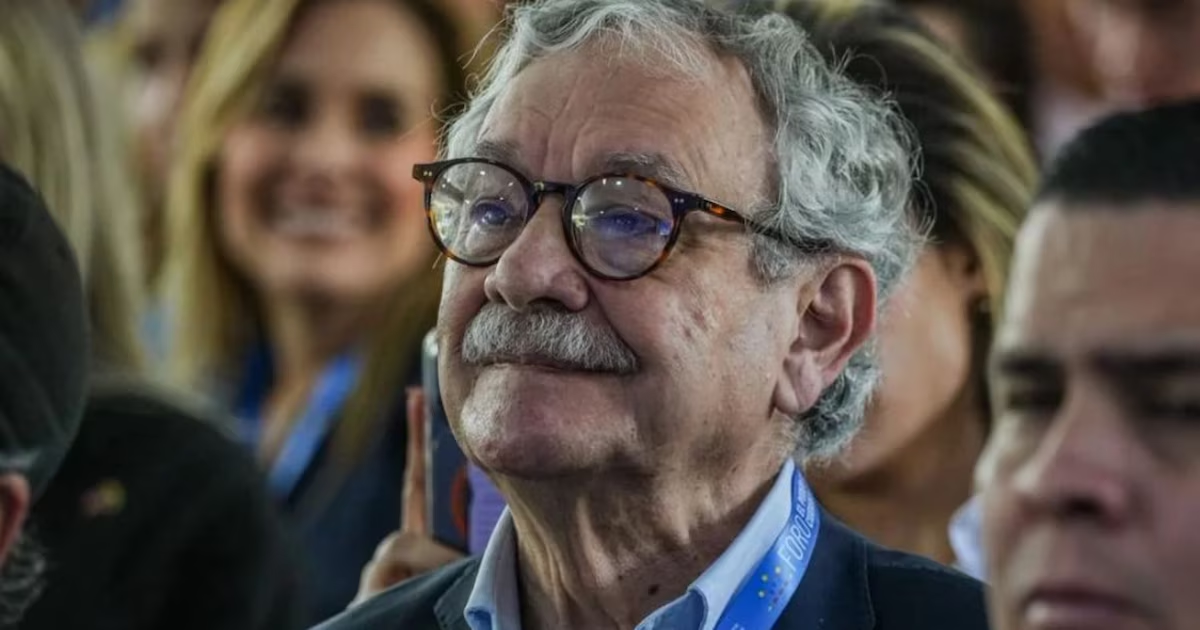
Eduardo Pizarro Leongómez, professor emeritus of the National University and former president of the National Commission for Reparation and Reconciliation (Cnrr), maintained that the Military Forces are weakened and the Total Peace strategy has not had positive results in Colombia. This was stated in an interview with The Timewhere he analyzed the current state of the public force, the causes of the deterioration of security and the impact of recent government decisions.
According to information published by the aforementioned medium, Pizarro agreed with President Gustavo Petro’s statement about the reduction in the operational capacity of the Public Force, but specified that the deterioration deepened during the current administration. According to the academic, the decrease in manpower, the deterioration of air capacity and the lack of resources for helicopters have seriously compromised military performance.
You can now follow us on Facebook and in our WhatsApp Channel
“The Military Forces have been dramatically weakened under this government. Colombia is a country of enormous geographical complexity: bi-oceanic, crossed by three mountain ranges and with very difficult borders. That requires a very high volume of men, weapons and resources,” said Pizarro. The expert stressed that The weakening of air capacity, particularly the reduction of helicopters, directly affects operations in the internal armed conflict. In addition, he warned that today about 60% of military helicopters are on the ground, which further limits the ability to respond to conflict and emergency scenarios.
Pizarro also pointed out the importance of the Kfir aircraft in the country’s military operations. He explained that the replacement of these aircraft should have been accelerated a long time ago, since the Kfir not only fulfilled national defense functions, but they were also key in operations against illegal armed groups. The delay in their replacement has weakened the capacity of the Air Force and, together with the deterioration of the helicopters, has left Colombia at a disadvantage in the face of the growth of the conflict.
The debate on historical responsibility and Total Peace
During a recent Council of Ministers, Petro attributed the deterioration of the public force to the last fifteen years. However, Pizarro pointed out that, although there may have been a previous trend, the situation “deepened radically under this government.”. The academic explained that the Total Peace strategy was based on the belief that groups such as the ELN and the FARC dissidents would accept peace due to political affinity with the new government.
“It was the mistaken belief that these groups were on the verge of peace that led, among other factors, to the weakening of the Military Forces,” Pizarro said in the interview. The researcher highlighted that the conviction of an imminent peace led to dismissing the need to maintain or increase military spending, a decision that he considered a strategic error.
Recent changes to security strategy
The Time documented that, since the middle of last year, the Colombian government implemented changes in its security policy, such as the resumption of bombings and the purchase of airplanes. About this turn, Pizarro considered that, although it represents a relevant change, it arrived late and was insufficientsince illegal armed groups had strengthened their presence on the country’s borders.
The former member of the Board of Directors of the Victims Fund of the International Criminal Court also linked these changes to Colombia’s relationship with the United States: “Given the decertification and financial isolation that comes with its inclusion on the OFAC list, Petro may be looking for bridges of understanding with Washington”, indicated Pizarro.
Failure of Total Peace and crisis in military morale
For Pizarro, Total Peace “has been a total failure, because there is not a single success.” According to El Tiempo, the case of Comuneros del Sur, in Nariño, reflects the deterioration of the negotiations, since new criminal organizations emerged and no concrete progress was achieved. The expert warned that, In addition to the operational deterioration, the morale of the public force is deeply affected by the perception that some promotions are being made for political reasons and not for professional merits.
“When a military force begins to promote its officers out of loyalty to the ruling party and not because of a resume, its professionalism is put at risk. That ended very badly in Venezuela. Hopefully that is not happening in Colombia,” Pizarro emphasized in his statements to El Tiempo. The academic warned about the departure of generals with accumulated experience, replaced by officers without the necessary experience, which could affect institutional functioning.
Scenarios and priorities for the next government
The professor maintained that the next government must rigorously analyze the situation of the public force and territorial control, pointing out that Colombia is at a critical point due to the advance of groups outside the law. Among the factors that could modify the scenario, Pizarro mentioned the possible change of policy in Venezuela, which would affect the rear of organizations such as the ELN, and the eventual end of the Cuban Revolution, which would influence the regional panorama.
Pizarro specified that, If the ELN is expelled from Venezuela, it could mean the beginning of the end for that organization. Regarding Cuba, he indicated that the end of the revolution would have a profound impact on all of Latin America and would force illegal armed groups to rethink their societal project.
In the interview Pizarro stressed the need to strengthen international cooperation, particularly with the United States and the European Union, to confront organized crime and drug trafficking. He explained that Colombia’s geopolitical location, as the only South American country with access to both oceans, makes it especially vulnerable to drug trafficking to North America, Europe and Asia.
The expert insisted that Colombia needs to reorganize the Military Forces, improve control of the territory and weaken the sources of illegal financing of armed groups. “If these three tasks are undertaken decisively, Colombia can begin to correct course,” Pizarro concluded for El Tiempo.