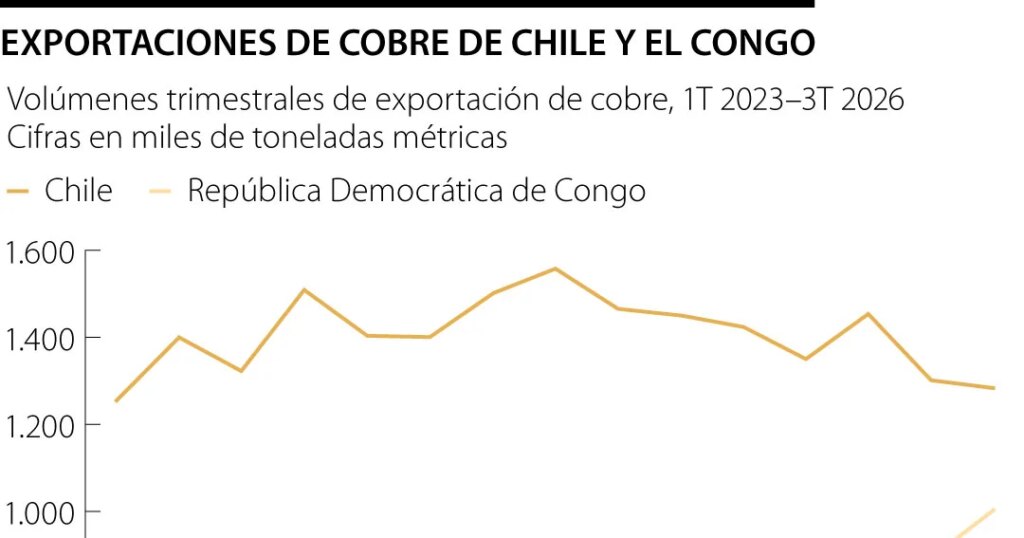
The Democratic Republic of Congo is closing the gap with Chile, the world’s top copper producer, after quarterly exports surpassed one million tonnes for the first time in the three months to September.
A boom fueled by high-quality deposits and a wave of investment has more than tripled production in a decade, transforming the Central African nation into the world’s second-largest supplier of the coveted metal.
Congo’s rise takes on added importance as the world searches for enough copper to meet growing demand from power grids, electric vehicles and hubs. data.
Chile and Peru, which together still account for about a third of global mining production, have struggled to revive growth due to declining ore grades, project delays and other operational and permitting challenges.
This leaves Congo, with its rich reserves and growing capacity, playing an increasingly crucial role in the face of looming shortages.
According to government data, Congo’s copper exports in the third quarter slightly exceeded one million tons, bringing total shipments in the first nine months of 2026 to 2.7 million tons.
This represents an increase of 8% over sales for the same period last year. These figures place Chile, which exported 1.28 million tons last quarter, in the Congo’s sights.
Two large Congolese mines, owned by the Chinese group Cmoc Groupproduced almost 550,000 tons until September, while the operations of Glencore and the Sicomines complex contributed 212,000 tons each. Sicomines is a joint venture between China Railway Group, Power Construction Corp. of China (known as powerchina) and a Congolese state mining company.
Kamoa-Kakula, jointly owned by Canadian companies Ivanhoe Mines and Zijin Mining Groupexported 187,000 tons, while the relatively little-known Brother Mining Sasu exported 112,000 tons. BMS It is a joint venture in which the Chinese company participates Chengtun Mining Group.
Chile’s production is expected to fall below five million tonnes this year, reaching its lowest level since 2003. While this would still represent an increase of approximately 40% over Congo’s production in 2025, the current trend favors the country African.
However, this narrowing gap is likely to be short-lived, as Chile expects supply to gradually recover as mine expansions and new projects come online, putting the country back on track towards six million tonnes annually by the end of the decade.
However, Congo’s growing importance is driving the country’s ambitions to accelerate its recent foray into marketing some of its copper. The state company Gecamineswhich owns minority stakes in several major mines, plans to set up a trading desk in Switzerland, its CEO said Wednesday. Baraka Kabembaat the Makutano conference held in the capital, Kinshasa.
“We cannot be the main copper producer in the world, nor the guardians of the next technological revolution, without having a presence in the raw materials market,” he stated. “From my point of view, that doesn’t make sense.”