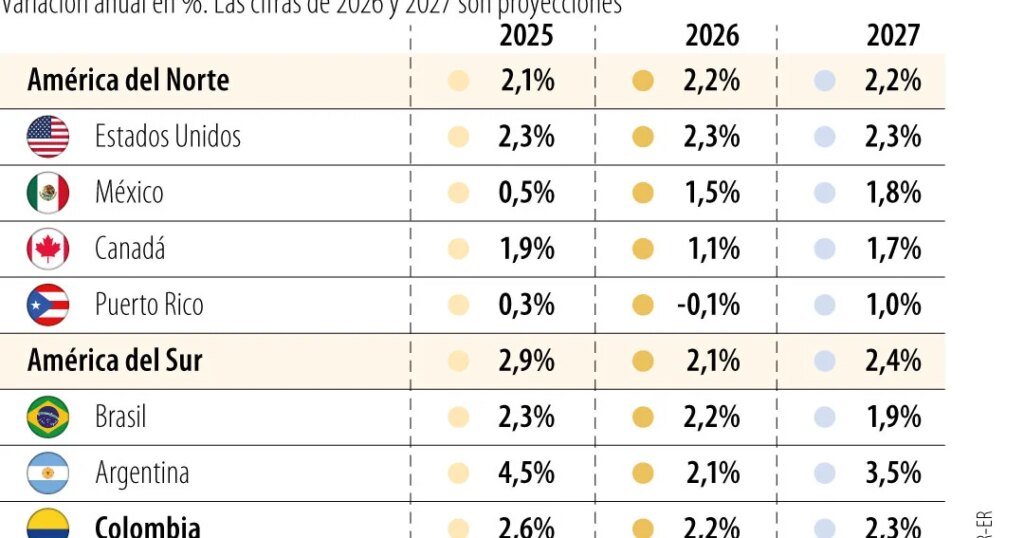
The Colombian economy would grow 2.2% in 2026 and 2.3% in 2027, according to projections from the International Monetary Fund, IMF. The figures show that the country would advance at a rate of less than the 2.6% estimated for 2025 and would remain below the growth forecast for Latin America and the Caribbean during the two years.
In his report of World Economic Outlook October, the organization projects that the region will grow 2.3% this year and 2.5% next year. Thus, Colombia would be 0.1 percentage points below the regional result in 2026 and 0.2 points in 2027. Although the national economy would have a slight acceleration next year, this would not be enough to reach the pace of the region.
The Colombian outlook combines moderate growth with greater pressures on prices and employment. In addition to the forecasts for the gross domestic product, GDP, the IMF It estimates that the country’s average annual inflation will reach 6% in 2026 and that unemployment will be 9%. By 2027, inflation would drop to 5.7%, while the unemployment rate would rise to 10%.
In terms of growth, Colombia will have a result this year similar to that of Brazil, the largest economy in Latin America, for which the Fund also projects an expansion of 2.2%. Both countries would advance more than Argentina, with 2.1%; Mexico, with 1.5%; Uruguay, with 1.3%, and Chile, with 0.6%. Bolivia, for its part, would register a drop of 3%.
However, several countries in the region would grow more than Colombia. The organization’s table foresees an expansion of 5% for Venezuela, 4.5% for Paraguay, 3% for Peru and 2.7% for Ecuador. Paraguayan growth would exceed Colombia’s by 2.3 percentage points, while the difference compared to Peru would be 0.8 points and compared to Ecuador, 0.5 points.
The comparison with neighboring countries also shows that Colombia would not be the only economy that would lose speed compared to 2025. Peru would go from a growth of 3.4% to 3%; Ecuador, from 3.7% to 2.7%, and Paraguay, from 6.6% to 4.5%. Argentina would have a more marked deceleration, going from 4.5% to 2.1%, while Chile would drop from 2.5% to 0.6%.
As a whole, South America would grow 2.1% in 2026, compared to the 2.9% estimated for 2025. In this comparison, Colombia would be slightly above the result of the bloc, with a difference of 0.1 percentage points. That is, the country would exceed South American growth, but it would be below the aggregate of Latin America and the Caribbean.
By 2027, the positions would change. Colombia would only accelerate from 2.2% to 2.3%, while Argentina would go from 2.1% to 3.5% and Chile, from 0.6% to 2.6%. Uruguay would also gain more momentum, rising from 1.3% to 2.4%. In this way, the three countries would have higher growth than Colombia next year, after falling below it in 2026.
Brazil would follow a different trajectory, with a moderation of 2.2% to 1.9% between this year and next. Mexico would improve from 1.5% to 1.8%, but would continue below Colombia. Peru and Ecuador would maintain rates higher than the national one, with expansions of 2.9% and 2.5%, respectively, although both would be lower than those planned for 2026.
Among the Latin American countries included in the table, Panama also stands out, with a projected growth of 5% this year and 4.2% in 2027. The Dominican Republic would advance 4.6% and 4.4%, while Guatemala would grow 4% and 3.8%. These figures show the distance between the pace planned for Colombia and that of other economies in the region.
The national outlook is also below global growth. He IMF estimates that the global economy will advance 3.1% in 2026 and 3.4% in 2027. The difference compared to Colombia would be 0.9 percentage points this year and 1.1 points next year. The country would also grow less than the group of emerging and developing economies, for which rates of 3.7% and 4.4% are expected.
He Background describes an international scenario in which activity has resisted the effects of the war in the Middle East and trade tensions, but with uneven results. Investment in artificial intelligence has boosted demand and benefited some tech-linked economies, while others face higher energy costs and less room in their budgets to respond.
For Latin America and the Caribbean, the organization points out that the impact of higher energy prices depends on the situation of each country. Exporters of raw materials can receive benefits from better sales prices, while importers face higher costs. The report also warns that, in most of the region’s economies, the technological push offers limited compensation for these pressures.
In Colombia, inflation figures point to an increase before a moderation. The annual average would go from 5.1% in 2025 to 6% in 2026, a difference of 0.9 percentage points. By 2027 it would drop to 5.7%, but it would still be above the 2025 level. These data correspond to the average of prices during each year and not to the inflation at the end of December.
The average inflation forecast for Colombia in 2026 would be higher than that of several countries in the region. Brazil would register 4.4%; Uruguay, 4%; Mexico and Peru, 3.8% each; Chile, 3.7%; Paraguay, 3.1%, and Ecuador, 2%. On the other hand, Argentina would have a rate of 32.5%, Bolivia 12.7% and Venezuela 467.9%, according to the same table.
Employment is another point of attention. The Colombian unemployment rate would go from 8% in 2025 to 9% this year and to 10% in 2027. This would represent an increase of two percentage points in that period, despite the fact that the economy would continue to grow. For next year, the rate forecast for Colombia would exceed those of Chile, at 9.6%; Brazil, 6.8%; Argentina, 7.1%, and Peru, 5.2%. The Fund clarifies that national definitions of unemployment may vary.
Added to this panorama is a greater current account deficit, an indicator that reflects the balance of the country’s transactions of goods, services and income with abroad. For Colombia, the deficit would go from 2.4% of GDP in 2025 to 2.6% in 2026 and to 3.4% in 2027. The increase would be one percentage point of GDP between 2025 and next year.
The projections are subject to risks that could affect growth. He IMF warns that a prolongation or escalation of the war in the Middle East could keep energy and food prices high, increase inflation and deteriorate public and external accounts. It also notes that new trade tensions and changes in financing conditions could weaken economic activity.