At the threshold of the first minimum wage negotiation during the government of the president, Abelardo de la Espriella, the discussion on labor productivity in the country once again takes on relevance.
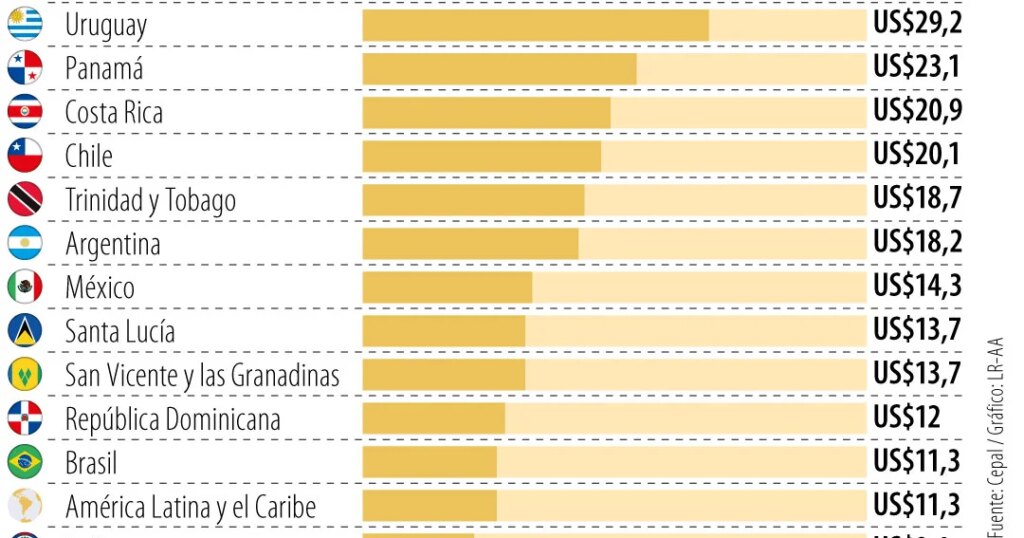
According to the Economic Commission for Latin America and the Caribbean (ECLAC), Colombia registered a productivity of US$8.4 per hour worked during 2025, a figure lower than the average for Latin America and the Caribbean, which reached US$11.3. This represents a difference of US$2.9 per hour compared to the regional indicator.
The result reflects a decline compared to the previous year. According to the report Panorama of Productive Development Policies in Latin America and the Caribbean 2026published by the entity, labor productivity per hour worked in Colombia decreased 0.6% in 2025, while the regional average grew 0.7%. In the comparison between 28 economies in Latin America and the Caribbean, the country ranked 18th.
The difference is also observed compared to other economies in the region. Peru registered a productivity of US$9.3 per hour, Brazil reached US$11.3 and Mexico reached US$14.3. The gap was greater compared to Chile, with US$20.1, and Uruguay, which registered US$29.2.
The ECLAC warns that stagnant productivity is one of the factors that limits the region’s growth capacity. Although hourly labor productivity in Latin America and the Caribbean increased 0.7% in 2025, the organization noted that it has maintained a trajectory of stagnation since the 2010s and that the distance compared to the rest of the world continues.
In the Colombian case, the report identifies important differences between economic activities. During 2025, productivity increases in community services and commerce were not sufficient to offset the declines recorded in business services, mining, hydrocarbons and construction.
Furthermore, sectors with lower levels of productivity concentrated a significant proportion of employment. Added to this situation is marked territorial inequality: productivity per employee shows differences between the different regions of the country and shows a general trend towards stagnation since 2012.
On the other hand, among the factors that explain the productive difficulties of the region, the ECLAC highlights the limited adoption of technologies and weaknesses in management practices, especially among micro, small and medium-sized companies. Faced with this panorama, the organization proposes promoting technological extensionism, a tool that offers diagnosis and specialized support to companies to facilitate the adoption of available technologies.