Follow and read us on Google Discover
Buy a vehicle It is usually one of the first financial goals when reaching young adulthood. In fact, many people already consider it an essential expense to get around without having to depend on public transportation.
At least 8 million motor vehicles travel in Colombia, according to Andres Chavespresident of the National Sustainable Mobility Association, Let’s walkwhile hybrid and electric models do not exceed 300,000 units. These figures show that having a car in Colombia can be considered common, but how affordable is it really?
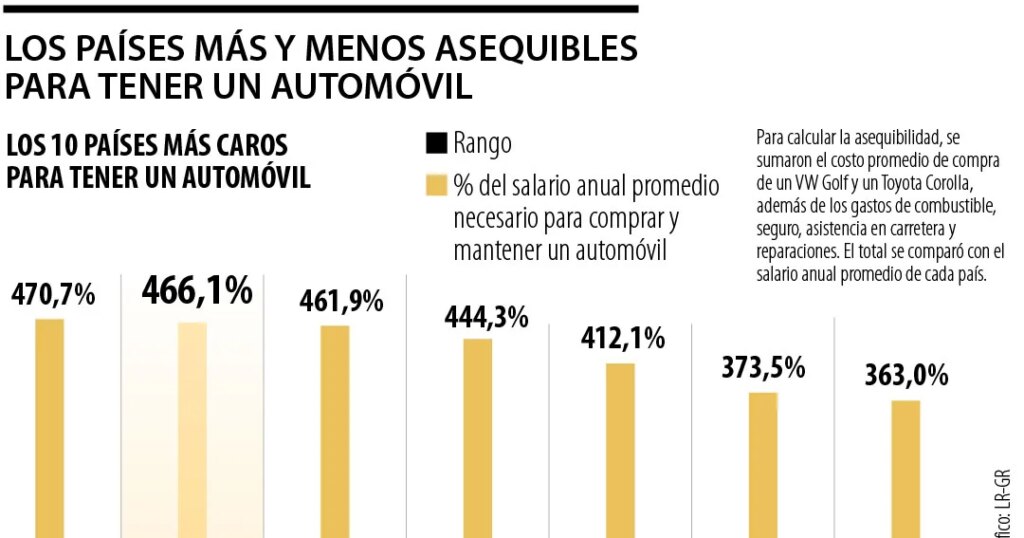
A global study of Scrap Car Comparison analyzed the costs of vehicle ownership in 98 countries and compared them to the average income of their inhabitants. The analysis allows us to identify where it is more affordable to buy and maintain a car and where it represents a disproportionate expense. The study compared the cost of buying a new car, calculated from the average price of the VW Golf and Toyota Corolla, plus annual expenses for fuel, insurance, roadside assistance and repairs, against the average annual income of each country.
The results show a strong gap between regions and advantages for developed markets with a greater supply of vehicles and financing options. The study Scrap Car Comparison revealed the ten countries where it is most expensive to acquire and maintain a vehicle, based on the percentage of the average annual income required to cover these expenses.
In other words, the percentages used to compile the ranking show what proportion of the average salary for a year represents the purchase and costs associated with the operation of a vehicle. Colombia stands out by occupying second overall place in this ranking, with 466.1%, being surpassed only by the Philippines, in first place, with 470.7%. Third place is occupied by Brazil, with 461.9%, while Türkiye appears in fourth international position, with 444.3%.
Have a car in Latam
Colombia tops the list in Latin America as the most expensive country to acquire and maintain a vehicle, representing 466.1% of the average annual salary. They are followed by Brazil, in second regional position and third overall, with 461.9%, and Ecuador, third in the region and fifth in the world, with 412.1%. Peru occupies the fourth regional spot and sixth in the world, with 373.5%, while Argentina completes the top five of the most expensive Latin American nations to own a car and is ranked seventh internationally, with 363.0%.
The regional list is closed by Uruguay and Costa Rica. Uruguay is ranked as the sixth most expensive country in Latin America and eighth worldwide, with 338.9%. For its part, Costa Rica ranks seventh regionally and ninth overall, requiring 304.1% of the average annual salary to cover the purchase and costs associated with the operation of a vehicle.
The contrast between the world ranking and the regional ranking shows that Latin America concentrates a good part of the countries where to buy and maintain a automobile It represents a greater economic impact compared to the income of its inhabitants. According to the study, this lower affordability in several developing economies is related to factors such as high import tariffs, taxes, weak local currencies and limited financing options.
The result is that the cost of acquiring and using a vehicle represents a much higher proportion of average annual income than in developed markets, where there are better conditions to access a car.
How is the rest of the world?
The global ranking of the most expensive countries to own a car is led by the Philippines, Colombia, Brazil, Türkiye, Ecuador and Peru. As is evident, a good part of the markets with the greatest economic difficulties in accessing a vehicle They belong to Latin America. In contrast, the study also reveals the countries where it is most affordable to buy and maintain a car. The United States heads this list, since the cost is equivalent on average to 56.4% of the annual salary, a figure 409.7 percentage points lower than that registered by Colombia.
They are followed by Australia, with 61.8%, and Canada, in third place, with 69.9%. The fourth place is occupied by the Netherlands, with 83.5%, while Norway closes the world top five with 88.1%. Germany, Sweden, Finland, Ireland and the United Kingdom complete the ten most affordable countries to buy and maintain a vehicle, according to the results of the study.
Market differences
Factors such as high import tariffs, tax burdens, weak local currencies and limited financing options dramatically increase the financial burden on buyers. This reality helps explain why seven of the ten least affordable nations on the planet belong to Latin America, while the Philippines registers the most extreme case in the ranking, where buying and maintaining a vehicle is equivalent to 470.7% of the average annual income.
Faced with this gap, the report points out that, while in many developing economies vehicle ownership can be especially expensive due to import tariffs, taxes and limited financing alternatives, in much of Europe and the Western world the outlook is more favorable.
In these developed markets, access to vehicles Local manufacturing, competitive financing and a strong used car market make ownership easier, while scrapping and recycling programs contribute to a cleaner, more cost-efficient vehicle life cycle.
Close figures of the cost needed to maintain a vehicle within Colombia
A study on Total Cost of Ownership, TCO, prepared by the Manuela Beltran University evaluates the real expenses of maintaining a new vehicle in Colombia, projecting an average use of 1,000 kilometers traveled per month. According to the institution’s research, the disbursement varies depending on the range of the car. For the low range, support involves $1.38 million per month, which is equivalent to about $16.6 million per year. In the mid-range, spending amounts to $2.38 million per month, reaching almost $28.6 million annually.