He Camisea Consortium recognized that an eventual extension of the natural gas export contracts of Lot 56 would have to be renegotiated between PERU LNGresponsible for shipments and with whom it shares one of its main shareholders, and the next government.
The contracts of Lot 56 They began in July 2004 and will end in 2044, after being signed with the Peruvian State through Supreme Decree No. 033-2004-EM.
However, the export contract expires in 2028, with an extension until 2031 due to force majeure conditions established in the agreements. This period coincides with the change of command in Peru.
Although Camisea supplies 96% of the gas consumed in Peru, produces 70% of the local LPG and supplies 40% of the energy in the national electricity matrix, export continues to be the core of the business.
“It is not Camisea that has to negotiate, PERU LNG has to negotiate that, and surely, it is part of its strategy,” he said. German AlvarezVice President of Operations and Integrated Services of Pluspetrol.
Hunt Oil is the main link between both consortiums, with significant participation in both Camisea (25.2%) and PERU LNG (35%), which gives it a strategic role in the entire process.
Camisea’s maximum production capacity is 1,850 million cubic feet per day (MMPCD) of natural gas. Current production stands at 1,650 million cubic feet per day.
Approximately 700 MMPCD are allocated for export, while 290 MMPCD are reinjected, which is equivalent to 20% of the daily production of the consortium led by Pluspetrol.
“For Camisea it is important that there is someone who exports, because it supports a large part of the business; but for Peru it is also important, because it brings the wealth and income that it has given to the country,” Álvarez continued.
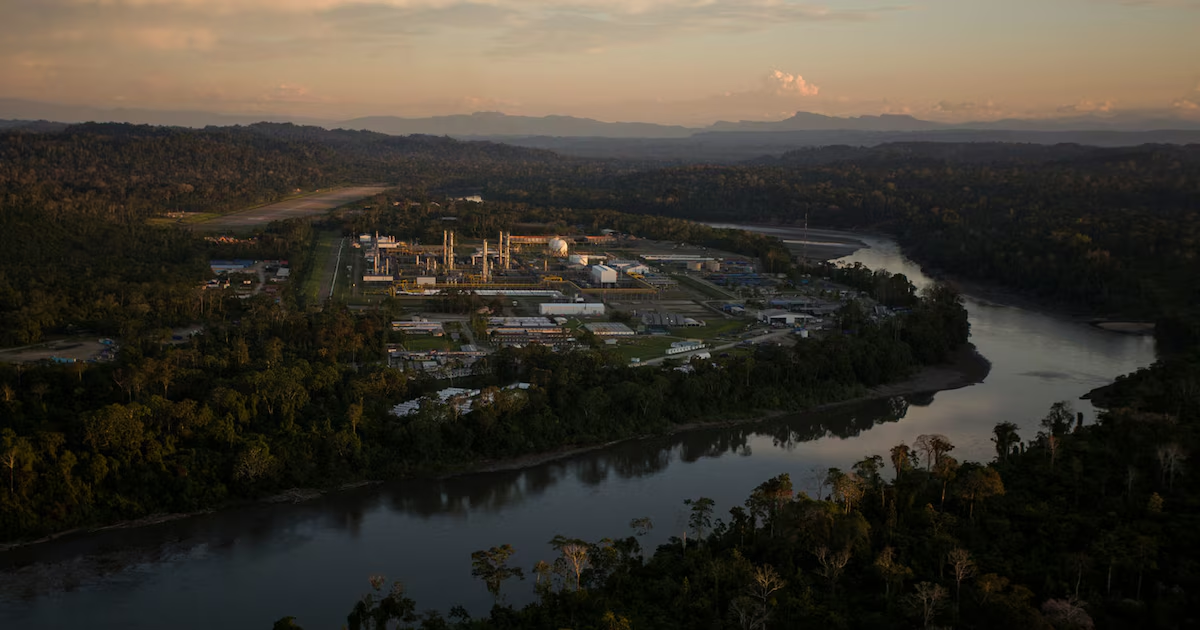
But how, precisely, does the business work? The Camisea Consortium manages two deposits: Lot 56, focused on export, and Lot 88, which is intended for the domestic market. Both in Cusco.
In the surrounding area, there is Lot 57, operated by Repsol, whose gas is also exported through the Camisea infrastructure. Soon, Lot 58, operated by the Chinese state-owned company CNPC, will be added.
The consortium dispatches its production through one of the pipelines of Transportadora de Gas del Perú (TGP), which in March registered an accident in its main pipeline to Lima (they are different branches).
The gas from Lot 56 is taken to Pampa Melchorita, in Ica, where PERU LNG is in charge of the liquefaction process and export to the international market, especially to destinations in Asia and Europe.
For Pluspetrol, Camisea is the second most important natural gas operation in South America, only behind Vaca Muerta, in Argentina. Álvarez compares the development of both projects with that of Venezuela or Bolivia, where nationalization “brought initial prosperity but, by not replenishing reserves, production fell over time.”
Although it is estimated that Camisea, as a whole, has gas left for another 16 years, Lot 56 is in a declining phase. In 2021, Osinergmin estimated that its useful life could be extended by an additional decade. Today the Consortium is processing an authorization from Senace to expand that horizon.
In addition, he shows interest in exploring other areas, such as Candamo, but not before “the government resolves environmental issues and establishes specific conditions,” as they are protected reserves. However, export is key.
“The extension of these agreements (for export) is an issue that must be discussed by the entire gas chain, seeking the best scenario for the parties involved and the continuity of the project,” he said in turn. Claudio Vasquezdirector of external affairs and sustainability at Pluspetrol.
As of May 2026, natural gas in the US is trading between 2.80 and 2.90 USD/MMBtu and the European TTF between 44 and 47 EUR/MWh, in a context of record LNG exports and high volatility due to tensions in the Middle East.
“When analyzing the numbers, we observe that close to 40% of the royalties, income contributions and GDP values that Camisea generates come from the export market, which represents a very relevant contribution for the country,” Vásquez highlighted.