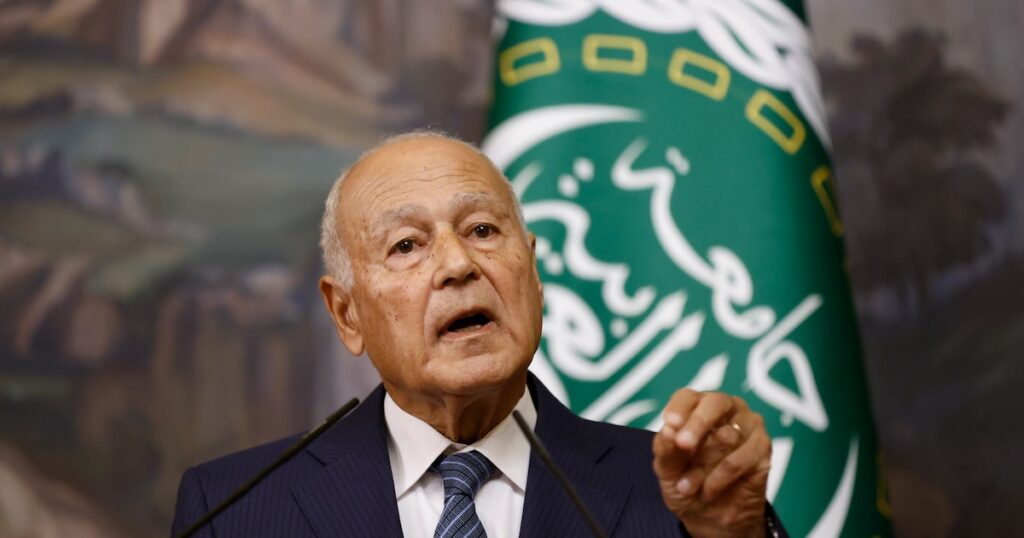
The Secretary General of the Arab League, Ahmed Abulgueitcelebrated this Tuesday the approval in the UN Security Council of a resolution sponsored by the United States to try to channel the end of the war in Gaza. The text, inspired by a 20-point plan promoted by donald trumpopens the door to the creation of an international security force in the Palestinian enclave and, above all, introduces an explicit reference to a ““credible path” towards the formation of a Palestinian state. For Abulgueit, this gesture is not an outcome, but just “the beginning of a path” that should lead to Palestinian self-determination.
The vote came after months of tense negotiations in the Security Council, paralyzed again and again by vetoes crossed between Washington, Beijing and Moscow. On this occasion, the project went ahead with 13 votes in favor and two abstentions, those of China and Russia, which questioned the centrality of the United States in the process and the lack of a more defined calendar for the Israeli withdrawal. Even so, they avoided the veto, allowing the adoption of a resolution that Washington considers a key piece to stabilize Gaza after the devastation caused by more than two years of conflict.
The spokesman for the Arab League, Yamal Roshdy, stressed in a statement that The approved text represents an international recognition of the magnitude of the destruction in Gazadescribed by humanitarian organizations as one of the most severe in recent history. The United Nations estimates that More than 70% of the enclave’s civil infrastructure – including homes, hospitals, water networks and schools – have been damaged or destroyed since the outbreak of war.
The resolution establishes the creation of a International Security Force (ISF), with a mandate until December 2027, formed by contingents from member countries and oriented to three tasks: securing Gaza’s borders with Israel and Egypt, protecting the civilian population and humanitarian corridors, and training a new Palestinian police force. This last point is especially sensitive, given that Palestinian security capacity is considered fundamental to any political transition in the territory.
The plan, according to US officials cited by agencies such as Reuters and APseeks to avoid a power vacuum that could be occupied by armed factions while moving towards a reformed Palestinian administration. Washington insists that the formula does not imply a direct return of Hamas to control of the enclavebut it does require the support of Arab actors to give it legitimacy and viability. Egypt, Jordan and Qatar have shown willingness to support the general framework, although they ask for clear guarantees on the end of the Israeli occupation.
Abulgueit expressed his hope that this resolution will serve as an impetus to reactivate a long-paralyzed political process. For him, the core of the problem remains the permanence of the Israeli occupation. The Secretary General’s message links with positions reiterated by the European Union, which since 2009 has defended the need for a viable Palestinian state and adjoining based on 1967 borders.
The US administration under President Trump had for years limited explicit references to the two-state solution. However, The magnitude of the crisis in Gaza and pressure from allied countries pushed Washington to publicly admit the need for a clearer political horizon.. Analysts cited by the International Crisis Group point out that, without a credible political project, no international force will be able to sustain lasting stability in the enclave.
The introduction of the concept of a path to Palestinian statehood comes at a particularly delicate time. Israel is going through a deep internal political crisis, with divisions in the Government over the management of the conflict and the conditions for an eventual withdrawal.to. The prime minister faces pressure from the most conservative parties, which reject any reference to the creation of a Palestinian state, which complicates the practical application of the resolution.
Despite this, several Arab countries see an opportunity in the text. For them, the recognition of an international commitment to the reconstruction of Gaza can become an anchor to demand concrete political advances. Saudi Arabia and the United Arab Emirates, which are holding discreet talks with Washington, have reiterated that Any full normalization with Israel must include verifiable steps toward a two-state solution.
In essence, a central question remains: how to articulate security, reconstruction and the political horizon in a territory marked by devastation and without a consensual authority. The Security Council resolution aims to respond to that equation, although for now it only offers a general framework.