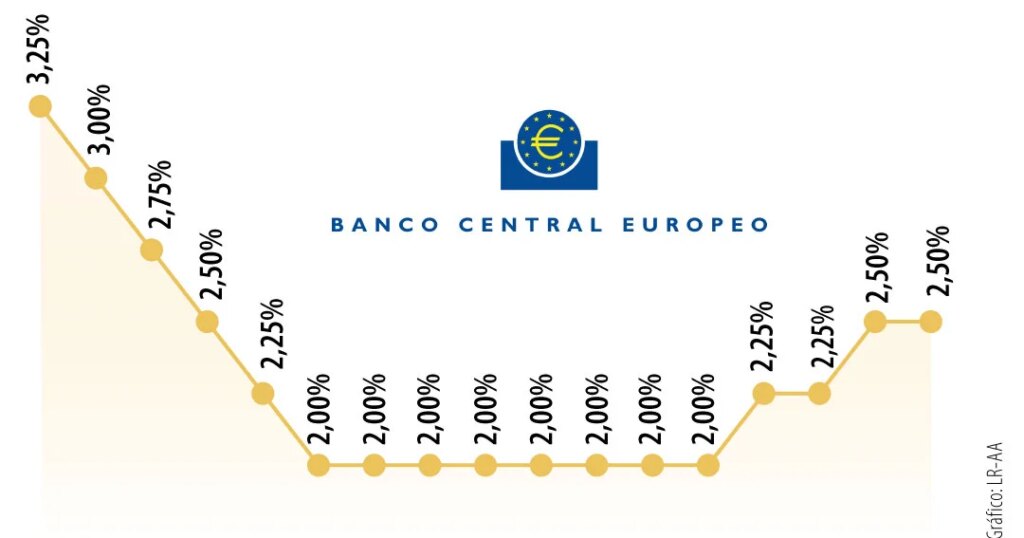
He European Central Bank kept interest rates unchanged, while the news that the president Christine Lagarde will resign early raised concerns about energy costs and the situation in France.
The deposit rate remained at 2.5%, as predicted by almost all economists surveyed by Bloomberg. The announcement came just hours after Lagarde said she would leave office in February, months before her term ended, to have more freedom to speak out on issues such as instability in her country.
“The greater magnitude and duration of the energy crisis, as well as its implications for indirect and second-round effects, will likely boost inflation and slow growth,” the ECB in a statement, once again refusing to commit to future measures.
“Financing conditions have tightened since the last Governing Council meeting, which is likely to negatively affect inflation and growth.”
The departure of Lagarde is overshadowing Thursday’s day, sparking a race between the former governors of the central banks of Spain and the Netherlands to succeed her at the head of the area’s monetary policy euro.
Regarding borrowing costs, the ECB He is cautious after raising them twice since the war with Iran shook the energy markets. While officials are concerned that inflation is headed for double the 2% target, they see no signs that the increase in oil and gas production will spread to other sectors. Still, Europe’s surprisingly strong growth is slowing.
“While the full effects of the energy crisis are still manifesting, core inflation has remained generally stable so far and wages are not showing a significant response at this stage,” stated the ECB.
Traders slightly reduced their bets on further rate hikes by the ECBestimating a monetary tightening of 70 basis points by the end of 2027, compared to the 72 basis points previously forecast. The euro extended its losses, falling to a new 17-month low of $1.11.
He ECB joins the Federal Reserve in keeping interest rates unchanged this week, and the Bank of Japan do the same on Friday.
Policymakers in Frankfurt are expected to raise interest rates again in December, when updated economic projections show the severity of inflationary pressure. Rising global bond yields – exacerbated by market, budget and political tensions gripping France – are dampening demand.
“Recent data suggest that the euro zone economy continued to expand in the third quarter,” he stated. Lagarde to reporters in Frankfurt, outlining the downside risks to the economic outlook. “At the same time, the rebound in energy prices has affected consumer confidence, and rising financing costs are likely to have a negative impact.”
Analysts believe that the interest rate rise at the end of the year will be the last of the year. ECB in this cycle. However, investors are betting on further increases, focusing on a further advance in oil, which has risen more than 6% since the last time the ECB set the rates. Natural gas, for its part, reached its highest level in almost four years.
The recent rebound in the energy sector contributed to consumer prices rising 3.8% in September, while inflation expectations indicators also began to gradually increase.
“Core inflation indicators have remained generally stable, although the early stages of the price chain point to upward pressures,” he stated. Lagardeadding that the risks are tilted to the upside. “Wage pressures remain moderate.”
The economy could be starting to suffer: business dynamism and morale are declining. Third-quarter growth likely slowed to 0.2%, survey finds Bloomberg to analysts before Eurostat publishes the data on Friday.
Rising interest rates contributed to the decline in loan demand during that period.