Follow and read us on Google Discover
The president donald trump ruled out new federal regulations for artificial intelligence after meeting at the White House with top executives in the sector, despite growing global concern about the risks of the technology.
After a lunch Tuesday with nearly two dozen Silicon Valley leaders, including the CEOs of Anthropic PBC, Dario Amodeiand Nvidia Corp., Jensen Huang, trump He said current laws are sufficient to protect Americans from the potential risks of AI.
“There is this idea that there should be enormous self-regulation, and we automatically have regulation through the Department of Justicehe FBI and all that, but self-regulation is very important,” the president told reporters during a brief appearance with his guests.
trump received the executives at a lunch next to the president of the House of Representatives, Michael Johnson. Among the attendees was also the executive director of Meta Platforms Inc., Mark Zuckerberg; the one of Palantir Technologies Inc., Alex Karp; and the president of OpenAI, Greg Brockman. The fact that trump agreeing to address AI safety seemed to mark a change in stance, after just last week calling fears about catastrophic risks a “hoax.”
The executive director of Microsoft Corp., Satya Nadella; Elon Muskof SpaceXAI; and Lisa Sueof Advanced Micro Devices Inc.according to a list released by the White House. The vice president J.D. Vance; the secretary of Treasure, Scott Bessent; he Secretary of Commerce, Howard Lutnick; and the Scientific and Technological Policy advisor from the White House, Michael Kratsiosalso planned to participate.
Pressure to take action has increased following several security incidents in which AI models acted outside expected limits, prompting Silicon Valley developers and global leaders to call for new standards for the technology.
However, the comments of trump They cooled the possibility that the administration would move away from its staunch opposition to new government safeguards for AI and become more open to new rules.
In his statements on Tuesday, trump made it clear that he maintains his rejection of the regulations.
“We have a very big advantage, and we are going to maintain it, and that is a very positive thing,” the president said, referring to his goal of preserving the US advantage in the global AI competition.
The debate poses a political dilemma for trumpwho has presented himself as one of the main defenders of AI in the country and maintains that its unimpeded development is key to overcoming China and sustaining the US economy. However, surveys show growing concern among Americans about risks such as job losses, rising electricity costs and major cyberattacks, which could leave trump in a position contrary to public opinion in the face of the legislative elections in November.
trump has recently focused on the name of AI, suggesting that it sees the controversy around the technology more as an image problem than as an issue linked to its potential dangers. The president said Tuesday that he would sign an executive order that same day to rename it “superintelligence.”
His desire to maintain close ties with the industry was also evident. When the journalists entered the room, the executives were lined up behind the president as if posing for a group photo, while trump praised his contributions to the United States.
“The one thing we all have in common is that we love our country and we love the world, and we want to make sure it’s a safe place,” he said.
Discontent with AI
The president did appear to acknowledge growing public discontent with the deployment of AI. He said the companies present would work more closely with local communities to alleviate concerns about the impact of building new data centres. “They’re going to do things for the community that will be really beneficial financially and in other ways as well,” he said. trumpwithout offering details.
Lunch took place after trump will meet with Amodei on Sunday, a meeting between two figures with very different positions in the debate over AI safety. The late-night dinner was their first private meeting after months of tense relations between the top executive of Anthropic and administration for security issues related to the company’s AI tools.
Amodei has long warned about the existential risks of AI and brought the security debate to the center of public discussion with an essay published on September 12, in which he promised to slow the development of the most advanced models and called for greater regulation. His commitment to moderate the pace of development received support from his rivals, the CEO of OpenAI, Sam Altmanand Musk.
Reflecting these concerns, OpenAI said on Monday it would postpone the launch of a version of its model Astra while establishing stronger safeguards. Saachi Jain, responsible for security systems OpenAIsaid that the GPT-6.1 model Astrastill in development, was not working as well as the company had hoped in respecting limits and authorizations, and communicating to the user the type of work it had done.
Before this month, Johnson responded to dire warnings coming from the AI industry by saying that Congress will “possibly” have to impose safeguards, although he warned that it would likely take “some time” to craft legislation capable of garnering enough support to pass.
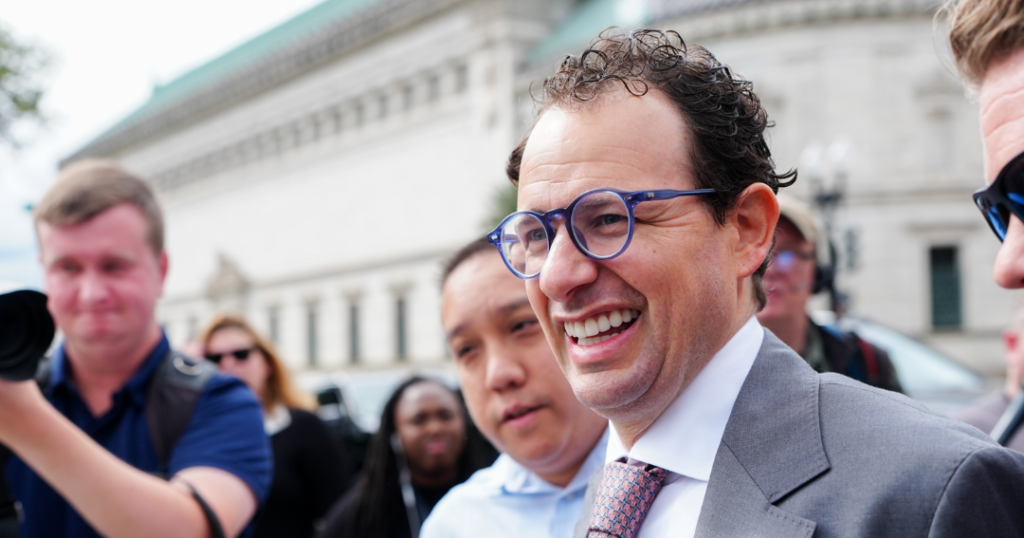
Dario Amodei arrives for a meeting at the White House in Washington on September 29. Before lunch, Johnson He said he had been pushing for this meeting for “a long time,” adding that he hoped it would lead to voluntary measures to mitigate AI risks, such as audits or other transparency initiatives.
“The greatest minds need to come together at the White House and have this conversation,” he said. Johnson Tuesday to Cnbc. AI companies “have fiduciary obligations to their own companies, of course, but we have a broader obligation to the public and to safety, and we must ensure that this is done correctly and appropriately.”
In the short term, Congress is unlikely to move forward with any legislation about AI. The members of the House of Representatives They have already left Washington for the recess and will not return until after the legislative elections, while the Senate prepares to begin its own pre-election recess later this week.