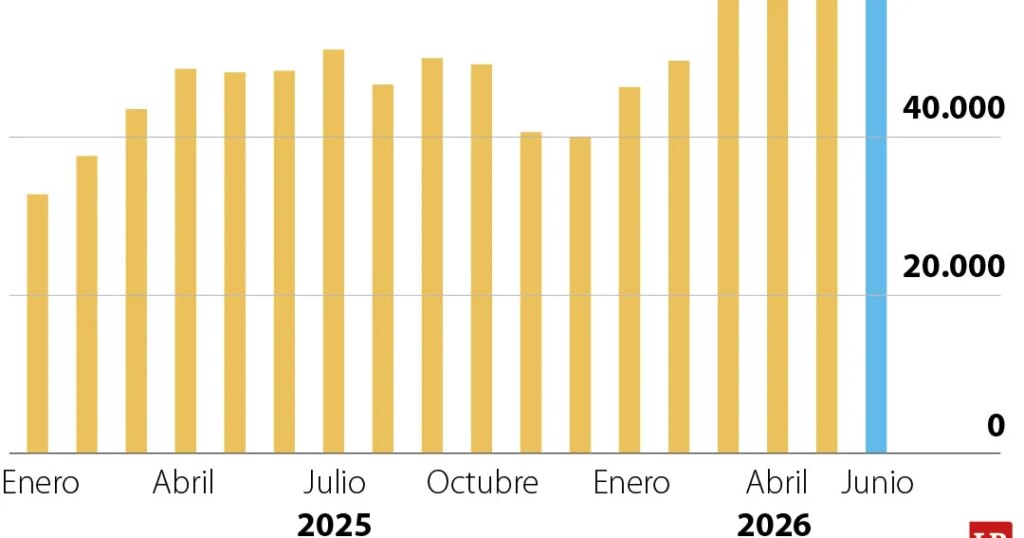
The immigration policy promoted by the president donald trump is reaching unprecedented levels. In June, the United States recorded the highest number of deportation orders since records exist, a sign that the strategy of hardening against irregular immigration is advancing rapidly. According to data from the Transactional Records Access Clearinghouse, Tracof the Syracuse Universityfederal immigration judges issued nearly 79,000 deportation orders during that month, a figure much higher than the more than 58,000 recorded in May. This is the highest monthly volume since 1998, when data collection began.
For Vanessa Dojaquez-Torres, director of policy and advocacy Hiasa nonprofit organization that supports refugees and asylum seekers, the Trump administration is delivering exactly on the plan it promised during the presidential campaign. As he explained, the objective was always to eliminate legal obstacles that delayed deportations and to expedite the processes as much as possible to expel those who did not obtain immigration protection. The goal set by trump is ambitious: to reach 1 million deportations per year, which is equivalent to more than 83,000 expulsions monthly.
One of the factors driving this increase has been the restructuring of the immigration courts. During the second term of Trump, These agencies remained under the direct supervision of the Department of Justice, leaving behind a model with greater independence. In addition, hundreds of judges considered too flexible were dismissed and replaced by military lawyers, former immigration prosecutors, and other jurists recruited with calls that even explicitly sought “deportation judges.”
Although the number of deportation orders reached historic figures, this does not mean that all of these people have been expelled from the country. Many remain free or under administrative proceedings, while others continue to appeal their cases before immigration courts or federal courts. However, having a greater number of orders judicial proceedings will allow the Immigration Service and Customs Control, ICEexecute deportations more quickly once those people are located and detained.
In parallel, the ICE has intensified its operations throughout the territory. During the first 11 days of July, the agency made an average of 1,400 arrests per day, surpassing the nearly 1,300 arrests per day recorded in June, the busiest month since Trump’s return. Unlike previous operations, concentrated in cities such as Chicago or Los Angeles, agents now deploy simultaneous actions in different regions of the country and have even increased detentions of foreign citizens at airports.