The irony was brutal. For decades he traveled the world preaching peace, detachment, tolerance and freedom. He filled theaters talking about love, God, the need to live without hate and the importance of valuing every moment of existence. Millions of people listened to him as if he were a popular philosopher. Others considered him a poet. Many simply defined him as a wise man.
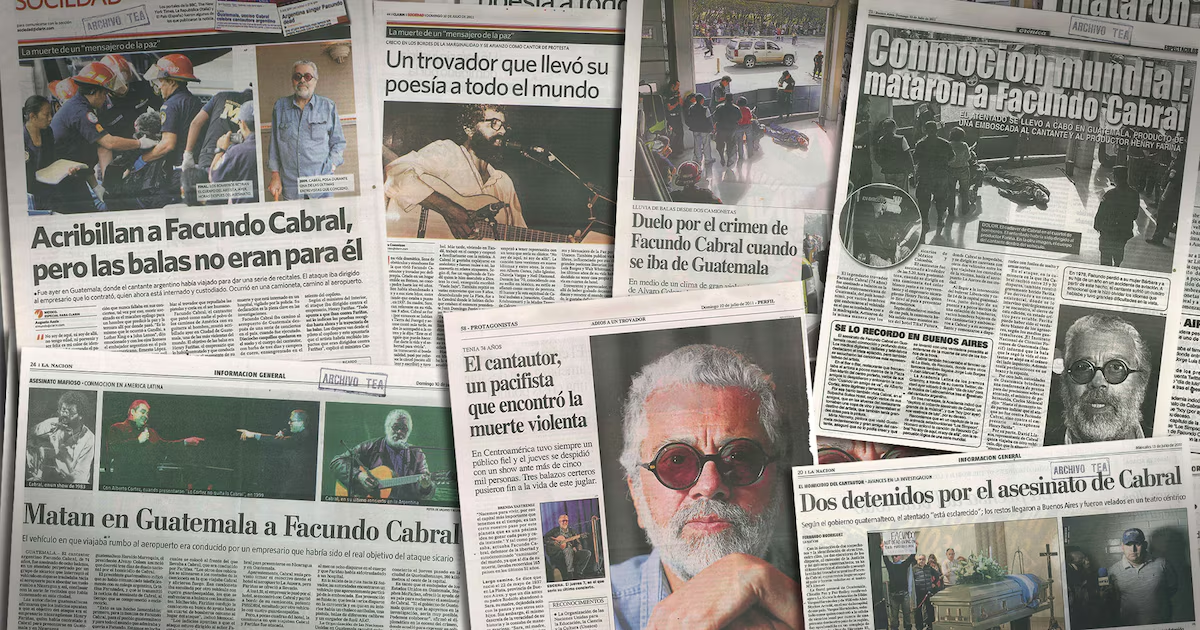
But in the early morning of July 9, 2011, on an avenue in Guatemala City, the bullets of a commando of hitmen ended his life. Facundo Cabral was 74 years old. And the most shocking thing of all was that, as investigations would later determine, the murderers were not even looking for him. The chosen victim was another person. Facundo was simply in the wrong place.
His death generated shock throughout Latin America. Presidents, artists, writers and admirers were trying to understand how one of the most peaceful and beloved men on the continent had ended up involved in a drug trafficking plot, settling scores and organized crime. To understand the magnitude of that tragedy it is necessary to go back to the beginning. Long before becoming a recognized artist, Facundo Cabral was a child who knew hunger, abandonment and despair.
He was born Rodolfo Enrique Cabral on May 22, 1937 in the city of La Plata. However, his childhood was spent mainly in Tandil, where economic difficulties deeply marked his family. His father left home when he was very young. His mother, Sara, was left alone to raise several children. Poverty was extreme.
Years later, Cabral himself would remember that many times they did not have anything to eat. Those deprivations shaped a rebellious personality and a very particular outlook on life. The school never managed to keep him for long. He was restless. Undisciplined. Curious. And he was convinced that the world was much bigger than the four walls of a classroom.
During his adolescence he began to run away from home frequently. In one of those adventures he starred in an episode that would become legend. As he recounted in countless interviews, when he was just a teenager decided to travel hundreds of kilometers to try to meet with Juan Domingo Perón. The meeting finally did not happen in the way imagined, but that experience fueled even more his desire to travel paths.
For several years he led a wandering existence. He worked as much as he could. He slept in train stations. He lived off small jobs. He went through extreme situations. That life as a wandering vagabond would end up becoming the raw material for his future songs. At the beginning of the sixties he began to seriously approach music. His first performances were modest. He sang in bars and clubs. In nightclubs. Small stages where only a few people were paying attention.
At that time he used different stage names until he finally adopted Facundo Cabral. The beginnings were difficult. Like many artists, he experienced more rejection than applause. But it had something different. He was not only a singer, nor only a composer. Yes, a curious and extraordinary narrator. His shows mixed songs, anecdotes, philosophical reflections, humor and observations on the human condition.
Over time he created a style that was impossible to pigeonhole. The big break came in the 1970s. One song in particular changed his destiny. “I’m not from here, nor am I from there”. The topic crossed borders and became an international phenomenon. It was recorded in numerous countries and translated into different languages. Suddenly, that man who had hitchhiked along dusty roads became a recognized figure throughout Latin America.
However, success never changed his way of life much. He continued traveling, reading, reflecting. Seeking spiritual answers. His fans didn’t come just to hear him sing. They were going to listen to him think. Thus, over the years he developed an almost mystical image. He talked about Mahatma Gandhi, Jesus of Nazareth, Jorge Luis Borges, Mother Teresa of Calcutta and the anonymous people he met on his travels.
For many he became a kind of spiritual teacher. But behind the character there was also a personal story marked by enormous tragedies. The most devastating occurred in 1978. That year he lost his wife and young daughter in a plane crash. The blow was devastating. Cabral later confessed that that tragedy came close to destroying him emotionally.
For a long time he sought refuge in travel and spirituality to cope with the pain. Paradoxically, from that experience emerged some of his deepest reflections on death, loss, and the meaning of existence. The years passed. New books and records arrived. New tours. Its prestige grew until it became a cultural reference for several generations.
At the beginning of the 21st century he continued touring stages with the same energy. At 74 years old, he maintained an intense schedule of presentations. That explains why in July 2011 he was in Central America on tour. He had given concerts in Guatemala and planned to continue his trip to Nicaragua.. Nobody imagined that they would be his last days.
On the night of July 7 he gave a recital in the Guatemalan city of Quetzaltenango. It was a very celebrated presentation. When he said goodbye he left a phrase that would later acquire a shocking meaning. “I already thanked you; after what God wants“Two days later he had to take a flight. He was accompanied by the Nicaraguan businessman Henry Fariñas, who had organized part of his presentations. Facundo was not traveling alone. In addition to Fariñas there were collaborators linked to the tour.
Early in the morning they left the hotel heading to La Aurora International Airport. The journey seemed routine. But it wasn’t. While they were traveling along Liberación Boulevard, one of the busiest entrances to Guatemala City, several vehicles began to chase the truck. The occupants were armed with assault rifles. Seconds later they opened fire. The hail of gunfire was devastating. The attackers emptied entire magazines into the vehicle.
Facundo received fatal impacts. Henry Fariñas was injured, but survived. The singer-songwriter died practically on the spot. The news spread around the world in a matter of minutes. How could something like this have happened? Why had Facundo Cabral been murdered? The first hypotheses pointed to a possible political attack. Others suggested an attempted kidnapping.
The reality was even darker. The investigation revealed that the true target of the attack was not Cabral. The hitmen sought to kill Henry Fariñasa Nicaraguan show businessman who maintained links with environments later related to drug trafficking and money laundering. The investigations determined that there were previous conflicts with the Costa Rican Alejandro Jiménez González, alias “El Palidejo”, a character linked to organized crime.
According to the prosecutor’s accusation, Jiménez had ordered Fariñas to be eliminated. The hitmen prepared an ambush. They followed the businessman’s movements. They waited for the right moment. And when the vehicle appeared, they fired regardless of who was sitting next to it. That companion was Facundo Cabral.
The international investigation was complex. There were wiretaps. Analysis of communications and monitoring. Statements of protected witnesses. Finally the authorities managed to reconstruct the chain of responsibilities. In March 2012, Alejandro Jiménez was captured in Colombia.identified as the intellectual author of the attack. He was later extradited and tried in Guatemala.
The process culminated in 2016. A Guatemalan court convicted five defendants for the artist’s murder. Alejandro Jiménez, known as “El Palidejo”, received a sentence of 50 years in prison: 30 for the murder of Cabral and 20 for the attempted murder of Henry Fariñas. Audelino García Lima and Juan Hernández Sánchez were also sentenced to 50 years in prison, while Wilfred Allan Stokes Arnold and Elgin Vargas Hernández received sentences of 53 years due to additional crimes linked to the cover-up. At the same time, other members of the criminal organization received sentences that reached up to 93 years in prison for different murders related to the same gang of hitmen.
In general terms, the main material and intellectual perpetrators were convicted and continue to serve their sentences in different penitentiary establishments. Meanwhile, Facundo’s body embarked on one last journey. Thousands of people came to say goodbye. After the tributes held in Guatemala, his remains were transferred to Argentina, where he received goodbye from admirers, artists and leaders of different political currents. A farewell in keeping with the continental dimension that his figure had achieved. The wake was held at the ND/Ateneo theater, located at Paraguay 918, City of Buenos Aires. And the funeral procession took his body to the Jardín de Paz Cemetery, located in the town of Pilar in the province of Buenos Aires, where he was finally cremated.
He had started out as a poor boy from the province of Buenos Aires. It ended up becoming a cultural reference for millions of Spanish speakers. Perhaps that is why his death produced such a strange feeling. It didn’t seem to fit the character. Facundo Cabral spoke of peace. He died in the middle of a shootout.
His absence created a huge void. He defended freedom and ended up trapped in another’s war. However, there is something that the murderers were never able to take from him, his voice. Because more than a decade after that bloody morning in Guatemala, his songs continue to play and his reflections continue to circulate through books, recordings and social networks. Perhaps that is the greatest paradox of all. The hitmen managed to kill the man. But they couldn’t silence the message. And that tireless traveler who repeated that he was neither from here nor from there continues to be, in some way, in every place where someone hears and feels him again.