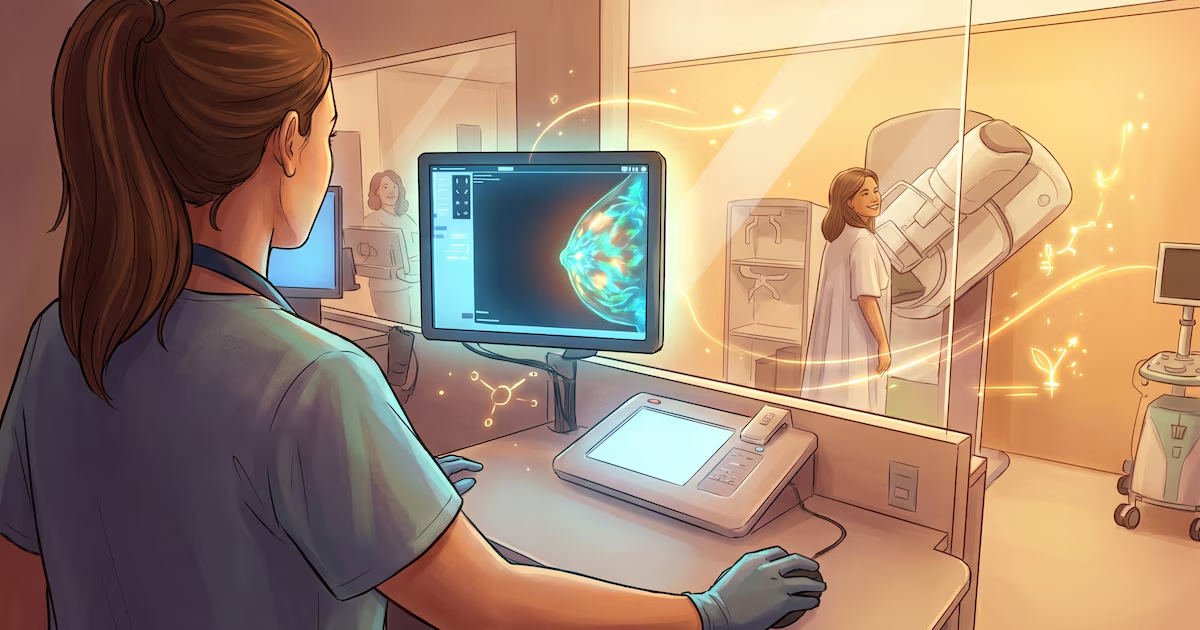
A team from the Institute of Advanced Chemistry of Catalonia (IQAC-CSIC) and the Vall d’Hebron Research Institute (VHIR) has developed and experimentally validated a novel photopharmacology strategy that uses light to activate a modified variant of chloroquine in the treatment of breast cancer. This technique allows the localized elimination of highly resistant tumor cells, including tumor stem cells, responsible for both resistance to conventional therapies and relapses. The results were published this week in ACS Chemical Biology.
The strategy consists of administering a photoactivatable variant of chloroquine directly into the tumor. This molecule remains inactive until it is activated by directed light, which triggers the release of the drug right in the illuminated area. In this way, it is possible to specifically eliminate tumor stem cells—a particularly problematic subpopulation due to their ability to resist treatments and favor recurrence—validating the mechanism of action through the inhibition of autophagy. The experiments, carried out both in vitro and in models animalsoffer the first proof of concept of this localized approach, which could minimize systemic side effects and the risk of relapse by avoiding damage to healthy tissues.
Laia Josa Culleré, researcher at IQAC-CSIC, points out in an article published by Vall d’Hebron that “the objective of the work has been precisely to find a way to selectively eliminate tumor stem cells.” These cells, also called ‘cancer stem cells’, constitute a minority but especially resistant subpopulation within the tumor. “Tumor stem cells represent one of the main challenges in oncology because they are capable of resisting conventional treatments and favoring tumor reappearance. This work demonstrates that photopharmacology “It can become a very promising tool to specifically attack this cell population in a localized and controlled manner,” adds Matilde Lleonart, head of the Head and Neck Cancer and Biomedical Research in Tumor Stem Cells group at the VHIR.
Photopharmacology is a discipline that allows activate drugs using lightproviding precise control over your spatial and temporal activity. In this study, researchers have chemically modified the chloroquine molecule—traditionally used in the treatment of malaria and autoimmune diseases—so that it remains inactive until exposed to specific lighting. Activation is possible thanks to the incorporation of a photolabile group derived from coumarin in the basic center of the molecule, so that the release of the active ingredient only occurs after receiving a certain wavelength.
“We design molecules that have no effect in the absence of light, but that, after being stimulated with light, release the active drug and they exert their action on tumor cells,” explains Sofía Alonso-Manresa, IQAC-CSIC researcher, in the article published by Vall d’Hebron. This design allows the compound to be administered safely and activate its toxicity only when desired, using blue or green light, which penetrates the affected tissues.
Unlike conventional treatments—where the administration of chloroquine causes systemic toxicity and adverse effects in healthy organs, such as the retina, muscle or heart—local activation through photopharmacology reduces exposure to the rest of the body.
The trials carried out have included cellular models of colorectal, head and neck, and breast cancer, using both conventional cultures and three-dimensional tumor spheres enriched in tumor stem cells. In the absence of light, the photoactivatable derivative of chloroquine has shown total inactivity; After a brief illumination—just seconds—the cytotoxicity characteristic of conventional chloroquine is recovered, preventing the formation of spheres and destroying the subpopulation of stem cells.