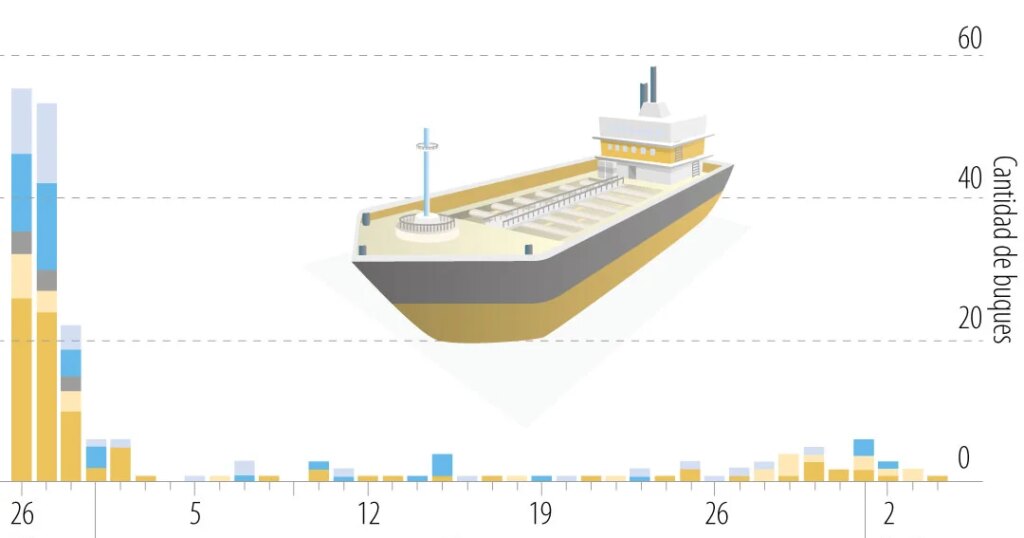
Traffic through the strategic Strait of Hormuz has been increasing over the last week, and On Friday the seven-day moving average of transits reached its highest level since the war began.
More ships are crossing, including those with no clear ties to Iran or China, as countries negotiate with Tehran to allow their ships to pass. The last day’s transits were led by liquefied petroleum gas tankers, including one bound for India and others linked to Iran.
A total of 13 vessels have crossed since Friday morning, with 10 leaving the Persian Gulf and three entering from the open sea, according to ship tracking data compiled by Bloomberg. Still, this is a trickle compared to figures before the war began on February 28. In normal times, about a fifth of the world’s oil and liquefied natural gas passes through the strait each day.
Iran has taken steps to tighten its control over the sea lane, establishing a toll system and forcing most ships to follow a specific route near its border. In the last 24 hours, all recorded transits have passed through that narrow northern passage, located between the Iranian islands of Larak and Qeshm.
Recent crossings include a French container ship and a Japanese-owned LNG carrier, apparently the first such transits since the war began. It is not clear whether these trips were the result of diplomatic efforts or negotiations by the shipping companies and their intermediaries.
Ship tracking is hampered by electronic interference in ship signals, and some vessels disable their AIS transponders in high-risk waters, which further reduces the timeliness and reliability of monitoring data.
Outbound transits
Since Friday morning, five bulk carriers and one oil tanker have joined the four LPG tankers that have left the Persian Gulf. Three of the bulk carriers and the tanker set sail on Saturday morning. Except for the Indian LPG tanker, the others are linked to Chinese or Iranian interests.
Since ships are hidden in high-risk waters, lTransit figures may initially appear lower and could be revised upwards as lagged data becomes available.
Entry transits
Among the inbound transits recorded since Friday morning There were two LPG tankers and one fuel tanker linked to Iran.