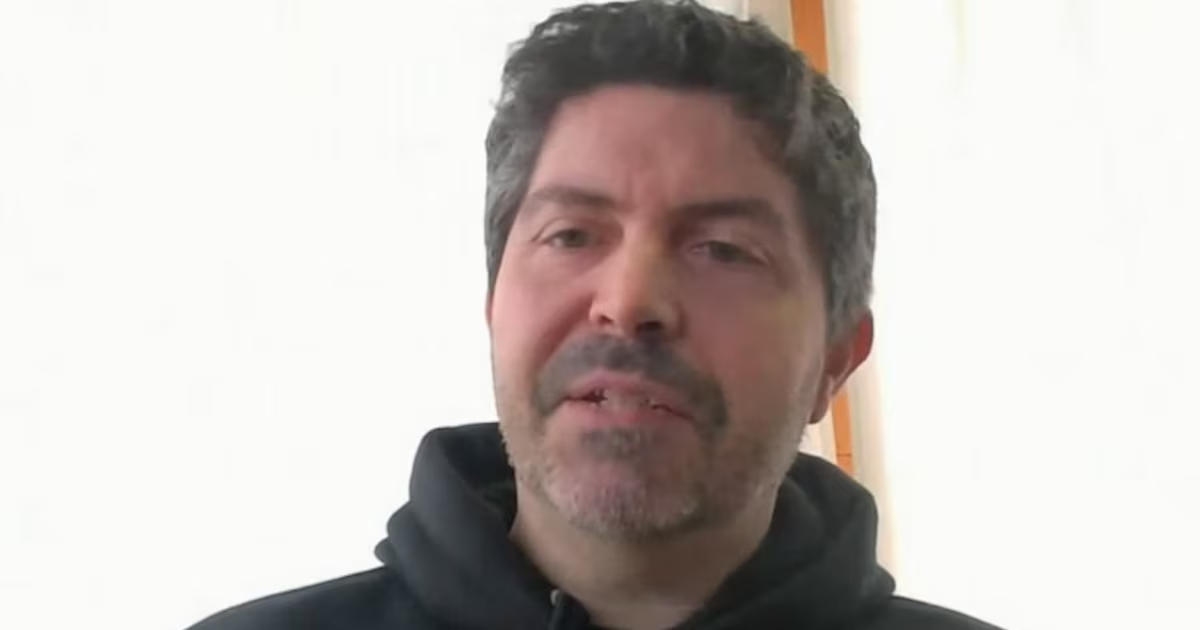
Juan Pablo Cuesta Gonzáleza representative of the National Commission for Space Activities, detailed during an exclusive interview in Infobae live how Argentina achieved integrate proprietary technology into NASA’s Artemis II mission via microsatellite Athenawhich already sends signals from more than seventy thousand kilometers away.
In dialogue with the team Infobae at Ninemade up of Gonzalo Sánchez, Tatiana Schapiro, Ramón Indart and Cecilia Boufflet, Cuesta González, project leader Athena Missionreviewed the different stages of it, the relevance of international cooperation, and the impact that Argentine scientific development has in a global context of lunar exploration.
Atenea: the leap of Argentine technology on the Moon
The news that Argentina added its own technology to the Artemis II mission was celebrated in the studio: “It is an honor to be able to be there. We received the proposal from NASA or the invitation to send ideas to participate in Artemis,” said Cuesta González.
The expert explained that the challenge required a quick and coordinated response: “We knocked on all the doors, of the people, the companies, all the organizations that here in Argentina work in the space sector. Together we were able to generate the idea that ended up being Atenea.”
The project leader highlighted the importance of the university contribution and collaboration between institutions. “The University of La Plata already had a CubeSat, a small satellite that had certain compatibilities with the size that NASA proposed to us“Although this Atenea is a little bigger,” he explained. “We rely on that base and some more subsystems from other actors, where the University of San Martín also appeared.”
Asked about the nature of the technology sent, he described: “It is a CubeSat type satellite, which is like squares. It’s like a cube, small in size. In this case it is twenty by twenty by thirty centimeters. For a CubeSat it is big, actually.”
The Argentine development was selected along with proposals from South Korea, Germany and the Arab Emirates. Cuesta González highlighted: “We remain part of Artemis II, which is a NASA program that greatly seeks international cooperation. They have known us, CONAE, for many years, we have worked with them for decades.”
When asked about the paradigm shift in space development, the specialist explained: “We at CONAE have been doing what is called traditional space, with larger satellites, which sometimes have been developing for decades. But in this case we went to what is called new space and we seek to work with young people, students, even startups. We are testing other types of technology, at very low cost, to change the paradigm of what traditional space was.”
The Artemis II mission: science and international cooperation
The objective of the Artemis II mission is, as Cuesta González described, to prepare the ground for the future construction of a lunar base. “All that is going to be done now is a approach to the Moon to finally see how we are going to move forward with the construction of a base, as if at some point bases were built in Antarctica,” he stated.
Regarding Athena’s specific function, he was clear: “In this case it is a technological demonstration. We are basically testing technology, to see what the space environment supports. In this case, a much more complex environment than we ever went to.” He pointed out that the majority of satellites operate in low orbit, below twenty thousand kilometers, and stressed: “Athena reached approximately seventy-two thousand kilometers altitude yesterday. More than ten times the normal, usual.”
The satellite deployment was followed in real time from several Argentine stations. “I am here with a team in Tierra del Fuego, at the CONAE ground station. Yesterday, since early morning we were receiving it. As soon as the NASA rocket, called SLS, deployed a second ICPS stage, which also carried the Orion ship, where the astronauts who were right above us were going,” he said.
“First they deployed the Orion ship with the astronauts inside and they were practicing maneuvers, they are called docking, hooking, which they are practicing for the next Artemis missions, where the idea is to go down to the Moon.”
The project leader recalled the key moment: “When we saw it we were very happy, which was approximately five hours after launch. It was the early morning of the previous one. We were surprised, very happy because we saw it very quickly, even a little earlier than we expected. We were preparing, there were two, three minutes left to see him and he already appeared because they deployed us a little earlier.”
The tracking of the satellite was coordinated between Tierra del Fuego, Córdoba and La Plata: “We saw it from the three places simultaneously and were very happy here, in Tierra del Fuego. Although it is the main station in the case of this mission, it was convenient to be close to the south pole to see it for longer.”
The interview also addressed the institutional complications that CONAE is going through in the current economic context. Cuesta González acknowledged: “The country is going through a different economic time. At CONAE, fortunately with Atenea we were able to work, we were able to do it. It is an agreement that we actually signed with NASA, which we signed last year. Today we are happy with this and we hope that we can continue doing things. I trust that this will be the case.”
Finally, he expressed his personal and collective satisfaction with the achievement: “It worked very well, we saw it. We were there the whole time until it went over the horizon at around three in the afternoon yesterday, from here, from Tierra del Fuego. A crazy moment on the roof when the ship connects. As is.”
The development of Atenea, its successful deployment and coordinated monitoring from national stations represent not only a milestone for Argentine science, but also an example of the capacity for international cooperation and technological resilience, even in adverse scenarios.
The complete interview with Juan Pablo Cuesta González
Infobae accompanies you every day on YouTube with interviews, analysis and the most outstanding information, in a close and dynamic format.
• From 7 to 9: Infobae at Dawn: Nacho Girón, Luciana Rubinska and Belén Escobar
• From 9 to 12: Infobae at Nine: Gonzalo Sánchez, Tatiana Schapiro, Ramón Indart and Cecilia Boufflet
• From 12 to 15: Infobae at Noon: Maru Duffard, Andrei Serbin Pont, Jimena Grandinetti, Fede Mayol and Facundo Kablan
• From 3pm to 6pm: Infobae in the Afternoon: Manu Jove, Maia Jastreblansky and Paula Guardia Bourdin; Marcos Shaw, Lara López Calvo and Tomás Trapé rotate during the week
• From 6 to 9 p.m.: Infobae to Return: Gonzalo Aziz, Diego Iglesias, Malena de los Ríos and Matías Barbería; Gustavo Lazzari, Martín Tetaz and Mica Mendelevich rotate throughout the week. News, talks and protagonists, live.
Follow us on our channel YouTube @infobae