President Donald Trump temporarily suspended a century-old shipping mandate to reduce the cost of transporting oil, gas and other raw materials in the United States, his latest attempt to combat the rise in energy prices caused by its war in Iran.
On Wednesday, the president authorized foreign-flagged ships to transport various products between US ports for the next 60 days. This temporary exemption from the Jones Act — a 1920 law designed to promote shipbuilding in the United States — has been presented by the Trump administration as a way to facilitate the shipment of energy products vital to national security and prevent shortages that could disrupt military operations.
“President Trump’s decision to grant a 60-day waiver under the Jones Act is another step toward mitigating near-term disruptions to the oil market as the U.S. military continues to meet the objectives of Operation Epic Fury,” White House Press Secretary Karoline Leavitt said in a statement. «The Administration remains committed to continuing to strengthen our critical supply chains».
The Jones Act requires that cargo transported between U.S. ports be carried on U.S.-flagged vessels built and owned by the United States. The waiver allows certain foreign vessels to temporarily transport various products, including coal, crude oil, refined petroleum products, natural gas, natural gas liquids, fertilizers, any product that uses refined petroleum products as the primary raw material, and other energy derivatives, according to White House officials who requested anonymity because details of the authorization had not yet been made public.
According to some analysts, the exemption could have a limited effect given the magnitude of the supply chain disruption. The war has generated what the International Energy Agency has called “the largest supply disruption in the history of the global oil market.”
Trump’s measure is one of several he has taken or proposed in recent days to counter rising fuel prices during the war. The conflict has led to the effective closure of the Strait of Hormuz, a crucial sea route for energy supplies, which blocks the passage of some 15 million barrels of oil and has generated turbulence in the financial markets.
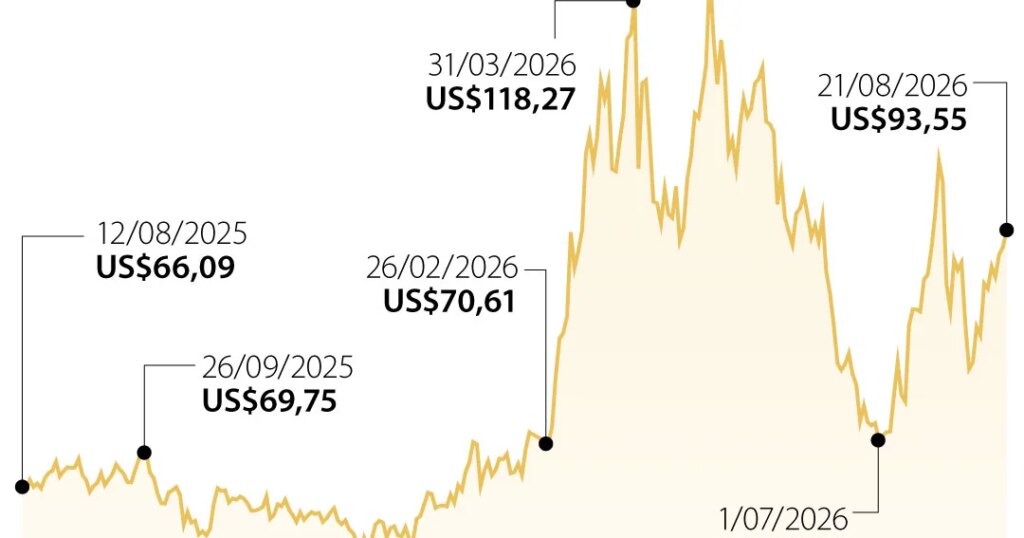
The price of global benchmark Brent crude rose to $109 on Wednesday morning in New York as the war showed signs of escalating.
In the short term, Temporarily lifting the law’s restrictions could reduce price pressure by allowing lower-cost foreign tankers to circulate through the country. This measure is intended to reduce the price of transporting crude oil from the Gulf to refineries on the east coast of the United States, as well as that of gasoline and diesel to the populated markets in the northeast of the country.
According to a 2022 JPMorgan Chase & Co. estimate, the Jones Act exemption could save East Coast motorists about 10 cents per gallon.
“The Jones Act prevents gasoline from being transported by barge from the Houston Ship Channel to New York Harbor and other East Coast destinations because it makes shipping excessively expensive,” said James Lucier, managing director of the research group Capital Alpha Partners. «Because of the Jones Act, cheap gasoline from US crude oil that could go from Houston to New York ends up in Mexico».
The exemption could also reduce the cost of nitrogen fertilizer transported down the Mississippi River, although some analysts predict that The waiver could come too late to significantly reduce costs for this spring’s optimal planting period.
Trump faces political pressure to address rising fuel prices, which It greatly influences Americans’ perception of inflation and the economic situation. The oil rally represents a particular risk for Trump and his Republican Party ahead of November’s midterm elections, which will determine control of Congress and are likely to depend heavily on public opinion on the cost of living.
The administration has already detailed plans to distribute 172 million barrels of crude from the U.S. Strategic Petroleum Reserve — part of a global release of 400 million barrels — and has lifted some sanctions on the sale of Russian crude. He has also pledged to send the US Navy to escort tankers through the Strait of Hormuz and has promised a reinsurance program to help reduce costs, although details of these proposals have been scarce.
Oil and gas executives had recommended the Jones Act exemption as an additional tool to reduce prices. American presidents had already used this same power to mitigate temporary interruptions in supply. For example, former President Joe Biden exempted a tanker headed to Puerto Rico with supplies after Hurricane Fiona in October 2022 from the Jones Act.
But the measure may prove controversial. The Jones Act has the backing of some of the nation’s largest shipbuilders, as well as their allies in Congress, who have previously fought even the temporary waivers, arguing that they undermine the law’s intent to support U.S. maritime power.
The American Maritime Partnership, a group that represents owners of U.S.-flagged vessels and opposes attempts to reduce the law’s protections, said Wednesday that it would be “closely monitoring” that each vessel movement is “publicly disclosed and justified under federal law“.
“We are deeply concerned that this 60-day blanket waiver is being misused and unnecessarily displacing American workers and businesses,” the group said in a statement. «This exemption exists only to address an immediate threat to military operationsnot to displace American workers or to benefit foreign operators.
A White House official stressed that the exemption is temporary and that the administration can ensure that it will not affect the US shipping industry.
According to a White House official, the waiver ensures an efficient and cost-effective power supply to US military bases and facilities, which is critical to national security and sustaining ongoing operations. He added that The waiver will ensure adequate supply of US airfields and military facilitiesthus avoiding any shortages that could interrupt their operations.