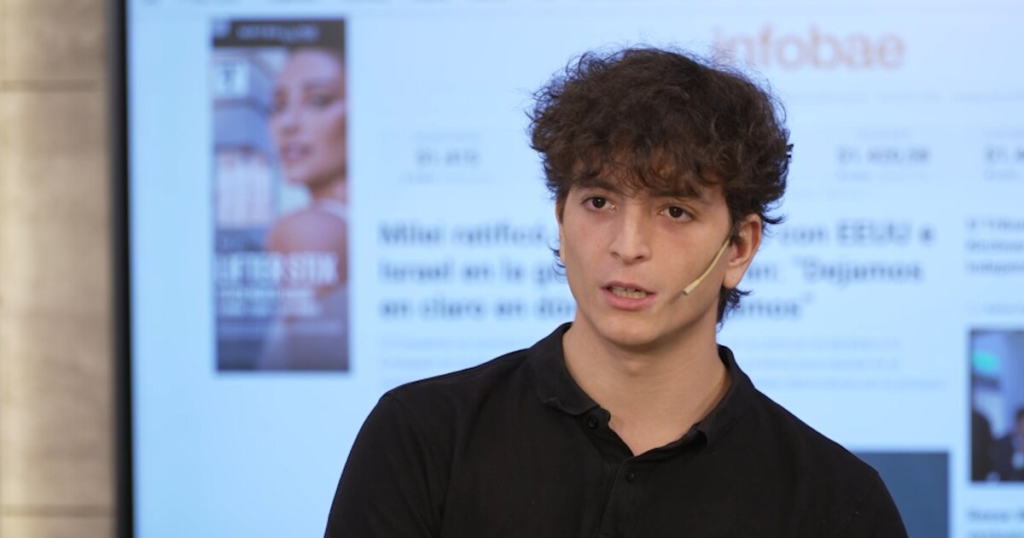
In an interview in Infobae Live the argentinian Valentin Poggio He narrated what the process was like to enter to study physics at Harvard and his experience in an international program linked to NASA.
During the talk with the staff of Infobae in the Afternoon —conducted on Tuesdays by Manu Jove, Maia Jastreblansky, Paula Guardia Bourdin, Rosendo Grobo and Lara López Calvo—, Poggio spoke about entering an American university. “What you do is apply and write essays, you send your analysis, you tell about your extracurriculars. The idea is that they get to know you academically and also as a person. What you intend to do in your life, what motivates you, what excites you, what you dedicate your time to outside of your academic endeavors,” he explained.
The student stressed that the selection process is the same for everyone: “It’s the same for us, whether we are international or American, whether you need a scholarship or not.”
The young man from La Plata, who today lives in Bostondetailed: “They are going to be looking a lot at the issue of interest, the issue of curiosity and the issue of motivation, because the knowledge part, let’s say, is a bit taken for granted. You have to have the grades, you have to have the exams, but that’s not enough.” He stressed that authenticity and personal interests make the difference: “They have to listen to what matters to you, what you want to solve, what moves you.”
From the perspective of international programs, Poggio was selected for the United Space Schoolan educational program supported by NASA and the Foundation for International Space Education (FISE), which brings together young people from around the world in Houston each year to simulate planning a manned mission to Mars. “The project was a simulation, it is not that we are really going, because the idea would be that this would eventually happen in reality with astronauts, that they would go to Mars, but for now ours was a simulation”said Poggio, who was part of the scientific exploration team.
The process to get to NASA was meticulous and required submitting a resume, letters of recommendation, essays and videos explaining their interests and capabilities, in addition to technical and personal interviews. The simulation required planning the launch, trajectory and exploration on Mars, defending each decision before a jury of international specialists.
Poggio recalled the origin of his interest in science: “I remember when I was very young, my parents got me a telescope. I was eight years old and we stayed up late looking at the stars. My dad focused on Jupiter and told me: ‘Well, there are these four moons’. From that moment on there was something that interested me, “I didn’t know it was called Physics or Astronomy or Astrophysics, but I was interested.”
The possibility of representing Argentina in these areas translates, for Poggio, into a validation of local educational quality and a responsibility: “It cannot be purely abstract science that has no results in reality.”
Today, from Boston, Valentín Poggio is committed to keeping his training open, exploring disciplines and possible paths, convinced that curiosity and personal motivation continue to be the driving force of his journey.
Infobae accompanies you every day on YouTube with interviews, analysis and the most outstanding information, in a close and dynamic format.
• From 7 to 9, Infobae at Dawn: Nacho Giron, Luciana Rubinska and Belén Escobar
• From 9 to 12, Infobae at Nine: Gonzalo Sánchez, Tatiana Schapiro, Ramón Indart and Cecilia Boufflet
• From 12 to 15, Infobae at Noon: Maru Duffard, Andrei Serbin Pont, Jimena Grandinetti, Fede Mayol and Facundo Kablan
• From 15 to 18, Infobae in the Afternoon: Manu Jove, Maia Jastreblansky and Paula Guardia Bourdin; Marcos Shaw, Lara López Calvo and Tomás Trapé rotate during the week
• From 18 to 21, Infobae to Return: Gonzalo Aziz, Diego Iglesias, Malena de los Ríos and Matías Barbería; Gustavo Lazzari, Martín Tetaz and Mica Mendelevich rotate throughout the week. News, talks and protagonists, live.
Follow us on our channel YouTube @infobae You can find the full interview at this link.