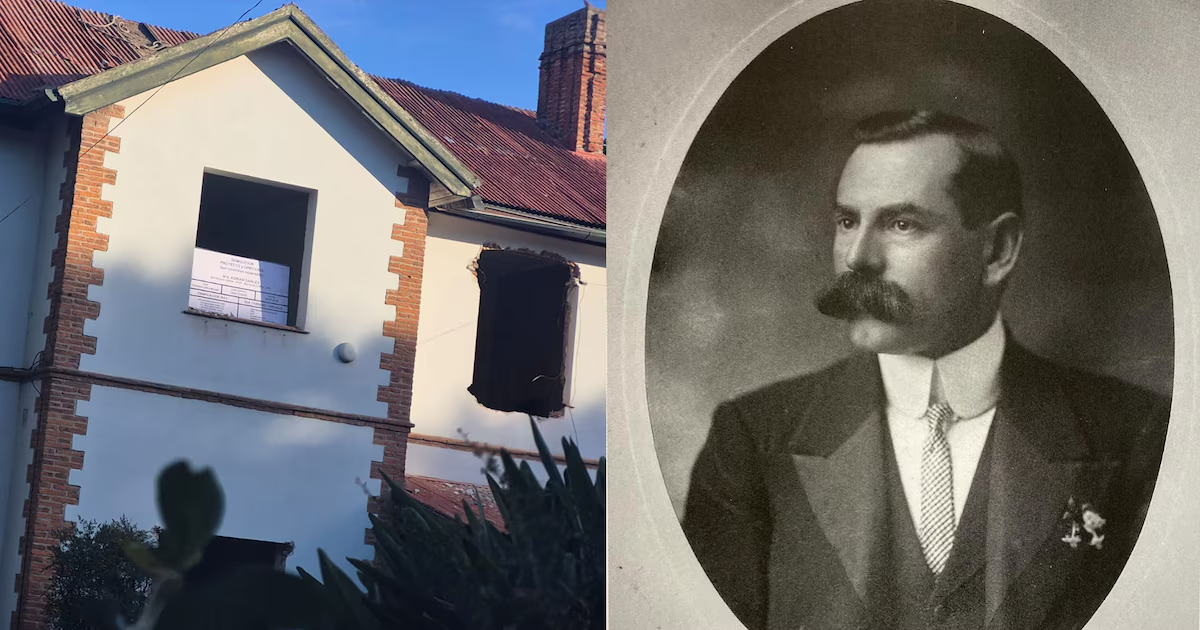
The portly, German figure of Don Ottowho had emigrated to our country with his wife because of the Second World War, was unmistakable. Otto Niederberger (probably few knew what his last name was, let alone how to pronounce it correctly, and I’m not sure if it was spelled that way) was almost an institution on the street. Pringles at 100 Temperley neighborhoodsince the times when the milkman did the delivery in a ramshackle turquoise Ford T and Don Lorenzo did the same with the La Razón farm with his heavy black bicycle, on that irregular cobblestone with immemorial wells, since over the years the people skilled in the art of arranging the cobblestones also disappeared.
Otto lived in a magnificent house with a ground floor and a first floor.in the English style, with a gabled sheet metal roof and crowned by two chimneys, whose days are now numbered.
We kids who wore out our sneakers in the distant days of playing games on the sidewalk, under the shade of the plane trees, and between the almost insolent shouts during the summer naps of the ice cream man or the blood-powered bottle rack, had learned to respect that big, conscientious man, accustomed to polite greetings and who, although at first impression he seemed to be distrustful and distant, hid a warm personality, an extremely affable character and that when he gained confidence he would even dismiss it with an innocent joke.
Otto lived with his wife. In addition, she shared the environment with her daughter Elisa, her husband and two children. The address was Pringles 150. The huge house was surrounded by a park that Otto always took care of keeping impeccable. There, a lantern stood out on its front on a column always painted English green.
We played with his grandchildren, and on some occasions, always with his supervision, he let us enter a room at the back of that house where he had built an incredible railway circuit, with several tracks, stations, tunnels and lights. A true dream for any boy.
That mansion, present and magnificent in the postcards of the block, within the English Quarter, which was born and grew from the installation of the railway station, is being demolished. And like any old house in a historic neighborhood, it brims with history.
By 1850 the area was a large wasteland of eucalyptus, oaks, paradise, willows and fruit trees. In 1854 the English George Allison Temperley built, in the south of the Buenos Aires suburbs, his country house fifteen rooms, with bathrooms with marble floors and fixturescistern, waterwheel and gardens with vineyards.
When he subdivided his land, he offered free bricks to buyers as an incentive. Temperley was a pioneer of the southern zone who, in addition, was a founding member of the Argentine Rural Society. The town that bears his name was formally born on February 1, 1893. The entire neighborhood is like an extension of any suburb of a British city, brimming with English, Scottish and Irish surnames -many managers and employees of the Ferrocarril del Sud, today Roca- who, over the years, would live with other Italians and Spaniards.
There, they had their villas on President Nicolás Avellaneda and Pablo RiccheriMinister of War of Roca. On the east side lived Commodore Martín Rivadavia, who died in a domestic accident. There is also the Greens’ fifth “Paradise Grove”, a clear example of British construction that, with modifications, is still standing, despite the fact that its characteristic viewpoint was removed years ago.
The person who built the Pringles 150 house was called Walter Bassett Smith. Born in London on July 23, 1855, he was the son of an architect, he dedicated himself to traveling through Europe with his sister and demonstrated his vocation for design when he won a prize for a sketch made of a Gothic cathedral. He studied architecture at the Royal Academy of Arts, worked with his father on various projects and He emigrated to Argentina in 1889, during the government of Miguel Juárez Celman.
In our country, he married Mary Chevallier-Boutell. In 1896, during the presidency of José Evaristo Uriburu, He built the house in question, which he called “the little house.” There he lived with his children and his in-laws.
He left an important mark on the country. He was one of the founders of the San Jorge de Quilmes school and designed the Madero Unzué palace, the current residence of the British ambassador. In addition, he created the Balcarce Quintana palace of the Chapadmalal ranch, mansions in Mar del Plata, the Presbyterian church of San Andrés in Temperley and the Llavallol dissident cemetery. And the list goes on.
In 1925 he emigrated to Australia, where he died in 1932 and there were no descendants left in the country. A few years ago a grandson came, interested in learning about his grandfather’s work.
As the neighbors explained to Infobaethere is the municipal ordinance 16,084 which contemplates the protection of historic buildings in the neighborhood built before 1960. They argue that at the time the list that was drawn up of those homes that could not be touched did not include Bassett Smith’s and that No one ever bothered to update it.
According to reports in the neighborhood, the sale would have taken place at the end of last year and the buyer would have assured that he would restore the property and enhance its value.
When the demolition works began on March 3, residents and heritage protection entities mobilized and they made a flood of orders to the mayor of Lomas de Zamora, Federico Otermín.
In a request for reports submitted on March 3, the municipality of Lomas de Zamora was asked for the file number by which the demolition was authorized, the municipal technical area that had intervened, whether an asset evaluation had been carried out and what were the reasons that justified the demolition. Finally, preventive suspension was requested until the points were clarified. According to Infobae, They had no response.
They also put the local British community on alert, which was aware, and one neighbor even wrote to the British embassy in the hope that they could intercede.
Meanwhile, the works continue. First there were the openings, then it was the turn of the roof made of old sheets painted red. Now only a few thick walls remain standing.
The neighbors are not clear about the project that will be developed on that immense piece of land.and they fear the loss of the usual tranquility, a characteristic attribute of the area. They are also struck by the speed of a procedure that, according to them, the Municipality’s Project Evaluation Commission will have had to work during January to evaluate this case.
This house was built the year Aristóbulo del Valle diedin which he committed suicide Leandro N. Alemand Varela Castex brings a Decauville automobile to the country, the first with an internal combustion engine. Furthermore, there was still a year left before the electric tram.
In this kind of chronicle of a death foretold, among the dust of the rubble and the protection of sheets where the evergreen fence was cared for, one can guess the figure of Don Ottothat helpful and correct neighbor, who was a distinctive character in that neighborhood whose apathy and indifference persist in taking away its identity and turning its back on the past, which is the same as ignoring a history of more than a century of existence.