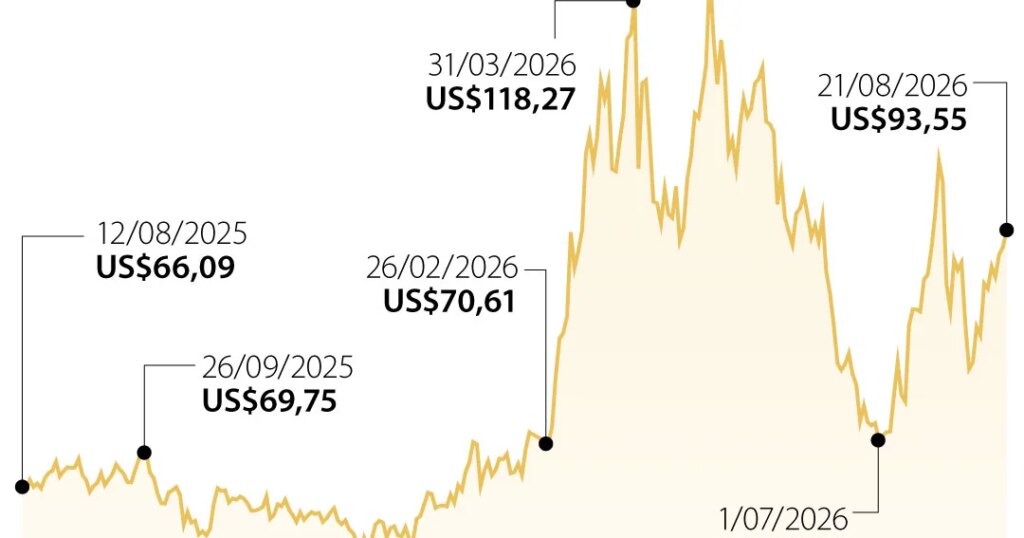
The war in the Middle East unleashed new turbulence in global markets, as oil surpassed $100 a barrel, causing losses in stocks and bonds. The dollar appreciated against most major currencies.
The The equity slump deepened this month, with the S&P 500 headed for its lowest level since November. Financial stocks came under fresh pressure, with Jefferies Financial Group Inc. sinking after an analyst downgrade.
Stocks sensitive to the economy, such as small caps, se were among the hardest hit as rising energy costs prompted investors to price in faster inflation, along with risks to growth. Ten-year Treasury yields rose for the sixth straight session.
“Risk aversion prevails,” said Marc Chandler of Bannockburn Capital Markets. “Stagflation is the main economic scenario being debated. Greater volatility in capital markets also contributes to reducing liquidity.”
Markets have been shaken by the continuing de-escalation of war in the Middle East, with the halt of oil tanker traffic through the vital Strait of Hormuz cutting off supplies to the rest of the world. Saudi Arabia has begun reducing its oil production as the kingdom races to boost exports through an alternative route.
According to France, the Group of Seven has not yet reached an agreement to organize a global release of emergency oil reserves in response to the war with Iran. Oil slowed its rise earlier, after news that the G-7 would discuss a possible release at its talks on Monday.
The S&P 500 fell 0.6%. The Russell 2000 lost 1.2%. The 10-year Treasury yield rose two basis points to 4.15%. West Texas Intermediate rose to around $100. Gold fell. Bitcoin exceeded US$69,000
The war between the United States and Iran is testing resilience to energy shocks, which is relevant to the extent that central bankers will remember that a general burst of commodity price inflation led to the burst of consumer inflation in 2022, according to Macquarie Group’s Thierry Wizman.
As the escalating war in Iran damages global markets, US stocks face growing risk of a sharp sell-off this year, according to veteran strategist Ed Yardeni, who updated his outlook for what he describes as “fast-moving times.”
Yardeni has raised the probability of a market collapse to 35% for the remainder of the year, up from 20% previously. At the same time, it sharply reduced the probability of an “upside breakout” (a rally driven more by investor enthusiasm than underlying fundamentals) from 20% to 5%.
The Traders are not prepared for a correction in the S&P 500 that could see the indicator fall as much as 10% from its peak as a result of the war in Iran, according to the trading desk at JPMorgan Chase & Co. Andrew Tyler, head of global market intelligence at JPMorgan, turned “tactically bearish” on Monday.