Technological advancement has transformed daily life and, with it, the exposure of personal and professional data on digital platforms. In this context, the World Password Day has been consolidated as a reference date to remember the importance of protecting access to sensitive information.
Every year, the first thursday in maygovernment entities, companies in the technology sector and user associations promote initiatives to educate about correct password management.
The main objective is reduce the risks associated with security breachespromoting the adoption of practices that strengthen access barriers against cyber attacks and data theft.
When and how World Password Day emerged
He World Password Day was established in 2013, in response to growing concerns about the vulnerability of personal and corporate data arising from the use of weak or repeated passwords. The choice of the first Thursday in May is not arbitrary, but rather responds to the intention of keeping the discussion on cybersecurity current and visible in a period of the year without other festivities that distract public attention.
The initial push came from the technology industry, inspired by security consultant recommendations Mark Burnett. in his book Perfect Passwordspublished in 2005, Burnett pointed out the need for users to adopt passwords unique and difficult to predict. These ideas were collected by companies and international organizations, which agreed to establish a global day to encourage the regular change of passwords and promote the use of tools for their secure management.
The commemoration was quickly adopted by cybersecurity organizations and digital platforms. According to the German statistics portal Statista, more than 60% of internet users admit to having changed their passwords at least once as a result of awareness campaigns linked to this anniversary. This data shows the impact that the initiative has had on global digital culture.
The website National Today highlights that the day has been key to making visible the need to update passwords periodically and avoid the use of simple combinations or personal information such as names, dates of birth or numerical sequences. Various specialists agree that the establishment of World Password Day It marked a before and after in the way of approaching digital security from the user’s perspective.
The relevance of World Password Day It is explained by the constant increase in cybersecurity incidents linked to credential theft. Data published by the medical journal The Lancet indicate that, in recent years, close to 80% of data breaches in health systems and financial services were caused by illegally obtaining passwords.
According to the United States Cybersecurity and Infrastructure Security Agencypasswords act as the first line of protection against unauthorized access. However, the tendency to reuse keys across multiple services and the preference for easy-to-remember combinations facilitate the work of cybercriminals. A spokesperson for the Telefónica company, during a recent campaign, stated: “Education and changing habits in the use of passwords are essential to reduce the risk of attacks.”
He National Cybersecurity Institute of Spain emphasizes that the complexity of passwords and regular updating are determining factors to avoid improper access. In addition, the implementation of two-step authentication has become a standard recommendation from international organizations, as it adds an additional layer of protection against possible leaks.
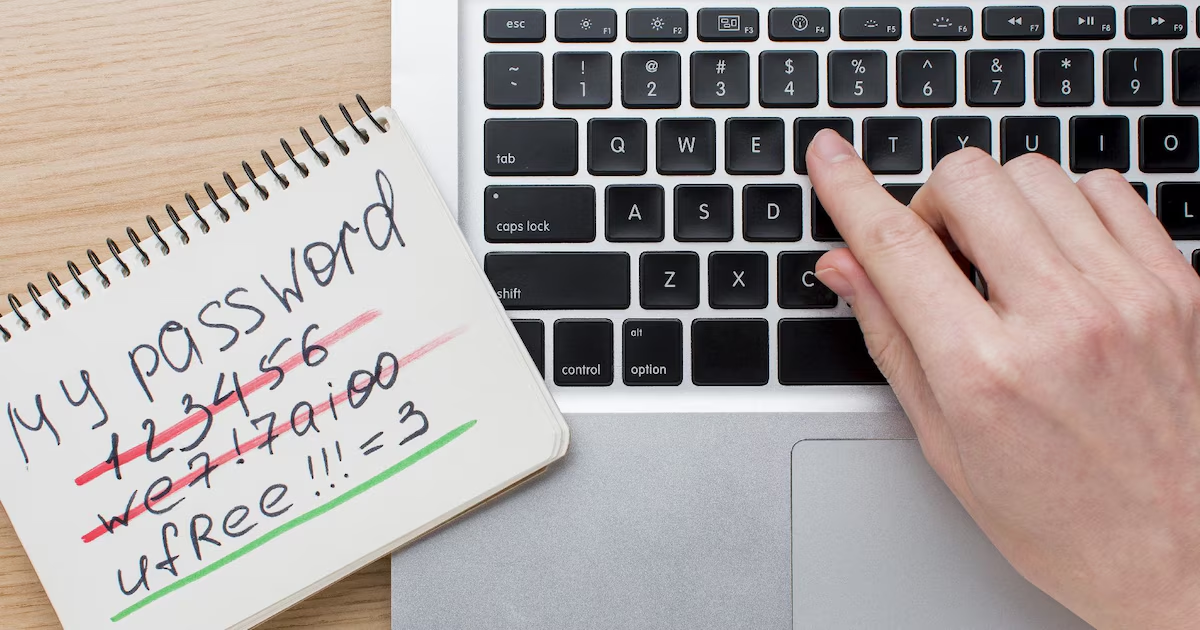
Various studies indicate that, despite awareness-raising efforts, bad practices still persist. Likewise, according to a recent report, “123456” and “password” They continue to be among the most used passwords worldwide. These habits expose users to unnecessary risks and demonstrate the need to keep active the dissemination of recommendations and preventive strategies.
Within the framework of World Password Dayorganizations and technology companies publish guides and advice to strengthen the digital security of users. One of the main recommendations is avoid using personal details or common words in passwords. In addition, it is advisable to combine upper and lower case letters, numbers and special characters, as well as use long and unpredictable phrases.
He National Cybersecurity Institute of Spain recommends changing passwords at least twice a year and not sharing them with third parties. It also suggests using password managers, applications that allow strong passwords to be generated and stored securely, preventing the user from having to remember them all. According to the portal Calendarranother effective measure is Be wary of emails or messages that request entering or updating passwordsa common technique used in phishing attacks.
Two-factor authentication, which requires a second verification code in addition to the passwordhas become popular as an effective measure to reduce the risk of unauthorized access. Other experts highlight that many companies have already incorporated this functionality into their services, allowing users to reinforce the security of their personal and work accounts.
Cybersecurity experts insist on the importance of periodically reviewing account activity and report any suspicious access. It is also preferable to avoid storing passwords in unprotected documents or in accessible places, like physical notes on desktops. The use of biometric methods, such as fingerprint or facial recognition, has established itself as a complementary trend to protect digital identity.
Every year, the World Password Day serves as a reminder for individuals and organizations to review their security policies and adapt to an ever-changing digital environment. Collaboration between users, companies and public entities is key to facing emerging challenges and strengthening the protection of information against new threats.