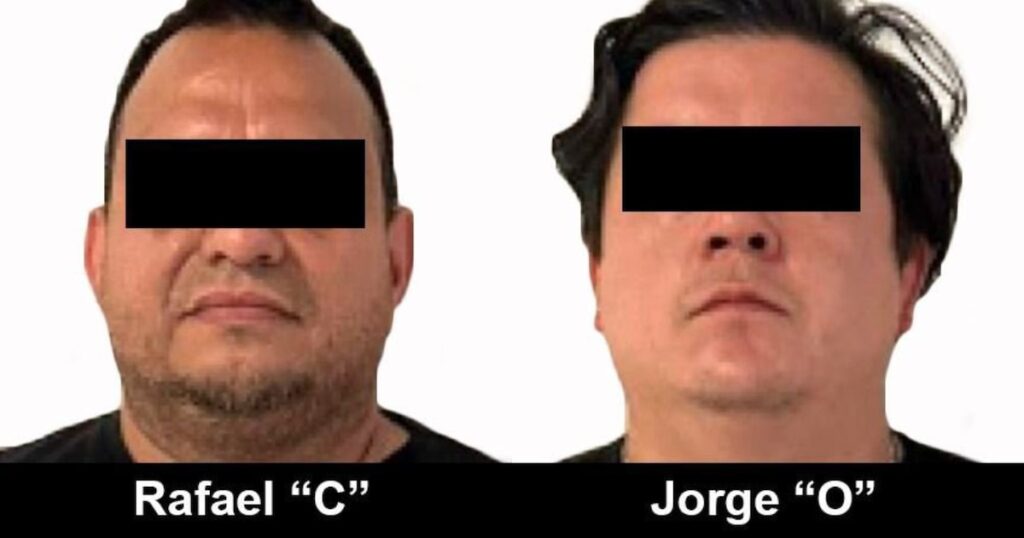
The Attorney General’s Office (FGR)through the Specialized Prosecutor’s Office for Organized Crime (FEMDO)obtained a conviction against Jorge “O” and Rafael “C” for their responsibility in crimes against health.
Those sentenced today were arrested in the year 2024, in the city of Tijuana, Baja Californiawhen they transported fentanyl inside a vehicle.
According to authorities, during the search of the guilty parties, a plastic bag was found that contained 10 packages with a total of 53 thousand 570 fentanyl pills.
During an inspection carried out by the State Citizen Security Force In Tijuana, state agents located a plastic bag with 10 packageswhich contained in total 53,570 fentanyl tabletsin the back seat of the vehicle where the sentenced people were traveling.
The discovery led to the immediate arrest of both subjects and the seizure of the vehicle, the police reported. FGR.
After the judicial process, the Federal Public Ministry (MPF) provided the necessary evidence before the District Court Specialized in the Accusatory Criminal System based in Tijuana.
The case was resolved through an abbreviated procedure, and a sentence of 4 years, 11 months and 29 days in prison for both defendants.
Those convicted must serve their sentence in the La Mesa Social Reintegration Centerlocated in the city of Tijuana.
The authorities highlighted that these types of sentences are part of efforts to combat the trafficking of synthetic opioids, such as fentanylwhich represent one of the main security challenges in the region.
The fentanyl crisis in Mexico has become one of the main public health and safety concerns in recent years.
Fentanyl is a high-potency synthetic opioid, legally used in medicine for the treatment of pain, but in the illegal market it is manufactured and distributed without control, causing thousands of overdose deaths.
Mexican criminal groups have increased the production and trafficking of fentanyl, mainly for export to the United States, where demand and consumption have grown alarmingly.
Drug trafficking networks import chemical precursors, mostly from Asia, to synthesize the drug in clandestine laboratories located in states such as Sinaloa, Sonora, Jalisco, Michoacán and Baja Californiaamong others.
The Mexican government has intensified operations to secure laboratories, seize precursors and capture drug leaders.
However, efforts face challenges due to corruption, the complexity of distribution routes and the ease with which fentanyl is transported, as small amounts can cause lethal effects.