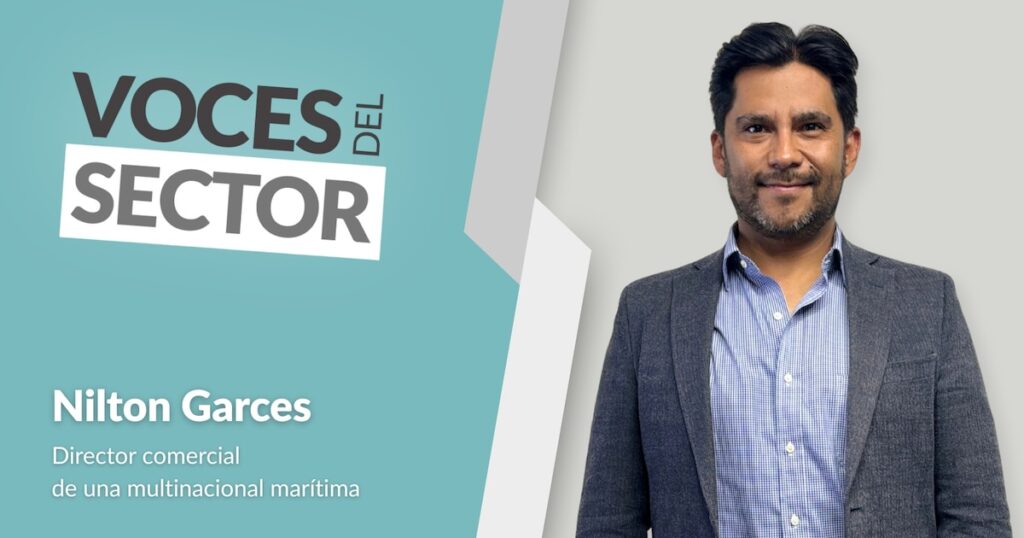
For Nilton, “Infrastructure shortcomings persist, especially on the east coast of South America. We cannot operate deep draft vessels, which are the ones that generate the best efficiencies”. In his analysis, he details how technology and planning can transform a key sector for the economic development and international expansion of the region.
Maritime transport is essential. In Latin America, exports and imports represent about 47% of the regional GDP. In other emerging areas, such as Asia Pacific, Eastern Europe and Sub-Saharan Africa, this weight reaches 67% or 70%. It’s huge. As economies deepen their integration into global trade, they grow, develop, and ensure that this growth trickles down to the population. The sector is a direct economic engine.
Today we face strong challenges. After the pandemic, geopolitical tensions were added: the war in Ukraine, the conflicts in the Red Sea, tariff disputes between the United States and different countries.
And in parallel, they persist infrastructure shortcomingsespecially on the east coast of South America. We cannot operate deep draft vessels, which are the ones that generate the best efficiencies. Also missing regulatory harmonization. Still, the potential is enormous: Latin America represents only 6% of global trade. Going up to 10% would already be a gigantic leap.
It’s a mix. There is natural limitationssuch as those of river transport to the Río de la Plata, but there are also investment deficit. To scale mining, technological and industrial activity, connectivity works, port expansions, dredging and integrated logistics systems are needed. Without that, opportunities fall halfway.
Directly. The infrastructure defines who gains advantage. Peru, for example, built a megaport in Chancay and today is positioned as a Pacific hub. That could have been Chile 15 years ago. The same thing happens on the east coast: Montevideo is looking for that role. But the entire region needs to simplify regulations, streamline procedures and modernize its terminals. Without that, charges become more expensive and we lose global opportunities.
There are two views. On the one hand, many companies deepened the vertical integration: land logistics, warehouses, port operators and fleet modernization. The idea of “end to end” appears strongly: a single supplier that manages the entire process.
But there is also the natural limit of specialization. Operating trucks is not the same as operating ships, nor managing customs is the same as managing a port. The key is integrate without losing expertise. And always taking care of the customer experience: make it simple, clear and on time.
Central. The maritime industry is old, physical and expensive: ships, ports and giant warehouses. More than 60% of its costs are fixed, so the margin for technological investment is not always wide.
Even so, we are moving towards artificial intelligence, geolocation, automation and chain efficiency. But nothing works without human talent. Innovation requires people who understand the context, make decisions and find opportunities in a volatile, uncertain and changing environment.
There are clear goals: decarbonize by 2045 or 2050. That drives more efficient ships, alternative fuels, automated terminals and cleaner operating practices. Autonomous driving models are already being explored on ships and ports with almost no staff. Everything will come gradually.
With much anticipation…and a lot of flexibility. We make plans a year or more in advance, but they are constantly adjusted. Globally, every two or three months; locally, every week. Everything is interconnected: What happens in a port in Brazil impacts the Río de la Plata, and that affects Europe, Africa or Asia. We must plan space on ships, availability of containers and export seasonalities. Planning changes depending on the objective: volume, profitability or economies of scale.