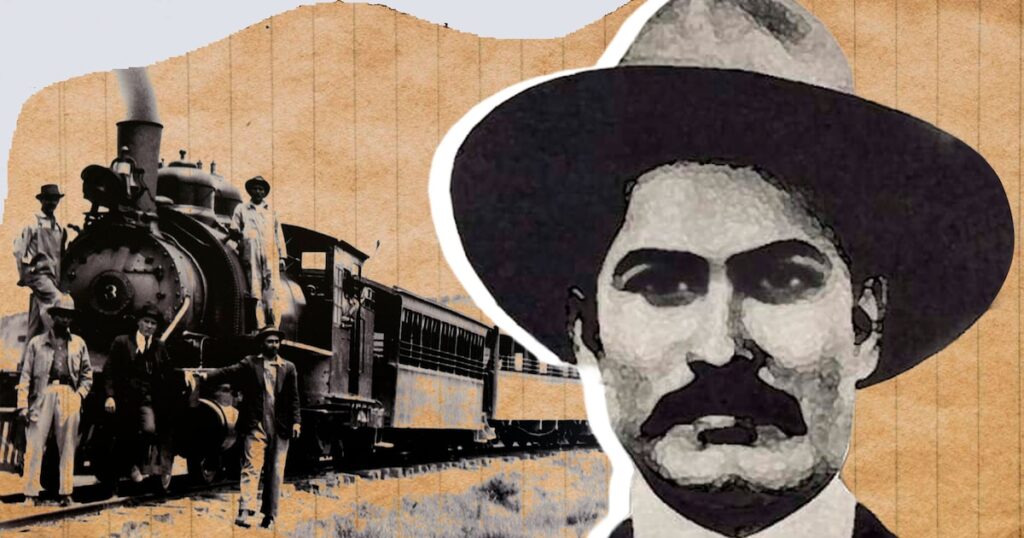
Jesus Garcia Corona was a mexican machinist who was immortalized in history for sacrificing his life to save the people of Nacozari, Sonoraof a tragic accident, a heroic act that earned him the title of ““The Hero of Nacozari”.
At the age of 17, Jesús started working in the office of the railway of the Mining Company. Due to his youth, W.L. York, in charge of the place, initially assigned him the position of water carrier. However, thanks to his dedication and effort, he quickly rose within the company.
In a short time he joined the road maintenance team, then worked as a brake controller and later as a firefighter. At the age of 20, he already held the position of machine engineer, demonstrating exceptional talent and commitment for his age.
On November 7, 1907, although he was not scheduled to drive the train, Jesus had to take responsibility for making three trips between Nacozari and the Pilares mine due to his partner’s illness.
During these runs, due to a loading error, the cars containing dynamite were placed at the beginning of the locomotive. Upon losing steam pressure, the machine began to generate sparks that reached the boxes of explosives, unleashing a fire that was quickly fueled by the speed and wind generated as it moved forward.
Given the magnitude of the fire, Jesús understood the imminent danger for the entire town, so he asked the crew accompanying him to jump from the locomotive to save their lives, while he tried to push the train away with all his strength.
The fire grew rapidly, fueled by air entering the dynamite boxes. Finally, Jesús failed to jump and, around 2:20 p.m., according to information from the Government of Mexico, a roar shook the Sonoran community; The shock wave broke glass and shook homes.
The explosion was so powerful that the locomotive was completely destroyed and Jesus lost his life instantly. In honor of his bravery, the Mexican government decreed November 7 as the Railway Day.
Since the beginning of the first Federal Republic in Mexico, Projects began to emerge for the construction of railways that would connect strategic points in the country.
In 1837, under the presidency of Antonio Lopez de Santa Annahe Mexican State granted Francisco Arrillaga the first concession to build the railway line between the Port of Veracruz and the Mexico City. However, due to various circumstances, the work could not be completed.
Between 1837 and 1850, four additional permits were granted to continue with the same project, but none of them managed to complete the planned section. Faced with these difficulties, the Mexican State decided to intervene and finish the segment from Veracruz to El Molino, only 14 kilometers long, thus beginning the operation of a small passenger railway in 1850.
Subsequently, the Government of Mexico granted a new concession to Antonio Escandon to conclude the line between Mexico and Veracruz, although the Reform War interrupted work again.
During the Maximilian Empire, The concession passed into the hands of the English company “Compañía del Ferrocarril Imperial Mexicano”, which managed to complete the Mexico-Apizaco section, with an extension of 139 kilometers.
After the fall of the Empire, the government of Benito Juarez He pardoned the concessionaire company, which was renamed “Compania del Ferrocarril Mexicano” and continued with the construction of the railway. Finally, in 1872, after overcoming important technical challenges related to curvatures and slopes, the work was completed.
On January 1, 1873, with the presence of the president Sebastian Lerdo de Tejadathe first 425-kilometer route was carried out between Mexico City and the Port of Veracruz.
From that moment on, the railway began to operate regularly with a fleet of 28 locomotives and 377 cars for cargo and passengers, representing an engineering feat for its time due to the complexity of the route from the coast to the plateau.