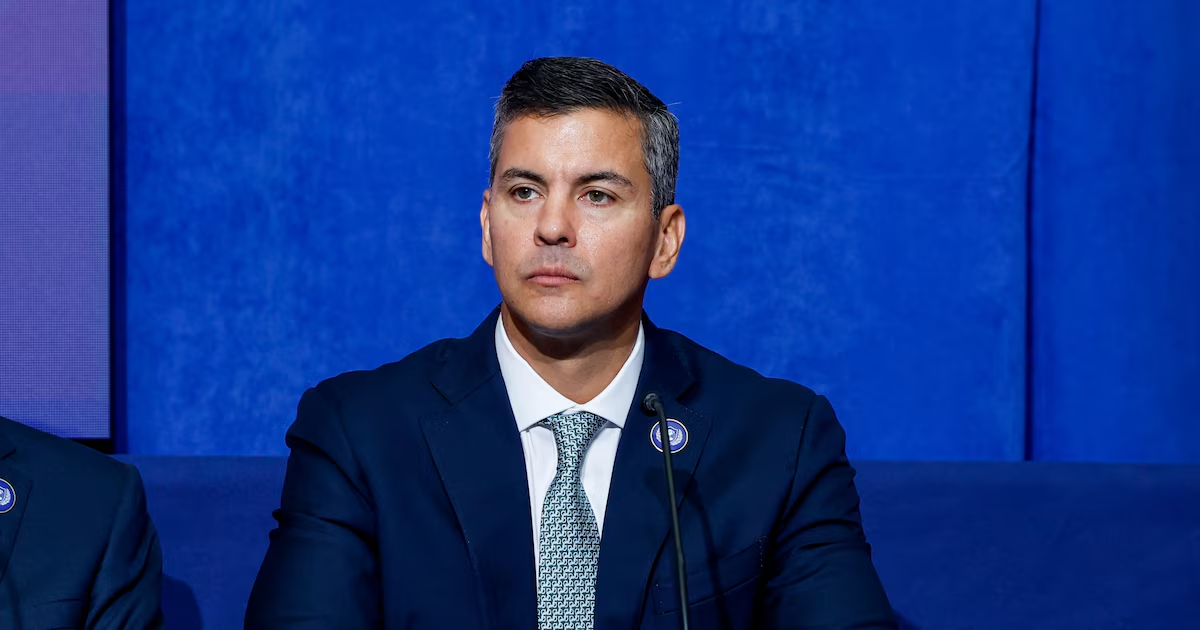
The president of Paraguay, Santiago Penaappointed this Monday Carlos Benítez as Vice Minister of Internal Security to replace Oscar Pereira and appointed César Silguero as the new commander of the National Police, in a reconfiguration of the area that the Government links to the strengthening of citizen security.
The announcement was made by the Minister of the Interior, Enrique Riera, who in a televised press conference stated that the measure aims to “strengthen” citizen security in the country. The change is part of the adjustment process promoted by the Executive in the second half of the mandate that began in August 2023.
During the presentation of the new authorities, Riera highlighted the professional background of the officials. “They are here because of their resumes which, by the way, are impeccable. So, it is very nice to make a change, because all changes, it must be said, renew hope”he expressed.
The head of the Interior explained that Pereira’s departure is not due to failures in his performance. “It has nothing to do with it” with poor performance or execution errors, he maintained, and linked the decision to the need to deepen current policies. According to him, the objective is to advance in the “deepening of work” within the National Police.
With his appointment as vice minister, Benítez, 55, retired from the police institution “voluntarily”according to Riera. The minister also stressed that the change was defined in advance. “It was a decision that was made before Easter, and we handled it with great caution”he stated.
Benítez held the command of the National Police since August 2023. In this context, he had publicly warned about the existence of alleged elements within the force that acted “outside the law”in reference to internal situations that required institutional control.
The appointment of Silguero as head of the National Police completes the leadership scheme in the security area. The official served as second in command and now assumes ownership of the body in a stage that the Government presents as one of consolidation of changes.
In June 2024, Paraguay reformed the law that governs the National Police with the objective of raising the level of professionalism and ratifying its non-deliberative nature, in accordance with the 1992 Constitution. This regulatory framework defines the functioning of the institution and establishes the guidelines for its actions.
At the press conference, Benítez indicated that from his new position he will seek to consolidate the approach established after that reform. The official indicated that he will work to strengthen the new paradigm in the performance of the security body.
The changes in the Ministry of the Interior are part of a broader reorganization of the cabinet in the second half of the presidential term. According to the authorities, the modifications seek to reinforce strategic areas of the administration.
Economic context and other movements
A week before these announcements in the security area, the Government ordered changes in the Ministry of Economy and Finance. The Chief of Staff, Javier Giménez, reported that Peña removed the head of the portfolio, Carlos Fernández Valdovinos, and appointed Juan José Galeano as interim.
“The President of the Republic, Santiago Peña, has ordered changes in the Ministry of Economy and Finance this morning”declared Giménez. The spokesperson maintained that the outgoing official “he did an extraordinary job” and explained that the “second half” management requires skills “very specific”.
Fernández Valdovinos had promoted fiscal adjustment measures under a scheme that he defined as “war economy”in response to the drop in tax revenues. After his departure, he wrote on the social network X: “Mission Accomplished!!! Everything for my beloved Paraguay”.
In addition, the Executive appointed César Riveros as director of the National Institute of Technology, Standardization and Metrology after the resignation of Lira Giménez.
On the commercial level, the president promulgated the law that ratifies the free trade agreement between the European Union and Mercosur. “Asunción was the cradle of Mercosur and today it is once again the protagonist”Peña wrote after signing. The Vice Minister of Foreign Affairs, Miguel Ángel Aranda Daroczi, pointed out that the agreement represents “a great opportunity to integrate the market and offer what Mercosur produces to the entire European market”.
According to official data, the treaty covers a market of approximately 720 million people and provides for the elimination of tariffs for more than 90% of trade between both regions.
(With information from EFE)