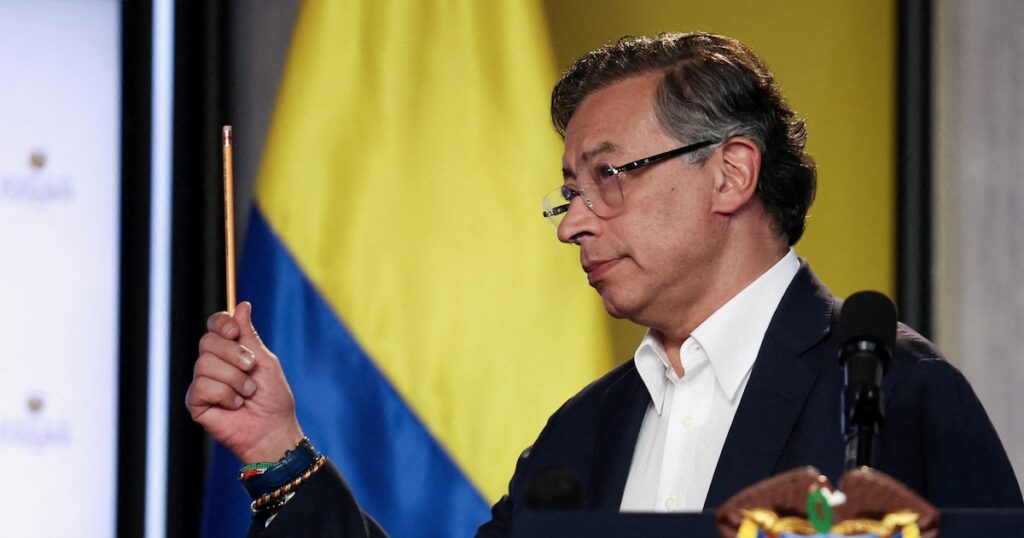
President Gustavo Petro harshly criticized the absence of the president of the United States, Donald Trump, at the COP30 Climate Summit in Belém do Pará, Brazil, and has made it known on social networks in more than one publication.
In fact, in his speech at the multilateral event, Petro included direct criticism of certain officials of the United States federal government.
You can now follow us on Facebook and in our WhatsApp Channel
But a new message he wrote on social networks added accusations that the North American federal government would be acting against the general interest of humanity by refusing to participate in the global dialogue on the climate crisis.
For Petro, this refusal arises from “climate denialism” and represents a serious risk. In his words he expresses: “I said yesterday in my speeches before COP 30, that the refusal to attend a dialogue with humanity due to simple denialism, placed officials of the US federal government against the interests of humanity.“, wrote.
The Colombian president said that ignoring scientific evidence and avoiding the climate crisis will only bring negative consequences for the most exposed regions of the United States, and explicitly cited “Texas, Florida, California, New York” as vulnerable areas.
In addition, he advocated for the construction of a joint agenda between Latin America, Mexico and the North American states with the greatest energy demand, aimed at cooperation to face environmental challenges.
The first dignitary also rejected the campaigns that, from the US federal government, brand Latin American offers as harmful.
Contrary to these characterizations, he maintained that the region has the capacity to produce the clean energy necessary to support the decarbonization process in electricity generation in the United States.
“We offer to have the potential capacity to generate the clean energy needed to decarbonize electricity generation in the US.“, he stated.
The president also stated that his proposal could favor the development of US investments in renewable energy in the south of the continent, encourage prosperity, reduce migratory flows to the north, reduce incentives for drug trafficking and strengthen democracy in Latin America. YesAccording to Petro, this approach would also contribute to the competitiveness of the United States and prevent a global climate collapse.
However, the president regretted that such approaches do not have an echo within the federal government of the United States. He considered, in his message, that the leadership is distracted: “These theses have no one to listen to them in the federal government, they are anesthetized among strikes and fake news and the smell of oil,” he said.
In another section of his message, Gustavo Petro referred to how some US sectors misinterpret his government’s positions regarding the protection of children in Palestine, wrongly associating them with an alleged intention to weaken the technological defense systems used by Colombia.
He rejected those accusations by recalling: “They don’t even know that I set up the radars, gave the maximum seizure order and that’s why many drug traffickers went to Ecuador.“.
Gustavo Petro announced that Colombia is prepared to reestablish diplomatic relations with Israel if a peace process begins in the region, as reported by the president on November 7, 2025.
The president also proposed that a stabilization and coexistence force in Palestine operate under the flag of the United Nations, an approach that seeks to support security and peace in the Palestinian territory.
Petro’s statement comes after recent attacks in the Gaza Strip, where significant damage and civilian casualties, including the death of minors, have been reported, as documented by international agencies.
The Colombian president conditioned the resumption of diplomatic ties on concrete progress in dialogue and peace between the parties involved. The announcement is framed in the context of the humanitarian crisis that Palestine is going through and the escalation of tensions between Israel and armed groups in the region.