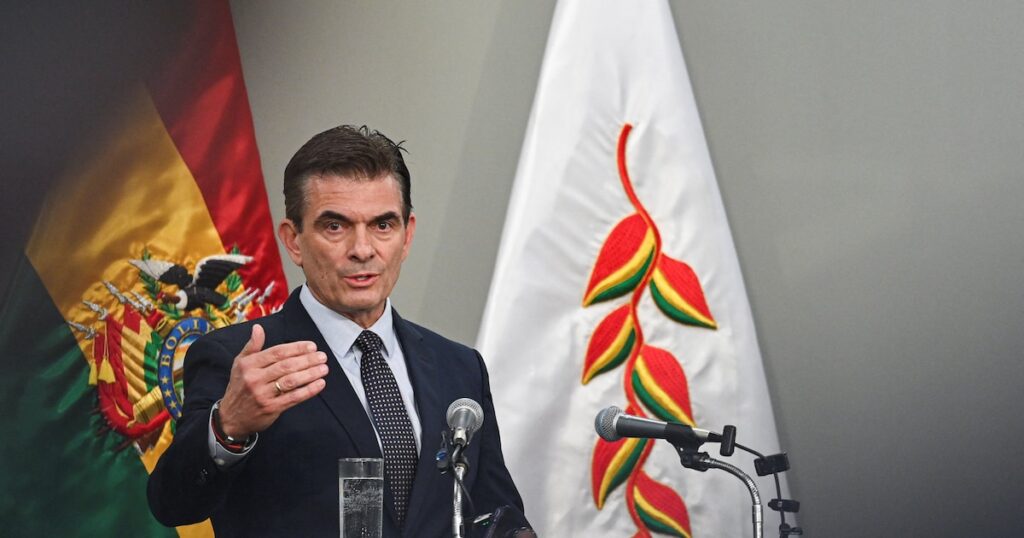
The president of Bolivia, Rodrigo Pazdeclared that measures such as the tax on large fortunes generated economic isolation in the country and kept away both national and foreign investment.
“(Those currencies) went abroad because the money, if you don’t respect it to reinvest, goes away. That’s why we We have turned (Bolivia) into an island, nobody wants to invest“said the president.
In an event with workers from the National Electricity Company (ENDE) in Cochabamba, he defended his administration’s recent decision to eliminate this tax, introduced during the previous mandate of Luis Arce.
Paz reported that the original intention of this tax was to redistribute resources from the sectors with higher incomes, but maintained that it did not meet that expectation. According to your vision, Some regulations of previous governments caused an exodus of capitalestimating that in the last six or seven years around 7,000 million dollars were moved out of the country.
The president mentioned as an example that merchants from El Alto, although they maintain their activities in Bolivia, prefer to deposit their money abroad, especially in Chile. In this sense, he stressed that the collection from this tax was low and that in the last three years it was registered a leak of 2.5 billion dollars.
Paz expressed the importance of these resources returning to the country, since their reinvestment would contribute to employment and economic activity. For this reason, he considered the foreign direct investment registered this year insufficient, a figure he placed at 247 million dollars.
The tax on large fortunes, imposed starting in 2020 and aimed at assets exceeding $4.3 million, officially contributed about $137 million in five years.
The Paz administration also reported that it will send initiatives to Parliament to eliminate other taxes, such as those applied to financial transactions, gambling and business promotionsarguing that their weight in collection is less than 1% and that they do not compensate for the cost of their management or the loss of confidence for investors.
For his part, the Minister of Economy, José Gabriel Espinoza, insisted that these taxes motivated capital flight and low international investment interest. In addition, the Executive announced that it will seek to adjust the General State Budget for 2026, with the goal of reducing public spending by at least 30%.
The official reported on Tuesday about the decision to eliminate four taxes: the financial transfer tax (ITF), the tax on large fortunes, the gambling tax and the tax on business promotions. The measure would be part of a package aimed at stabilizing the economy.
Espinoza explained that the tax on large fortunes generated the outflow of capital from the country and discouraged foreign investment, and business organizations expressed their support for the elimination of these taxes. The Confederation of Private Entrepreneurs of Bolivia, in a statement, described the taxes as “regressive and unnecessary”, and pointed out that they harmed the economy and stopped investment.
The government of Rodrigo Paz affirmed that the elimination of the four taxes and the 30% reduction in public spending, provided for in the reform of the General State Budget, mark the beginning of a series of measures that will be implemented progressively until March. Espinoza pointed out that these actions seek to lay the foundations for the recovery of the economy.
(With information from EFE)