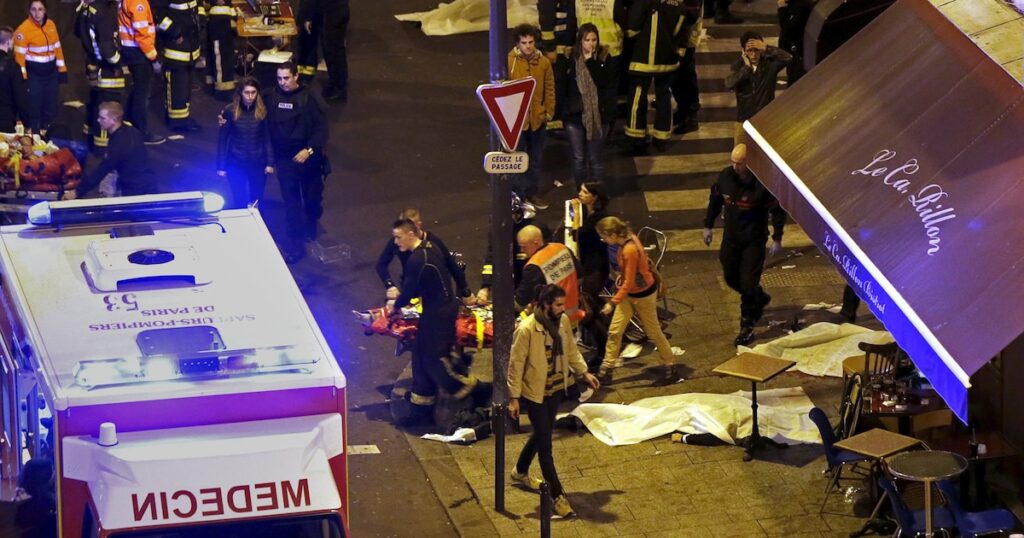
The nightmare began exactly a decade ago. In a perfectly planned action between 9:20 p.m. on Friday, November 13, 2015 and 1:40 a.m. on Saturday the 14th, three nine-man commandos carrying automatic weapons and explosive belts killed 130 people and injured 350. Ninety of those people were murdered at the Bataclan concert hall. In various terraces and restaurants in the 10th and 11th arrondissement of Paris, another 39 were murdered. In the Stade de France, one more. That Friday Paris changed forever.
France faced one of its greatest social and political tests since World War II. That November 13, ten years ago, the country, shocked by the deadliest jihadist attack on its territory, began a long process of transformation both in the public sphere and in the private lives of the survivors, the victims’ families and the entire society.
Hours after the bloodbath, the Islamic State terrorist group (ISIS), which still had cities such as Raqa, in Syria, or Mosul, in Iraq, under its control, claimed responsibility for the attacks. They said the killings were a response to France’s involvement in the international coalition that bombed their positions in Syria and Iraq.
On November 13, 2015, Paris lived a regular Friday night. The national soccer team faced Germany in a friendly match at the stadium located in Saint-Denis, while the Eagles of Death Metal band offered their music at Bataclan, an emblematic venue in the city of Light located on Boulevard Voltaire. It was there that three armed young men burst in around 9:40 p.m., shooting into the crowd. Ten minutes earlier, two suicide attacks had occurred in the vicinity of the stadium, with the intention of also attacking the massive concentration of people, including the presence of President Hollande and the German Foreign Minister Frank-Walter Steinmeier, who were evacuated after the explosions. There were also shootings in bars and restaurants.
The highest number of deaths occurred in Bataclan. There three terrorists armed with AK-47 rifles and explosive belts began an all-out shootout. “You bomb our brothers in Syria, in Iraq,” “French and American soldiers bomb from the air. “We are men and we bomb from the ground.”“Thank you (François) Hollande, you elected him,” said Ismael Omar Mostefai, one of the extremists, according to reconstructions of the time. After the shooting, people tried to escape and the terrorists took hostages. Finally, after being wounded by the police, Mostefai blew himself up: the terrorist was identified by a finger that appeared between the theater seats. He was French, of Algerian descent.
The police response and state of emergency declared after the assault marked the beginning of a new era of security and surveillance in France. The then president François Hollande described the attacks as “act of war” and declared a state of emergency nationwide, allowing for faster investigations and warrantless searches. Around 10,000 soldiers were deployed in sensitive areas, such as train stations and places of worship..
The government reinforced surveillance in the nerve centers and adopted a series of measures that altered the daily lives of citizens. The trauma, as described by those who experienced the massacre up close, was felt both collectively and intimately. A debate began between freedom and security.
The daily life of Parisian society changed drastically: heavily armed soldiers patrolled museums, stations and squares; ID and backpack checks became common at the entrance to any venue; The culture of “living together” – central to the country’s official and identity discourse – acquired a new dimension. For many, the spontaneity and confidence typical of the French “art de vivre” were replaced by fear, suspicion and permanent surveillance. However, the resistance of social sectors and artists, who demanded freedom and the right to joy in the face of jihadist terror, was also manifested in the following months and years.
In terms of broader social impact, the collective trauma fueled national debates about integration, Islamic radicalization, the role of intelligence, and the limits of immigration. The local Muslim community – which immediately denounced the massacre – was exposed to an increase in hate speech and controls, generating tensions and, at the same time, dialogues about coexistence. Political leaders of various tendencies took advantage of the context to demand harsher measures or, on the contrary, warn on the dangers of restricting freedoms in the name of security.
The artistic and cultural collective of Paris, directly hit by the Bataclan tragedy, suspended its activities for weeks. The reopening of the room, one year laterbecame a symbol of resistance and improvement. The first performance was performed by Sting. The famous musician asked for a minute of silence to honor the victims and opened the recital with the song Fragile. “We will not forget them”was the phrase that Sting chose to remember those who had been killed there a year before.
The judicial process that tried the surviving accomplices and perpetrators acquired historical dimensions. Fifty-four months after the tragedy, the French justice system began the largest criminal trial in its history, with more than 1,300 plaintiffs, witnesses, police officers and experts. Twenty defendants and nearly twenty thousand documents made up the file. The trial resulted in revealing confessions, tense confrontations and a public display of the victims’ pain. Deliberations began in September 2021. There were 148 hearings, statements from more than 400 survivors and family members were heard. The courtroom was built for that trial, 330 lawyers, five judges participated and there were extreme security measures and everything was recorded. There were 14 defendants present and another six absent.
The only survivor of the jihadist cell that carried out the attacks, Salah Abdeslam, 36, was in the dock. In court, some were considered accomplices. The rest of the terrorists who were involved in the event that has been going on for a decade blew themselves up or were killed by the police. Abdeslam is serving a life sentence without the possibility of parole at the high-security Vendin-le-Vieil prison in northern France.
In recent statements, the national anti-terrorism prosecutor, Olivier Christen, stated that the jihadist threat remains “the most significant, both in its magnitude and in its level of operational preparedness,” and warned that it has been “growing steadily over the last three years.”
Every November 13, as will happen today, family members and institutional representatives carry out acts of remembrance that seek to keep alive the memory of those who died and reaffirm the decision of French society not to forget or leave crimes unpunished.
As a balance, after a decade, Denis Peschanski, a historian at the French National Center for Scientific Research, who has studied the aftermath of the attacks, points out: “Anyone could have been a victim, either because they were old enough to be there, or because they were old enough to have children who could have been there.”. French society was no longer the same.