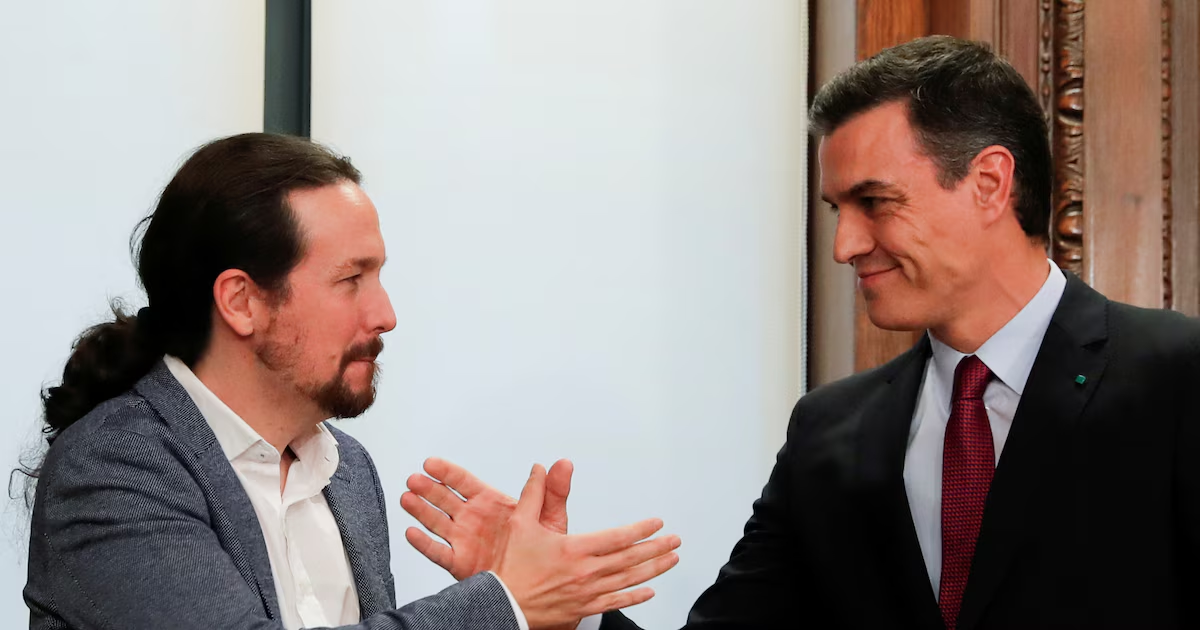
Pablo Iglesias revealed this Monday that Podemos deceived the PNV and Ciudadanos to get the motion of censure against Mariano Rajoy came out ahead in 2018 and Pedro Sanchez became president of the Government. Eight years have passed since that moment. Iglesias has explained it in RNE mornings.
“Sánchez suddenly found himself president of the Government without having made a sad phone call to ask for support,” said the former vice president, who has opined that the socialist’s lack of time to negotiate worked in his favor. “If he had had to negotiate, he would not have been able to deliver what the PNV or Junts would have asked of him,” he noted.
The first step of the strategy, Iglesias has begun, was to convince Albert Riverathen president of Ciudadanos, that early elections after the motion would benefit his party. To do this, he told him that the polls indicated that Cs would obtain more seats than the PP since Podemos would surpass the PSOE in a hypothetical election.
With that argument on the table, Iglesias proposed to Rivera the possibility of jointly presenting a motion of censure of an instrumental nature, whose only declared objective would be to force the electoral call.
“We made him believe that it was indeed possible for us to present together a motion of censure of an instrumental nature to call elections,” the former Podemos leader admitted. Rivera, however, ended up voting against the motion. Despite this, the conversation fulfilled its function: to sow the idea that the initiative would have broader support than it finally had, which Iglesias used as leverage for the next movement.
With that scenario built, Iglesias contacted Andoni Ortuzarthen president of the PNV, to warn him that the motion was going to succeed with the support of the PSOE and Ciudadanos. He told him that if the Basque nationalists continued to support the PP after the ruling in the Gürtel case – which condemned the party for systematic corruption – they would suffer a severe electoral cost in the elections that, in theory, would be called after the approval of the motion. He also reminded him that Podemos had already surpassed the PNV in the 2016 general elections, a fact that reinforced the pressure on the Basques.
“You will see,” he told him, according to his own story, in what he described as a victory “for the mus” that “comes once in a lifetime.”
Iglesias has also mentioned that, in parallel, he spoke with Martha Pascalthen leader of the PDeCAT, to try to gain the support of Carles Puigdemont to the motion. The former Catalan president was not initially willing to support it given the political cost it could entail at a time of maximum tension between the independence movement and the State. The negotiations with Pascal were part of the same support-building strategy that Iglesias described this Monday.
One of the most striking aspects of Iglesias’ story is the secondary role he attributes to Sánchez himself in the entire operation. According to the former leader of Podemos, the then general secretary of the PSOE did not participate in any of the negotiations that made his arrival to power possible. “Sánchez suddenly found himself president of the Government without having made a sad phone call to ask for support,” he repeated, making Podemos the true architect of that change of government.
Despite this, Unidas Podemos was left out of the Executive during the first year and a half of that legislature. The coalition between socialists and the purple formation did not materialize until after the elections, in November 2019, when Iglesias did enter the Government as second vice president.