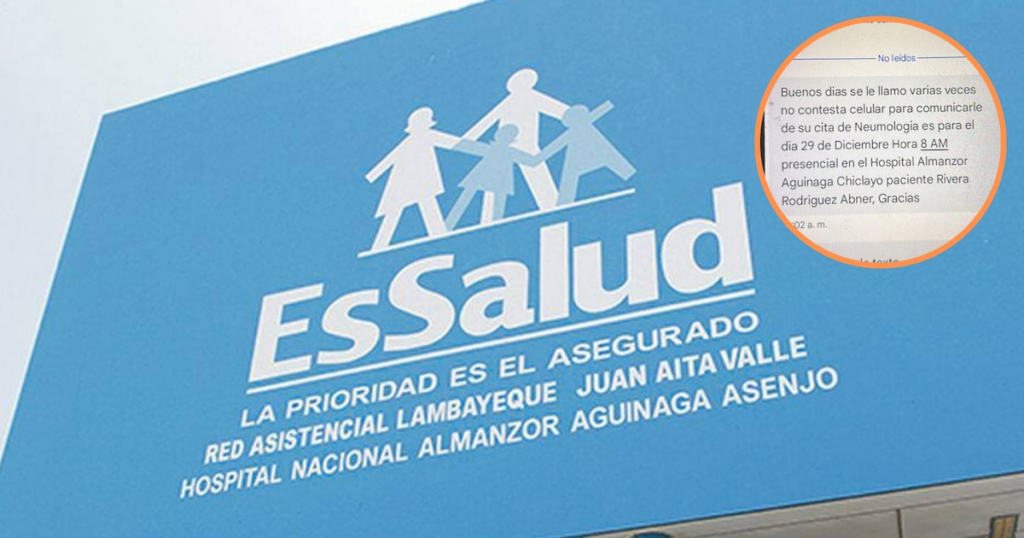
In the midst of the public debate about the deterioration of Social Health Securitya complaint spread online starkly showed the distance between citizen demand and the institutional response capacity. The publication started from a young woman who told the case of her father, a patient who waited for months for a specialized appointment that never arrived on time. According to him, the family recently received an official message with the assignment of care scheduled for December 29 at the Almanzor Aguinaga Hospital, in Chiclayo. The patient’s name, Abner Rivera Rodríguezreappeared in the records as if it were still on the list.
The young woman stated that her father died almost four months ago in the same emergency area of that establishment, last attended by the Pulmonology service. In his message he wrote: “The patient, Rivera Rodríguez Abner, my father… died almost four months ago.” And he added that the notification came “precisely from the same (service) that today sends you an appointment as if you were still waiting to be seen.”
He also explained that his father lived with pulmonary fibrosis, a disease that required constant monitoring. He said he searched for a specialized appointment for months without success. He described that he was a retiree who contributed to the Social Security throughout their lives, with the expectation of receiving adequate care. In his publication he expressed: “He waited for months for an appointment that never came on time.”
The young woman showed her discomfort by pointing out that, while a registry keeps a deceased patient active, another person in real need continues without an opportunity for care. In his message he stated: “Today we feel anger and helplessness, because while the system assigns an appointment to someone who is no longer here, there is another person alive who is waiting for an opportunity like the one my dad needed in life.” He also maintained that the situation reveals internal failures: “All due to the poor management and lack of coordination of the hospital, which does not even have a updated control of your patientsFinally, he described the case as an example of the abandonment of the public health system and wrote: “I hope that my father’s story is not repeated, and that this message serves to remind us that each late medical appointment can mean one less life.”
The testimony became a reference within the debate on the excessive deadlineswhich affects thousands of users. The publication became one more example of dissatisfaction with a system that, according to civil and business organizations, maintains long delays in addressing basic and specialty medical needs.
In a recent conference, the president of Confiep, Jorge Zapata Ríoswarned that Social Security faces a structural problem that prevents timely attention. He indicated that the delay in the delivery of appointments has already become a constant. He reported the following: “There are services that take 105 days, and currently 42 thousand patients They are waiting for care.” His observation pointed out, among other cases, the time required to obtain an appointment in endocrinology and the waiting list for operations.
Zapata Ríos asked President José Jerí to prioritize the sector. He said: “Just as you visit prisons and police stations, we ask you to do the same with EsSalud hospitals. We cannot continue waiting. EsSalud has to improve and it has to do it now.” His request sought for the Executive to take concrete measures in the face of a system that, as he indicated, lost its capacity to respond.
Another critical voice came from Indyra Oropeza, president of the ‘Con L de Leucemia’ collective. She highlighted that the institution went through multiple changes in its executive presidency during the Government of Dina Boluarte, which prevented minimal continuity in leadership. He maintained: “No entity survives that rotation. No management can consolidate with that level of instability.”
Oropeza indicated that the lack of response pushes many workers to look for alternatives outside the formal framework. He explained that many users request to leave the payroll to access Comprehensive Health Insurance, since Social Security does not cover high-cost diagnoses, such as cancer. He stated: “If a patient must choose between working formally and saving his life, it is because the system has failed.”
Both Confiep and various groups showed concern about the impact of delays in essential programs, including PADOMI, aimed at older adults, and Farmacia Vecina, which allows access to medicines. The continuity of these services was in doubt due to the lack of internal management and coordination.