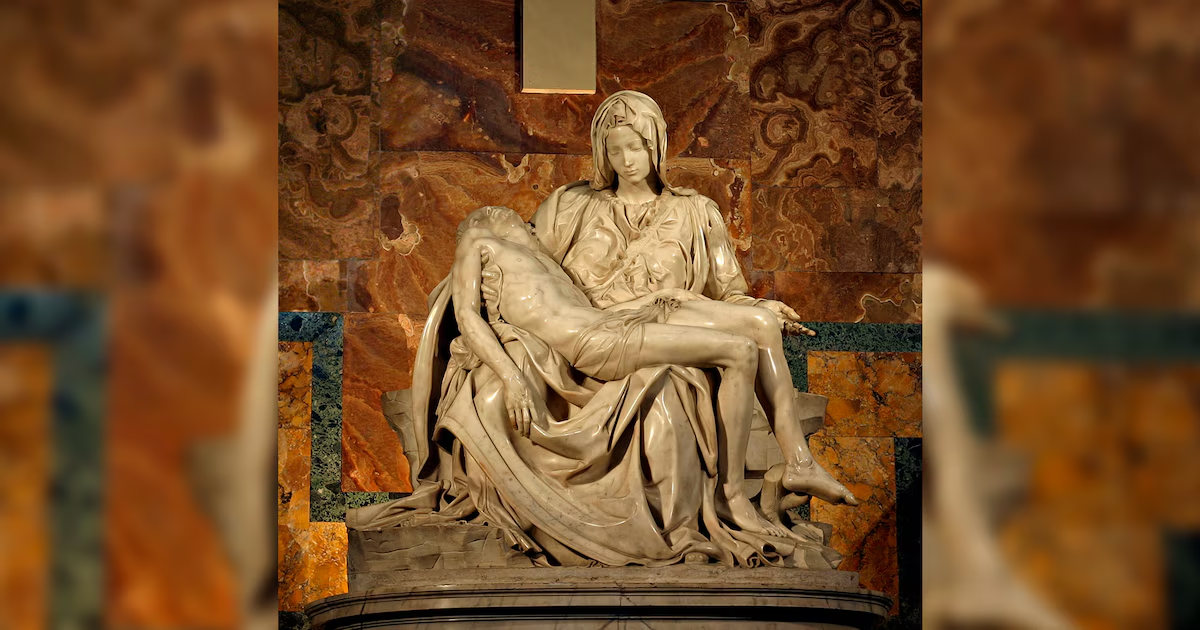
In the silent marble where the flesh seems to breathe and the pain becomes a perfect form, Miguel Ángel Buonarroti left one of the most disturbing and sublime images in the history of art: the Piety. He was barely 23 or 24 years old when, in 1498, he accepted the commission that would launch him into immortality. At that age when many artists are still looking for a teacher, he was already ready to argue with the stone and extract a scene from it that would condense the Christian drama: a mother holding the dead body of her son in her lap. The sculpture would forever be known as “the Piety” and today it rests in the first chapel to the right of the central nave of the St. Peter’s Basilicain the heart of Vatican City. But his story, like everything Michelangelo touched, is made of pride, faith, violence and an almost unhealthy obsession with perfection.
The order came from a French cardinal, Jean de Bilhères de Lagraulas, ambassador of the King of France to the Holy See. He wanted a sculpture for his funerary monument in the ancient Constantinian Basilica of St. Peter. It was not a minor request: it had to be a work, “the most beautiful that could be found in Rome”as stated in the contract. Michelangelo personally traveled to the Carrara quarries to choose the block of marble. He looked for it without streaks, without fissures, with that almost translucent purity that would allow light to penetrate the surface and the flesh to appear alive. The young Florentine understood that marble is not sculpted: it is liberated. The figure is in there; the artist only rescues her. The sculpture was not conceived for the place it occupies today. It was originally in the chapel of Saint Petronila, in the old basilica. That chapel, associated with the French monarchy, reinforced the political and diplomatic nature of the commission. When the demolition of the old church began in the 16th century to build the new Renaissance basilica, the sculpture was moved several times until it found its final location in the current chapel, where a thick sheet of armored glass protects it from men, not time.
The scene that Michelangelo composed is revolutionary. The Virgin—because iconographic tradition maintains that she is the Virgin Mary—supports the body of Christ without theatrical tear. There is no scream, there is no tension. The pain is contained, almost philosophical. María is young, too young to be the mother of a 33-year-old man. Critics noticed it early on. Michelangelo responded that purity preserves youth: the incorruptibility of the soul translates into a face without wrinkles. That idealized youth is not biological; It is theological. And yet, the doubt persists: Is it really the Virgin or could it be Mary Magdalene? The traditional iconography of the Pietywhich emerged in northern Europe in the 14th century, presents Mary as a grieving mother. Mary Magdalene usually appears at the foot of the cross or in scenes of the Resurrection. In Michelangelo’s work there are no attributes that refer to Magdalene—no loose hair, no perfume bottles. The figure wears a veil over her head, serene, maternal. The historical consensus is clear: it is the Virgin Mary. But the emotional ambiguity, that mixture of young woman and eternal mother, fuels the question and makes it fruitful.
There is a detail that makes this Pieta a unique case within the artist’s production: It is the only work he signed. On the band that crosses the Virgin’s chest you can read, in Latin, “MICHAEL ANGELUS BONAROTUS FLORENTINUS FACIEBAT”. Why did he do it? Tradition says that, upon hearing that some attributed the sculpture to another artist – a certain Cristoforo Solari is mentioned – Michelangelo, wounded in his pride, entered the chapel of Santa Petronila at night and engraved his name. Later he would regret that gesture of youthful vanity and I would never sign a work again. The signature is an ego scar in the middle of perfection.
In the sacristy of the Vatican there is a copy of the Piety. It is not a museographic whim but a historical necessity. For centuries the work was exposed without protection, within reach of the faithful. On May 21, 1972, a man named László Tóth burst into the basilica during the Pentecost mass and, shouting “I am Jesus Christ risen!” hit the sculpture with a hammer. He destroyed the Virgin’s left arm, damaged her nose and one of her eyelids. The attack shocked the world. Tóth was subdued and subsequently admitted to a psychiatric hospital. The restoration was meticulous; fragments were recovered scattered among visitors who had collected them as involuntary relics. Since then, the Piety It was protected by bulletproof glass. The copy in the sacristy allows details to be appreciated without the visual barrier of glass and preserves the memory of the work prior to the attack.
Before the Piety occupied its current chapel, that space of the new basilica had other functions and decorations. With the internal reorganization of the temple in the 18th century, the sculpture was located in the Chapel of the Crucifixion. The movement was not only logistical: it involved reconfiguring the symbolic dialogue between the sacrifice on the cross and the body already descended. The monumental architecture of Saint Peter—that declaration of spiritual and political power of the papacy—finds in the delicacy of the Piety an intimate counterpoint.
But the story of Michelangelo’s “Pietes” does not end there. Decades later, the artist would return to the subject, no longer as a young virtuous man but as an aging man, obsessed with his own death. This is how the call was born Piedad Bandinialso known as “Florentine Pietà” either “Pieta del Duomo”. The name Bandini comes from Francesco Bandini, the banker and collector who acquired it after a dramatic episode. Michelangelo had conceived this sculpture, around 1547-1555, for his own funerary monument. The composition is more complex: four figures—the dead Christ, the Virgin, Mary Magdalene and Nicodemus—are intertwined in a vertical group. And in the face of Nicodemus (the man who according to the Gospel helped take Jesus’ body down from the cross), Michelangelo took a self-portrait. It is a gesture of radical identification: the artist positions himself as a witness and supporter of the dead body, as if rehearsing his own descent.
Why did you want to destroy it? The reasons are multiple and discussed. Problems in the marble—treacherous veins that weakened the structure—technical frustration, an increasingly tormented spirituality. In an outburst, Michelangelo hit the work and tried to break it. His assistants managed to save what they could. Bandini bought it and commissioned its restoration. The sculpture, today in the Museo dell’Opera del Duomo in Florence, retains visible scars. It is no longer the perfect harmony of youth; It is a broken meditation on death.
The third and last variation is the Piedad Rondaninibegun around 1552 and worked on until a few days before the artist’s death in 1564. It is preserved in the Sforzesco Castle in Milan. Here the form becomes thinner, stylized, and becomes almost abstract. Christ and Mary seem to merge into a single column of pain. There is no anatomical virtuosity or brilliant polish; There is a spiritual search that borders on the unfinished. Some historians maintain that Michelangelo modified an earlier version and redid the composition in his later years, as if stripping the material of all excess. The Rondanini It is a whisper compared to the silent scream of the Piety from the Vatican.
To describe the three Pieties is to go through the emotional biography of a man. The Vatican is balance and ideal beauty: the compositional pyramid, the wide draping that multiplies the folds to support the fainted body of Christ, Mary’s left hand open in a gesture of acceptance. The marble is worked with a softness that turns mineral hardness into epidermis. The Bandini is vertical tension: the body of Christ slides, held with effort; the figures overlap; the self-portrait in Nicodemus introduces an introspective gravity. The Rondanini is extreme dispossession: The proportions lengthen, the faces barely appear, the matter seems to be consumed in an internal flame.
When Michelangelo sculpted the first Piety He was little more than twenty years old; When he worked at the last one he was over eighty. Between one and the other passes not only a life but also the transition from the Renaissance to Mannerism, from the humanist confidence in beauty to the spiritual anguish of the Counter-Reformation. The Piety of the Vatican responds to a world that believes in harmony between reason and faith. The other two were born in a time of religious crisis, crossed by the Protestant Reformation and internal tensions in the Church.
The 1972 attack added a contemporary layer to the myth. The violence against the work was not a simple act of vandalism but a delirious gesture loaded with symbolism. That someone shouted to be Christ while destroying the image of his mother holding him dead reveals the extent to which sacred art continues to be a field for the projection of obsessions. The restoration Later it was also an act of faith in the human capacity to repair what has been damaged. The copy in the sacristy today fulfills a pedagogical and conservation function. It allows you to study volumes and details without the filter of the protective glass. It is, in a way, a reminder of the fragility of beauty. The original remains behind glass like a relic.
Three “Pites”, three ages of man. The first, signed with youthful pride; the second, struck by doubt; the third, stripped to the bone. The same obsession beats in all of them: capturing the moment in which pain becomes form.. Michelangelo did not only sculpt a mother with her dead son. He sculpted the tension between matter and soul, between life that is extinguished and the hope of redemption.
Perhaps that is why, five centuries later, the Piety of the Vatican continues to attract crowds. It doesn’t matter how many photographs circulate or how many reproductions are sold: There is something in that marble that resists reproduction. It is the mark of a 24-year-old young man who decided to sign his work just once, as if he knew that this gesture would be enough for the world to remember his name. And it is also the shadow of an old man who, chisel in hand, continued searching in the stone for an answer that perhaps never came, but that remained vibrating forever on the white surface of the marble.