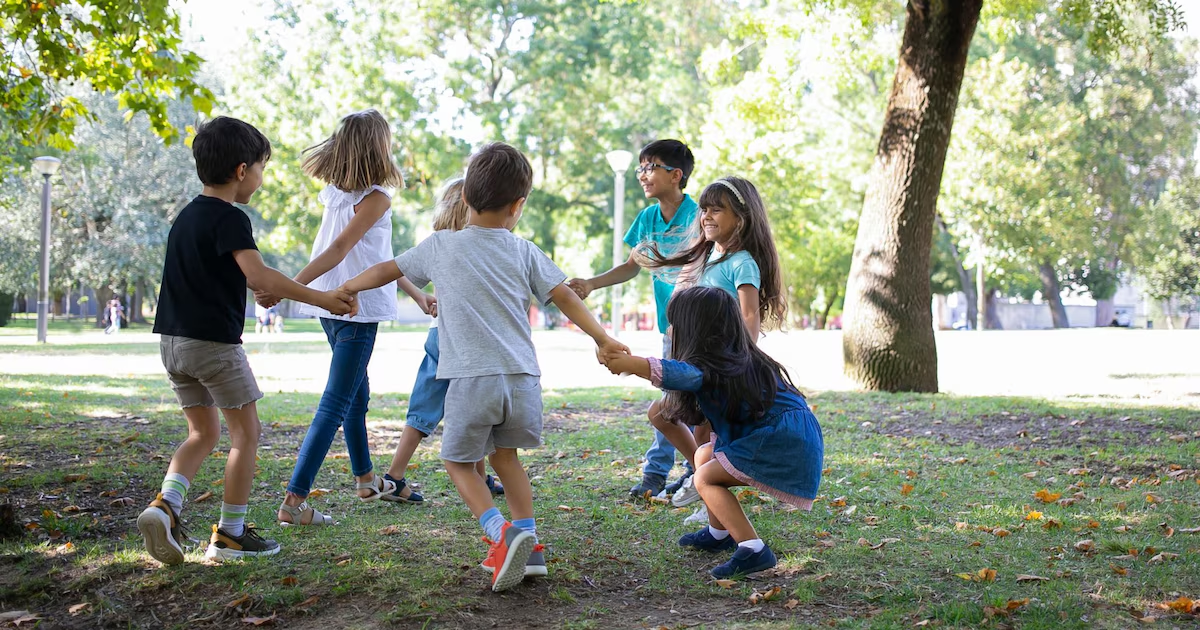
In 2024, the international agenda added a new anniversary dedicated to a daily activity with social and educational impact: playing. Since that year, the June 11 figure as International Day of Playa day that seeks to install the issue in public policies, schools and homes.
The decision came by resolution of the United Nations General Assemblywhich invited States and different actors to carry out awareness-raising and educational actions about its importance, with a focus on children.
In parallel, a previous commemoration is maintained, promoted by the toy library movement, which is celebrated every May 28 and which, since 1999, has promoted the same objective: making gambling visible as a right.
He June 11 was established as International Gaming Day based on a resolution adopted on March 25, 2024by the General Assembly of the United Nations, which established its annual observance since that same year.
The text of the resolution highlights the role of play in the development of physical, social, cognitive, communicative and emotional skills at all agesand highlights its effects to promote tolerance, resilience and social inclusion. It also links it to the well-being and physical and psychosocial development of children and young people.
The resolution invited Member States, specialized agencies, observers of the General Assembly and other interested parties, such as civil society, the private sector and academia, to commemorate the day with activities aimed at education and awareness.
In that same decision, the General Assembly included an operational section on implementation: the cost of the activities derived from the celebration must be covered with voluntary contributionseven from the private sector.
The establishment of June 11 as a fixed date incorporated a new milestone in an international calendar that already had other commemorations related to children’s rights, education and healthand aimed to generate a meeting point for coordinated actions on a local, national and global scale.
The proclamation of International Day of Play It was based on the recognition that playing is not just recreation. The argument that accompanies the event maintains that the game plays a role in building bonds, acquiring skills, and managing difficult experiences.
The Convention on the Rights of the Childmentioned as a framework in previous initiatives linked to this day, establishes in its article 31 the right to rest, recreation, play and recreational activities appropriate for age, in addition to free participation in cultural life and the arts.
In the approach adopted for the date of June 11, play appears as a condition that requires protection and priority, especially to ensure that boys and girls can exercise that right under real conditions. It is also presented as a language shared between ages and diverse social contexts, capable of promoting creativity and the ability to adapt.
In dissemination materials linked to the commemoration, a diagnosis was also proposed on barriers that restrict time, space or access to recreational experiences: poverty, conflict, displacement and discrimination. This context is used to justify the call to strengthen public and community commitment to children.
Within the framework of international campaigns associated with the anniversary, figures from global surveys on children’s perceptions were disseminated: 78% of children surveyed indicated that adults do not always consider it important to play and 73% indicated who doesn’t think adults take the game seriously. These data were used to argue that the social validation of the game influences its presence in the home, school, and public space.
Before the official incorporation of June 11 into the UN system of international days, there was already another date with the same name in different countries: May 28, celebrated since 1999.
This commemoration arose at the initiative of the International Toy Library Association (ITLA). The May 28 election responded to the date of constitution of that entity, according to the record that accompanies its dissemination. Later, the promotion of the anniversary received a new boost in 2008, attributed to Dr. Freda Kim.
The explicit objective for that date focused on the same axis that the UN proclamation later took up: install the game as the right of boys and girls and remember its support in international instruments on children’s rights, with emphasis on article 31 of the Convention on the Rights of the Child.
According to the same record, the celebration of May 28 extended to more than 40 countrieswith public and community activities aimed at making visible the importance of play in daily life, learning and coexistence.
With the proclamation of June 11 by the UN, since 2024 they will coexist two commemorative dates dedicated to the game: one of associative origin, in force since 1999, and another of an international institutional nature, defined by resolution of the General Assembly.